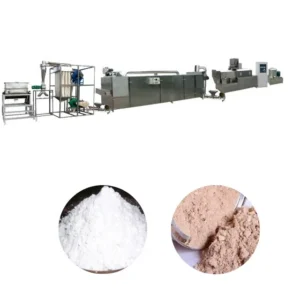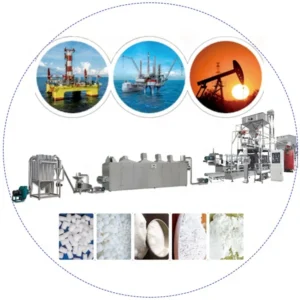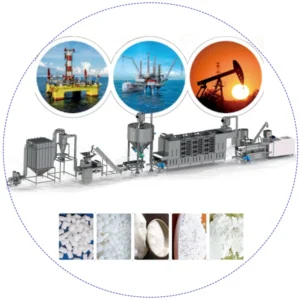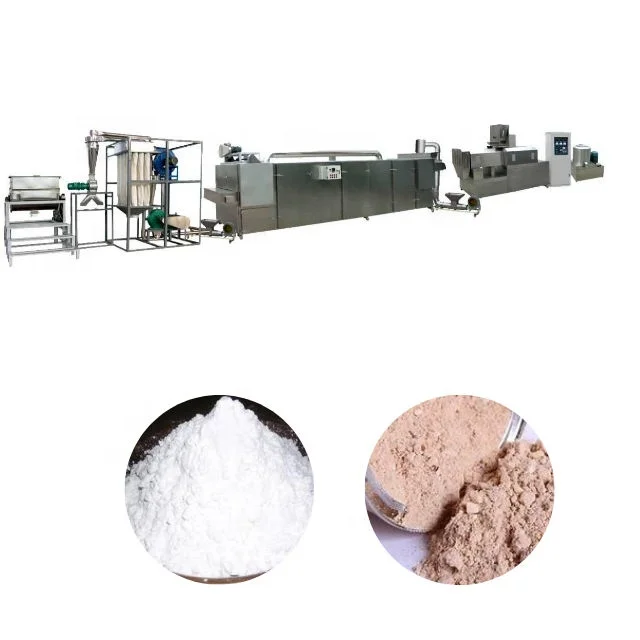
Integrated Extrusion Engineering — Screw configuration and die geometry specified to the buyer’s starch chemistry, then validated with a trial run on actual raw material before the modified starch production line equipment ships.
Technical Specifications
| Parameter | Value |
|---|---|
| Product Type | Modified and Pregelatinized Starch Extrusion Production Line |
| Extruder Type | Heavy-duty twin-screw extruder |
| Raw Material Compatibility | Cassava, corn, potato and other grain starches |
| Modification Types | Pregelatinized, oxidized, cross-linked modified starch |
| Process Control | Adjustable temperature, screw speed and pressure |
| Line Stations | Mixing, extrusion, drying, grinding, packaging |
| Construction | Food-grade stainless steel on all material-contact parts |
| Automation Level | Full automatic continuous production |
| Output Capacity | basis to be confirmed — depends on raw material type, moisture content and target modification degree |
| Certification | CE, ISO |
Application Suitability
| Application | Material or Output |
|---|---|
| Pregelatinized starch for instant food and beverage thickening | Cassava or corn starch with controlled gelatinisation |
| Oxidized starch for paper coating and textile sizing | Corn or potato starch treated under oxidative modification |
| Cross-linked starch for construction adhesives and binders | Grain starches processed at elevated shear and temperature |
| Nutritional-grade modified starch for infant formula and health food | Food-grade cassava or corn starch with tight viscosity control |
| Industrial starch for corrugated board and packaging adhesive | High-amylose corn starch modified for adhesive performance |
Why Your Starch Report Matters More Than the Brochure Capacity
A line that runs perfectly on one starch source can stall completely on another.
I spent nearly a month on-site in Colombia after a pregelatinized starch extrusion machinery for sale was installed and ran without issue during factory testing — only to produce a sticky, under-gelatinised mass at the customer’s facility. The problem traced back to amylose content: the customer’s local cassava had a straight-chain ratio significantly higher than the sample we tested on. The standard screw profile could not deliver enough shear energy to achieve full gelatinisation under that chemistry. By the time a reconfigured screw set arrived by air freight, the entire extrusion line had been idle for weeks. That is the gap between a nominal capacity figure and what a modified starch production line equipment actually delivers on your specific raw material [NEED_CITE: raw material variability in tropical starch sources].
How Screw Geometry Dictates Starch Modification
Starch modification inside a twin-screw extruder is fundamentally a balance between mechanical shear and thermal energy. The screw profile — the arrangement of conveying elements, kneading blocks, and reverse-flight sections — determines how long the material stays in the barrel and how much mechanical work is applied per gram. For pregelatinized starch, the goal is complete granule disruption with controlled expansion at the die. For oxidized or cross-linked starch, residence time and reagent mixing uniformity take priority. Every screw configuration on this modified starch production line equipment is matched to the buyer’s target modification type and raw material profile before production begins.
Matching Dryer and Grinder Throughput to the Extruder
An extruder running at full output means nothing if the downstream dryer cannot remove moisture fast enough, or if the grinder creates a bottleneck at the milling stage. The drying requirement for pregelatinized starch differs sharply from cross-linked starch — moisture content at the extruder discharge, particle porosity, and target final moisture all change the dryer specification. On this line, capacity is calculated station by station so that mixing, extrusion, drying, grinding, and packaging all operate at matched throughput. This prevents the common failure mode where one undersized station forces the entire line to run below its capability [NEED_CITE: throughput balancing in continuous starch processing lines].
Reading the Specs That Actually Affect Your Output
The heavy-duty twin-screw extruder at the core of this line is selected for the high shear demands of starch modification. Single-screw extruders struggle with the viscosity swings that occur when starch granules rupture and release amylose — the material can wrap around the screw or surge unpredictably. Twin-screw co-rotation provides self-wiping action and consistent conveying even as the material transitions from granular powder to a molten, gelatinised mass. Adjustable barrel temperature zones let operators build a precise thermal profile: lower feed-zone temperatures prevent premature gelatinisation that would block intake, while higher mid-barrel temperatures drive the modification reaction. The die design controls expansion ratio and product density at the exit — a parameter that directly influences downstream drying time and final particle structure after grinding. Food-grade stainless steel on all contact surfaces prevents corrosion from acidic reagents used in oxidation and cross-linking processes, and simplifies wash-down between product changeovers. Full automatic control across mixing through packaging keeps batch-to-batch variance within tight limits, which matters when your customers specify viscosity and fineness on a certificate of analysis.
The Hidden Cost of Skipping a Trial Run
Buyers who accept a line based on a supplier’s standard test — run on a generic starch sample rather than their own material — expose themselves to commissioning delays that are difficult to recover from. The screw set may need replacing, the barrel heating zones may require rewiring for a different temperature profile, or the die may need remachining to correct expansion behaviour. Each of these corrections means weeks of downtime on a line that was supposed to be generating revenue from day one. In my experience across Latin American installations, the buyers who sent raw material samples early and reviewed trial run reports before shipment had noticeably smoother startups than those who deferred product development to the installation phase [NEED_CITE: commissioning delays in starch extrusion projects].
What Sets This Line Apart at the Equipment Level
The complete modified starch production line equipment is sourced under one supplier, meaning throughput calculations span every station from the batching mixer to the packaging scale — not assembled from separate vendors who each guarantee only their own machine. Screw configuration and die design are documented against your specific raw material analysis and target modification degree, giving you a repeatable baseline for future production runs. Before the line leaves the factory, a trial run on your actual starch sample is conducted in the in-house testing workshop, and the results are shared as a formal report. Electrical schematics are drawn and voltage confirmed to match your facility’s supply before the control cabinet is wired, avoiding the on-site rewiring delays that plague poorly specified exports. The twin-screw platform covers pregelatinized, oxidized, and cross-linked starch on the same base extruder family, so expanding your product range later does not require replacing the core machine.
Documentation & Verification
- Line layout drawing with throughput matched across mixing, extrusion, drying, grinding and packaging stations
- Screw and die configuration record tied to your starch type and target modification degree
- Trial run report generated on your raw material in the testing workshop before dispatch
- Electrical schematic with voltage, frequency and control language confirmed for your market
- CE declaration of conformity and ISO certificate included with shipping documentation
- Operation and maintenance manual with wear parts list specific to your line configuration
Installation, Commissioning & Support
- Foundation plan provided based on the full line footprint including dryer and grinder placement
- Power supply specification covering extruder motor, heating zones, dryer and grinder loads on dedicated circuits
- Line shipped in modular sections for container loading, with assembly sequence documented for on-site reconnection
- First-run commissioning includes barrel temperature profiling and screw speed tuning on your starch material
- Operator training covers process parameter adjustment for switching between pregelatinized and cross-linked production
- Wear parts list identifies screws, barrel liners and die inserts with recommended replacement intervals
What We Need From You to Configure the Line
To size this modified starch production line equipment correctly, share your raw material type and a recent laboratory analysis covering amylose content, moisture, and particle size. Tell us the target modification type — pregelatinized, oxidized, or cross-linked — along with the end-use application and any viscosity or fineness specifications your customers require. Your local voltage, frequency, and preferred control language determine how the electrical cabinet is built, so confirm these early. If you can send a representative sample to the testing workshop, we run it on the extruder and share the trial results before you commit to production.
Frequently Asked Questions
Q: How is the line capacity verified against my specific starch raw material?
A: We request a raw material sample and laboratory analysis, then run the material on a twin-screw extruder in our testing workshop under conditions matching your target modification. The trial run report documents actual throughput, gelatinisation degree, and product characteristics, forming the basis for the final line configuration and capacity guarantee.
Q: How do you configure the screw and die for different modification types?
A: Pregelatinized starch requires a screw profile that maximises shear for full granule disruption, with a die designed for controlled expansion. Oxidized and cross-linked starch prioritise uniform reagent mixing and longer residence time. Each configuration is documented and matched to your raw material before the extruder is assembled.
Q: What voltage and control language will the line ship with?
A: The electrical cabinet is wired to your facility’s confirmed voltage and frequency before dispatch. Control panel language and documentation are set to your operator team’s preference. This is verified during the specification confirmation stage, not left to on-site discovery during commissioning.
Q: Can I send my raw material for a trial run before the line ships?
A: Yes. Our testing workshop runs customer-supplied starch samples on production-class twin-screw extruder elements. You receive a formal trial run report covering output rate, product quality parameters, and the recommended screw and die configuration for your material.
Q: How do you prevent dryer or grinder bottlenecks on the full line?
A: Capacity is calculated for every station — mixing, extrusion, drying, grinding, and packaging — based on your material’s moisture curve and target particle size. Each downstream unit is specified to handle the extruder’s actual output on your starch, not a generic nominal figure.