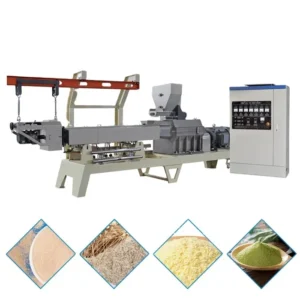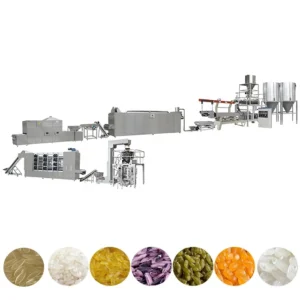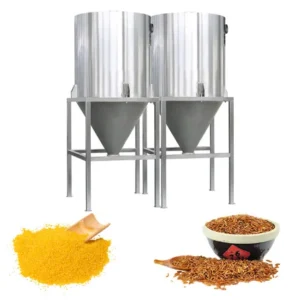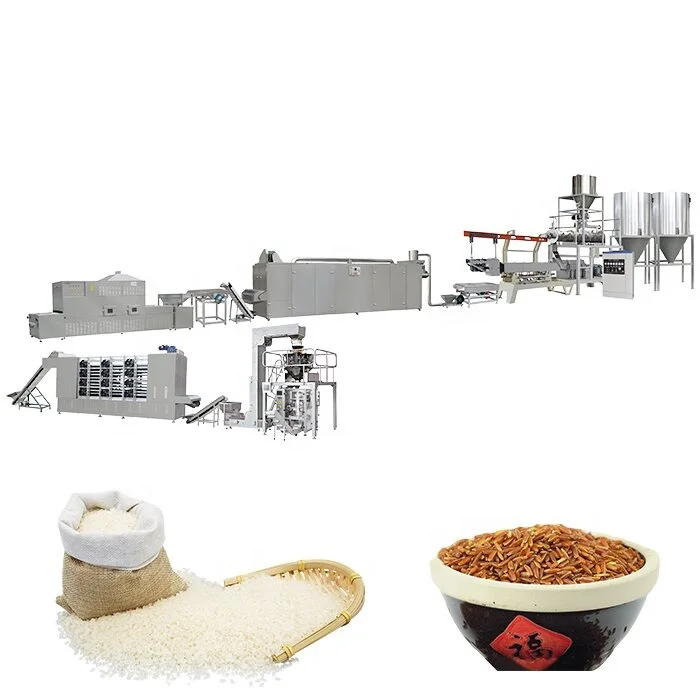
Screw & Die Matching — Every barrel segment and die opening in this Fortified Rice Production Line manufacturer’s extruder series is configured to the buyer’s specific grain blend and fortification premix, ensuring target density and gelatinisation are achieved on the actual raw material, not a generic test substrate.
Technical Specifications
| Parameter | Value |
|---|---|
| Product Type | Fortified Rice and Artificial Rice Production Line |
| Available Models | MT65, MT70, MT85, MT75, MT95 |
| Installed Power Range | 85 kW (MT65) to 260 kW (MT95) |
| Power Consumption Range | 60 kW (MT65) to 195 kW (MT95) |
| Capacity Range | 80–100 kg/hr (MT65) to 800–1000 kg/hr (MT95) (basis not stated in source — confirm raw material type, moisture content, or pellet size) |
| Line Dimensions (MT65) | 28 × 1.2 × 2.2 m |
| Line Dimensions (MT70) | 30 × 1.5 × 2.2 m |
| Line Dimensions (MT85) | 34 × 3.5 × 4.3 m |
| Line Dimensions (MT75) | 32 × 3.5 × 4.3 m |
| Line Dimensions (MT95) | 36 × 3.5 × 4.3 m |
| Screw Type | Twin-screw, single or double screw feeding system available |
| Control System | Frequency speed controlling, high automation |
| Heating Source (Dryer) | Electric or gas |
| Line Stations | Mixing → Extruding → Vibrating → Low temperature drying → Cooling → High temperature roasting → Cooling → Packing |
| Certification | CE |
Application Suitability
| Application | Material or Output |
|---|---|
| Fortified rice kernels for nutrition programmes | Broken rice base blended with vitamins, minerals, and micronutrient premix |
| Artificial rice from upcycled grain fractions | Corn, millet, wheat, and oat flours reconstituted into whole-kernel shapes |
| Specialty grain rice analogues | Buckwheat and bean flour blends for high-protein or gluten-free product lines |
| Starch-modified rice kernels | Starch-enriched formulations for controlled cooking behaviour and texture |
| Multigrain rice blends for retail or institutional supply | Mixed grain bases with added fibre, iron, folic acid, and vitamin A |
Why Capacity Claims Fail on Actual Grain Blends
Nominal throughput figures rarely account for the moisture, fat, and fibre content of the buyer’s real raw material.
I have stood in processing halls where a line rated for a specific hourly output on standard rice flour stalled completely once the operator switched to a bean-enriched blend. The starch gelatinisation curve shifted, the extruder barrel pressure spiked, and the entire downstream sequence fell out of sync. That Fortified Rice Production Line manufacturer brochure number was meaningless against a 20% legume inclusion rate. When sourcing a complete machine catalogue for nutritional rice, the capacity conversation must begin with the buyer’s actual recipe, including moisture percentage and particle size distribution [NEED_CITE: raw material moisture impact on extrusion throughput].
How Each Station Fits the Nutritional Rice Sequence
This full equipment range starts with batch mixing, where grain flours and micronutrient premixes are blended to a uniform moisture target before entering the extruder. The twin-screw extrusion station then subjects the blend to controlled shear and heat, achieving the starch gelatinisation required for the dough to hold a rice-kernel shape through the die. Frequency speed controlling across the extruder series allows operators to fine-tune screw RPM against the specific viscosity of their grain blend.
Matching Dryer Capacity to Extruder Output
A common bottleneck in artificial rice processing sits between the extruder die and the first drying stage. The low-temperature drying station in this catalogue is specified to handle the moisture load exiting the vibrating conveyor, while the high-temperature roasting stage that follows develops the final kernel hardness and cooking behaviour. If the dryer belt speed and thermal capacity are not calculated against the extruder’s actual output on the buyer’s material, kernels arrive at the roasting stage with inconsistent internal moisture, leading to cracking or incomplete gelatinisation [NEED_CITE: staged drying requirements for extruded rice kernels].
Reading the Specification Sheet for Real Production Impact
The installed power figures across the MT series — ranging from 85 kW on the MT65 to 260 kW on the MT95 — indicate the thermal and mechanical energy available for starch gelatinisation and dough conveyance through the barrel. Higher installed power supports longer barrel configurations and greater screw torque, which matters when processing high-fibre or high-protein grain blends that resist shear. The twin-screw design provides positive displacement feeding, meaning material residence time remains consistent even when ingredient ratios shift between batches. The choice between electric and gas heating for the dryer affects both the thermal profile of the drying curve and the utility infrastructure the buyer must prepare on-site. Frequency speed controlling across the line ensures that every station from extrusion to packing can be adjusted independently, preventing one station from dictating the pace of the entire Fortified Rice Production Line manufacturer system.
What Happens When Stations Are Mismatched
I have seen lines where the extruder was sized correctly but the drying oven was specified for a different product category entirely. Kernels exited the dryer with surface case-hardening while the core remained doughy, and the roasting stage could not correct the defect. The buyer then blamed the extruder, when the real failure was a throughput calculation that ignored the actual moisture removal rate required by their specific grain formulation. Entire production runs ended up as rework or waste [NEED_CITE: consequences of undersized drying in extruded food lines].
What This Equipment Range Delivers
Every station from mixing through packing is specified under one supplier, so throughput calculations account for material behaviour at each transition point rather than treating each machine as an isolated purchase. Screw configuration and die design are matched to the buyer’s grain blend and target kernel specification before production begins. The in-house testing workshop runs trial batches on the buyer’s actual raw material, confirming gelatinisation, density, and shape before the line ships. Twin-screw expertise extends across multiple grain bases — corn, millet, buckwheat, broken rice — so the same extruder platform adapts to different product briefs without a full hardware change. Electrical schematics and voltage confirmation are finalised against the buyer’s local grid before the control cabinets are wired, avoiding on-site rewiring delays that push commissioning back by days or weeks.
Documentation & Verification
- Line layout drawing showing station sequence and throughput matching for your grain blend
- Screw and die configuration record tied to your specific raw material and kernel target
- Electrical schematic with voltage and frequency confirmed for your local supply standard
- Trial run report from testing workshop using your shipped raw material sample
- Machine specification sheet covering installed power, dimensions, and utility requirements
- Operation and maintenance manual with wear parts list and replacement intervals
Installation, Commissioning & Support
- Foundation plan based on the MT model footprint, with floor loading and drainage points marked
- Dedicated electrical circuit sized to the model’s installed power, from 85 kW to 260 kW
- Line arrives in modular sections with station-by-station assembly sequence and rigging plan
- First-run parameter setting for screw speed, barrel temperature, and dryer belt rate on your material
- Operator training covering frequency speed adjustment and die changeover procedures
- Wear parts list specifying screw elements, die plates, and dryer belt segments for initial stocking
Before You Request a Quotation
Share the grain base or bases you intend to process, along with the micronutrient premix composition and target moisture content of the finished kernel. Confirm your local voltage and frequency supply, the available floor space and ceiling height in the production area, and whether existing upstream milling or downstream packing equipment must integrate with the new line. If your formulation includes legume flours or high-fibre additions, send a raw material sample so the testing workshop can verify extrusion behaviour before a configuration is locked in.
Frequently Asked Questions
Q: How do I choose the right extruder model from the MT series for my target capacity?
A: Start with your daily output target and the specific grain blend you will process, including moisture percentage and any legume or fibre additions. The MT series spans from the MT65 at lower throughput to the MT95 for industrial-scale output, but the correct model depends on how your actual material behaves under shear, not just the brochure capacity figure. A trial run on your raw material confirms the match.
Q: What is the difference between the low-temperature drying and high-temperature roasting stations?
A: Low-temperature drying removes surface and internal moisture gradually to prevent kernel cracking and case-hardening, stabilising the extruded shape. High-temperature roasting follows to develop the final hardness, colour, and cooking behaviour that the end market expects. Both stages must be capacity-matched to the extruder output on your specific grain formulation to maintain consistent kernel quality.
Q: Can the twin-screw extruder handle different base materials like corn, millet, or buckwheat?
A: Yes. The twin-screw configuration provides positive displacement feeding and adjustable shear, allowing the same extruder platform to process corn, millet, buckwheat, broken rice, wheat, oats, and bean-based blends. Screw element arrangement and die selection are adjusted to match each material’s starch gelatinisation characteristics and target kernel density.
Q: How is the drying oven capacity matched to the extruder output?
A: The dryer belt speed, thermal input, and dwell time are calculated against the moisture load exiting the extruder and vibrating conveyor for your specific formulation. This ensures kernels reach the roasting stage at the correct internal moisture level, preventing defects like cracking or incomplete drying that would compromise the final product’s cooking performance.