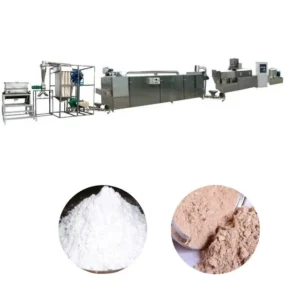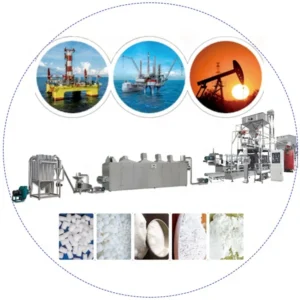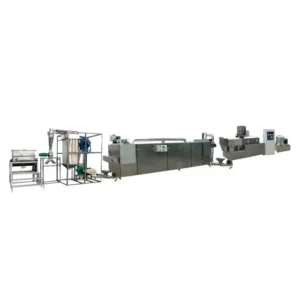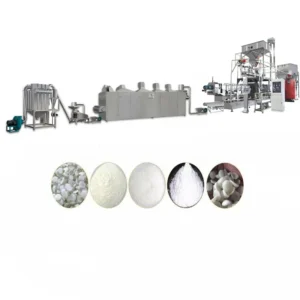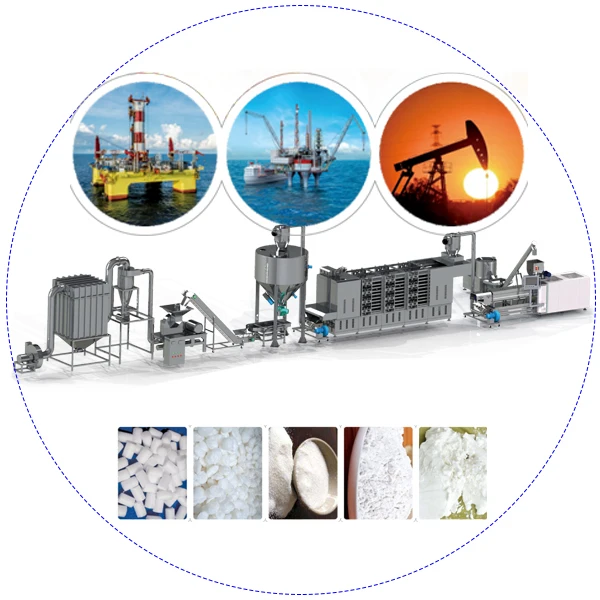
Integrated Line Throughput — Every station from mixing to pulse grinding is sized so the extruder never waits on the cooler or the grinder, eliminating the hidden bottlenecks that plague split-vendor setups.
Technical Specifications
| Parameter | Value |
|---|---|
| Product Type | Modified Starch Production Line |
| Extruder Type | Twin screw |
| Power | 45–200 kW |
| Capacity | 100–1500 kg/h (basis not stated in source — confirm raw material type, moisture content, and specific modified starch variant) |
| Voltage | 220–440 V, tri-phase (verify frequency and exact configuration for target market) |
| Line Stations | Mixing, twin screw extrusion, cooling conveyor, pulse grinding |
| Material Contact Parts | Food-grade stainless steel (conveyors with PVC exceptions noted) |
| Downstream Drying Fuel Options | Gas, diesel, electricity, steam (must be specified at inquiry) |
| Weight | 1000–5000 kg (source value — verify whether this refers to main extruder or complete line) |
| Standards | CE certified, ISO certified |
Application Suitability
| Application | Material or Output |
|---|---|
| Food-grade modified starch for sauces and bakery fillings | Corn starch, wheat flour |
| Pregelatinised starch for instant porridge and nutrition powders | Corn starch, rice flour, soybean flour |
| Industrial modified starch for oil drilling fluids | Cassava starch, corn starch |
| Modified starch for paper-making coating and sizing | Corn starch, cassava starch |
| Fortified grain-based starch with added nutriments | Multi-grain flour blends |
Why Nominal Capacity Numbers Mislead Starch Buyers
A rated output means nothing if it was measured on a material that does not match yours.
I once configured a modified starch production line full equipment range for a client who planned to run cassava starch. During the proposal stage, we had benchmarked the extruder on standard corn starch — a material with a substantially different gelatinisation temperature and shear response. When the client’s actual cassava starch arrived for a trial, the expansion rate fell far short and the hourly throughput dropped well below the nameplate figure. The gap was not a machine defect; it was a mismatch between the test material and the production material [NEED_CITE: starch gelatinisation behaviour across botanical sources]. That experience reshaped how I approach every starch line enquiry: capacity is only meaningful when it is tied to a specific raw material, moisture level, and starch variant. Buyers who accept a single headline number without that context often discover the shortfall after installation, when re-engineering the screw configuration becomes an expensive field exercise.
Matching Every Station Across the Modified Starch Line
When surveying a modified starch production line full equipment range, the extruder tends to capture all the attention, yet the cooling conveyor and pulse grinder dictate whether you actually bag the output the extruder produces. If the cooling conveyor cannot shed surface moisture fast enough, starch particles clump before they reach the grinder. If the pulse grinder lacks the cyclone discharge capacity, fine dust accumulates and particle size drifts outside specification. The twin screw extruder, cooling conveyor, and pulse grinding station must therefore be selected as a matched set rather than as independent machines [NEED_CITE: throughput balance in continuous food processing lines].
Screw Geometry and Barrel Zones for Starch Modification
The twin screw extruder at the heart of this line handles a wide raw material range — corn starch, cassava starch, wheat flour, rice flour, and multi-grain nutrition blends — but the screw configuration and barrel temperature profile must be set differently for each. Cassava starch gelatinises at a lower temperature than corn starch and is more sensitive to shear, so the screw elements and zone heaters are adjusted accordingly. Getting this wrong means either under-cooked starch that fails viscosity tests or over-sheared starch that degrades into unusable fines.
What the Specification Sheet Tells You About Real Output
Three parameters deserve close reading before you sign off on any modified starch production line full equipment range. First, the power band of 45–200 kW spans a broad set of extruder sizes; the correct motor rating depends on the viscosity of your target starch and the degree of modification required — higher modification demands more torque. Second, the voltage range of 220–440 V tri-phase must be locked to your facility’s supply before production begins, because rewinding a motor after arrival is costly and delays commissioning by weeks. Third, contact materials are specified as food-grade stainless steel with noted PVC exceptions on certain conveyor sections; if your starch is destined for infant nutrition or pharmaceutical applications, you need to confirm every contact surface meets the relevant regulatory standard [NEED_CITE: food contact material regulations by market]. The downstream drying fuel options — gas, diesel, electricity, or steam — also affect both operating cost and product colour, so this choice belongs in the initial specification rather than as an afterthought.
The Hidden Cost of Skipping a Pre-Shipment Trial
Buyers who waive a trial run on their own raw material often face a painful sequence after installation: the line starts up, the starch expansion is wrong, and the troubleshooting cycle begins in a production environment where every hour of downtime burns revenue. Screw elements may need to be reordered, barrel heater zones reconfigured, and die plates re-cut — all while the buyer’s customers wait for delivery. In contrast, a pre-shipment trial in the supplier’s testing workshop surfaces these issues when there is still time to adjust the screw configuration and die design without penalising the production schedule [NEED_CITE: benefits of factory acceptance testing for extrusion lines].
Why Source This Line Here
Every station — mixer, twin screw extruder, cooling conveyor, and pulse grinder — is specified under one supplier, so throughput is balanced across the entire modified starch production line full equipment range rather than assembled from mismatched vendors. The screw configuration and die design are matched to your exact raw material and target starch type, not copied from a generic build. An in-house testing workshop allows trial runs on your material before the line ships, reducing the risk of post-installation rework. Twin screw expertise spans modified starch, pregelatinised starch, and nutrition grain applications, so the same engineering team handles food-grade and industrial starch projects. Documentation covers the full chain from line layout and capacity calculation through to wear parts lists and electrical schematics.
Documentation & Verification
- Line layout and capacity calculation matched to your starch variant and target output
- Screw and die configuration record specific to your raw material formulation
- Trial run report conducted on your starch sample before shipment
- Electrical schematic confirming voltage, frequency, and control language
- CE declaration of conformity and ISO certificate for the complete line
- Operation and maintenance manual with wear parts list and replacement intervals
Installation, Commissioning & Support
- Foundation and utility planning based on the 45–200 kW power draw and cooling conveyor footprint
- Voltage and frequency locked to your facility supply before the extruder motor is wound
- Line arrives in modular sections for staged assembly inside your workshop
- First-run parameter setting covers barrel zone temperatures, screw speed, and die gap for your starch
- Operator training addresses moisture control, pulse grinder adjustment, and dust collector maintenance
- Wear parts list identifies screws, dies, and conveyor belts with recommended replacement intervals
What to Include in Your Enquiry
To receive a configuration that holds capacity on your actual material, share the specific starch source — corn, cassava, wheat, rice, or a blended formulation — along with the target modification type and desired particle size range. Confirm your facility voltage, frequency, and preferred control language so the electrical package is built correctly from the outset. If you have existing upstream batching or downstream packing equipment, include the model and throughput so the modified starch production line full equipment range can be matched at both ends.
Frequently Asked Questions
Q: How is output capacity verified on my specific starch raw material?
A: Before the quotation is finalised, your raw material sample is run in the supplier’s testing workshop. The trial records throughput, expansion rate, moisture content, and particle size. The resulting trial report becomes the basis for the screw configuration, die design, and downstream cooler sizing, so the quoted capacity reflects your actual material rather than a generic benchmark.
Q: What screw configuration is used for modified starch versus pregelatinised starch?
A: Modified starch typically requires a screw profile that delivers higher shear and longer residence time to achieve the desired degree of substitution, while pregelatinised starch uses a gentler profile focused on complete gelatinisation without molecular degradation. Both the screw element sequence and barrel temperature zones are adjusted, and the exact configuration is recorded in the documentation package supplied with the line.
Q: How do I confirm voltage, frequency, and control system language before production?
A: During the specification stage you provide your facility’s voltage, frequency, and preferred interface language. These details are written into the electrical schematic and confirmed before the motor is wound and the control cabinet is wired, preventing commissioning delays caused by incompatible power supply or unreadable screen prompts.
Q: Which cooling and drying capacity matches the extruder output without bottlenecking?
A: The cooling conveyor and any downstream dryer are sized to the specific moisture reduction your starch requires between the extruder die and the pulse grinder. Air-knife airflow, conveyor length, and dryer fuel option are all calculated from the trial run data so that surface moisture is reduced at a rate that keeps pace with extruder output.
Q: Can a trial run be performed on my raw material before shipment?
A: Yes. The supplier operates a dedicated testing workshop where your starch sample is processed through the same twin screw extruder configuration specified for your line. The trial run report documents capacity, product quality, and parameter settings, and any necessary adjustments to screw elements or die plates are completed before the line is packed for dispatch.