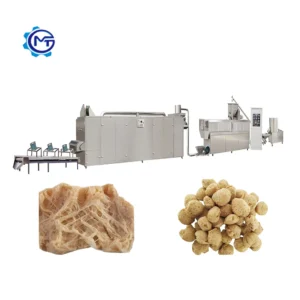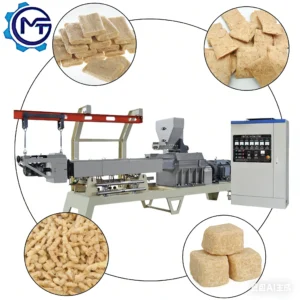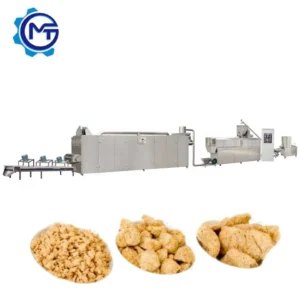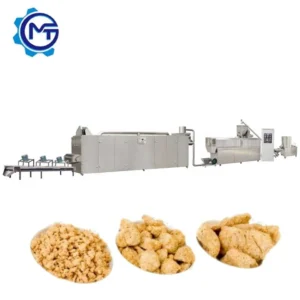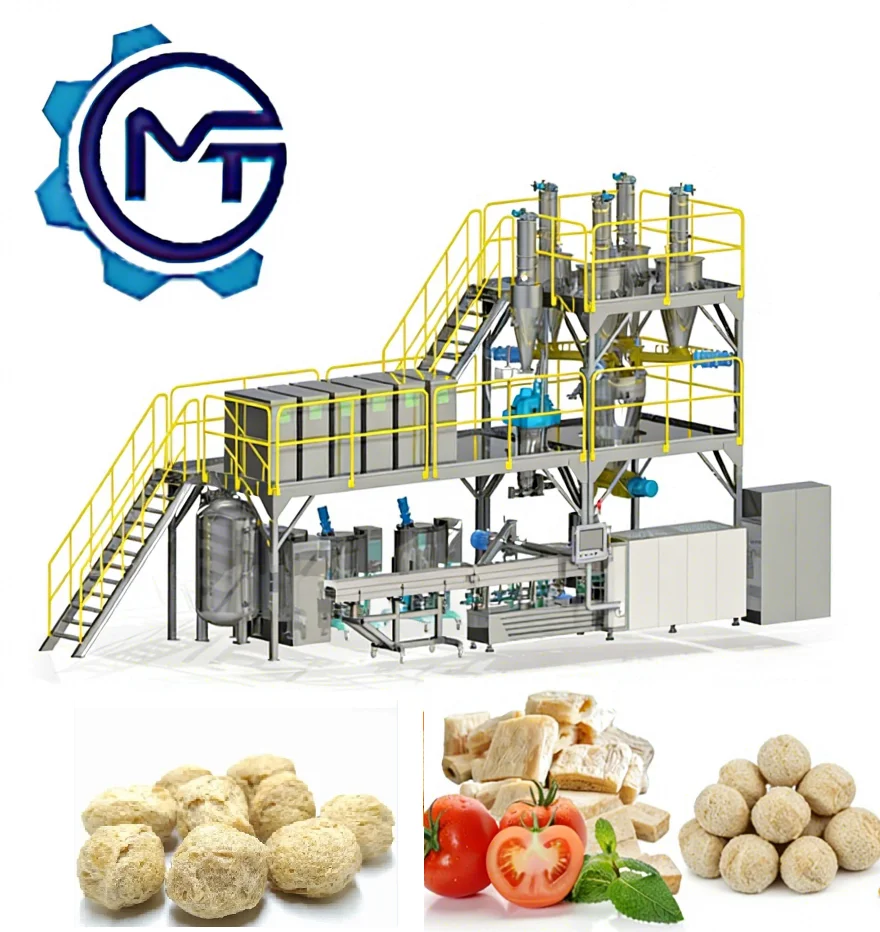
Matched throughput — Every station from mixer to cooler is sized against the extruder output on your actual defatted soya flour formulation, preventing bottlenecks that stall a plant based meat processing line mid-run.
Technical Specifications
| Parameter | Value |
|---|---|
| Product Type | Textured Soy Protein Production Line |
| Models Available | MT65 / MT70 / MT75 / MT85 |
| Screw Type | Twin-screw |
| Installed Power | 84 kW (MT65) / 160 kW (MT70) / 190 kW (MT75) / 210 kW (MT85) |
| Power Consumption | 59 kW (MT65) / 120 kW (MT70) / 140 kW (MT75) / 140 kW (MT85) |
| Output Capacity | 100–150 kg/h (MT65, basis not stated in source — confirm raw material spec / moisture); 150–200 kg/h (MT70); 150–200 kg/h (MT75); 250–300 kg/h (MT85) |
| Overall Dimensions | 40,000×1,200×2,200 mm (MT65) up to 45,000×1,500×3,500 mm (MT85) |
| Line Sequence | Mixer → Screw Conveyor → Twin Screw Extruder → Air Conveyor → Multi-layer Dryer → Cooling Machine |
| Mixer Contact Material | Stainless steel 304 mixing ruler; carbon steel shelf |
| Mixer Power / Capacity Options | 4 kW / 7.5 kW / 15 kW — 20–30 kg / 70–80 kg / 170–180 kg |
| Extruder Main Motor | 22 kW / 30 kW / 45 kW |
| Extruder Auxiliary Motors | Rotary cutting 0.75 kW, feeding 0.75 kW, pump 0.37 kW |
| Extruder Heating Power | 10 kW / 14 kW |
| Dryer Heating Options | Fuel / Gas / Electricity |
| Dryer Drive System | Double pitch roller chain drive, round-trip drying |
| Die & Screw Configuration | Adjustable moulds for soya nuggets, TVP/TSP, soya chunks; screws interchangeable for other extruded products |
| Standards | CE, ISO |
Application Suitability
| Application | Material or Output |
|---|---|
| Textured vegetable protein (TVP/TSP) production | Defatted soya flour, low temperature soya flakes |
| Soya nuggets and soya chunks for meat substitutes | High-protein soya blends with controlled moisture |
| Plant-based meat analogues for frozen food lines | Layer-fiber structure TVP for patty, sausage and strip formats |
| Vegetarian snack and fast food ingredient supply | Soya-based formulations with added starch or peanut dregs |
| Dual-purpose extrusion for cereal and puffed snacks | Adjusted screw configuration on the same twin-screw platform |
What "Nominal Capacity" Means When Your Soya Flour Arrives
A plant based meat processing line rated at a fixed output on generic material may stall the day your specific defatted soya flour enters the hopper.
I once watched a twin-screw extrusion line run smoothly on standard soya protein during factory trials, then ship to a buyer who switched to a pea-protein blend and spent two weeks chasing the right barrel temperature, screw speed and moisture balance before the fiber structure stabilized. The problem was never the machine — it was that the screw configuration and dryer capacity had been set to a generic recipe rather than the buyer’s actual formulation [NEED_CITE: twin-screw extrusion sensitivity to raw material protein content and moisture]. Capacity figures only hold meaning when tied to a specific raw material and moisture target, which is why the first question before any line layout should always be about your exact flour grade and protein percentage.
Full Equipment Range from Batching to Cooling
This plant based meat processing line covers every station in sequence: mixing, screw conveying, twin-screw extrusion, air conveying, multi-layer drying and cooling. Each station is specified as a matched set so throughput is balanced — the dryer handles the moisture load the extruder delivers, and the cooler brings product temperature down to packing requirements without creating a backlog. The full equipment range means one supplier is accountable for the complete material flow rather than separate vendors pointing at each other when output falls short.
Dryer Configuration and Moisture Control
The multi-layer dryer uses a double pitch roller chain drive for round-trip drying, with adjustable temperature and drying time to match the moisture reduction target for TVP or soya chunks. Heating source options — fuel, gas or electricity — let you align the dryer with local energy costs and availability [NEED_CITE: industrial dryer energy source selection for food processing plants]. Selecting the wrong heating source or undersizing the dryer bed length causes product to leave the line above specification moisture, leading to mold risk during storage or insufficient fiber texture in the finished meat analogue.
Extruder Motor, Heating and Screw Configuration
The twin-screw extruder platform offers main motor options from 22 kW to 45 kW across the model range, with heating zones at 10 kW or 14 kW to maintain the barrel temperature profile needed for protein texturization. Screw elements are configurable: the arrangement of conveying, kneading and reverse-screw sections determines residence time, shear intensity and the degree of protein alignment that creates the layer-fiber structure buyers expect in meat substitutes. Die moulds are adjustable for soya nuggets, TSP flakes or chunk formats, and the same screw platform can be reconfigured for cereal or puffed snack production when market demand shifts.
The Cost of Mismatched Stations
When an extruder is supplied without matching dryer or coating capacity, the line bottlenecks at the drying stage — product queues up, moisture stays too high, and texture degrades before the cooler ever sees it [NEED_CITE: production line bottleneck analysis in food extrusion operations]. Buyers who discover this after installation face weeks of lost output while sourcing a larger dryer separately. Voltage and frequency left unconfirmed until the machine arrives can delay commissioning further, especially where local supply does not match the motor nameplate.
Why Procurement Through This Channel
Every plant based meat processing line is configured against the buyer’s raw material data before production begins — screw arrangement, die selection and dryer sizing are set together rather than copied from a generic build. An in-house testing workshop runs trial production on your defatted soya flour or soya flakes before shipment, so fiber structure and expansion are verified in advance. Line layout and capacity calculation documents are provided alongside the electrical schematic, and the same engineering team that designs the layout handles on-site installation and operator training. CE and ISO documentation supports customs clearance and regulatory filing in the destination market.
Documentation & Verification
- Line layout and capacity calculation based on your soya flour protein content and moisture target
- Screw and die configuration record matched to your TVP shape and density specification
- Electrical schematic with voltage and frequency confirmation for your factory supply
- Trial run report on your raw material conducted in the testing workshop before dispatch
- CE declaration of conformity and ISO certificate for customs and regulatory submission
Installation, Commissioning & Support
- Foundation planning for line lengths up to 45,000 mm across the MT85 configuration
- Dedicated electrical circuit sized to 210 kW installed power on the largest model
- Modular station delivery with on-site assembly aligned to the sequence layout drawing
- First-run parameter setting using your raw material to confirm fiber structure and output
- Operator training covering screw configuration changes and die swap procedures
- Wear parts list covering screws, dies and roller chains with replacement supply channels
Preparing Your Inquiry
To move from catalog browsing to a line proposal, share your raw material specification — protein percentage, flour grade and target moisture content — along with your daily output target and available workshop floor area. Include your local voltage and frequency, preferred control language, and whether your facility uses gas, fuel or electric heating so the dryer can be configured accordingly. If you are switching from an existing line or adding capacity alongside other equipment, note the upstream and downstream machines already in place.
Frequently Asked Questions
Q: How is the output capacity verified on my specific soya flour or soya flake formulation?
A: Before shipment, your raw material is run through the extruder in the in-house testing workshop. The trial run report documents barrel temperature, screw speed, moisture addition and resulting fiber structure, confirming that the line produces your target TVP density and shape at the quoted capacity range for that specific model.
Q: What voltage, frequency and control language options are available for my market?
A: The electrical schematic is confirmed against your factory supply before production begins. Voltage and frequency are set to match your local grid, and control panel labeling follows your preferred language. This confirmation step prevents commissioning delays that arise when equipment arrives with mismatched motor nameplates.
Q: Can the same extruder produce different TVP shapes and also switch to cereal or snack products?
A: The twin-screw platform uses adjustable moulds for soya nuggets, TSP flakes and soya chunks. Screw elements are also reconfigurable — by changing the arrangement of conveying and kneading sections, the same extruder can process cereal formulations or puffed snack recipes when your product mix requires it.
Q: How is the dryer capacity matched to the extruder output to avoid line bottlenecks?
A: The multi-layer dryer bed length and chain speed are calculated against the moisture load the extruder delivers at your target output. Heating source selection — fuel, gas or electricity — is based on your local energy cost structure, and drying time is adjustable so the product reaches packing moisture without queuing between stations.
Q: What spare wear parts are included and how are replacements supplied?
A: Each line ships with a documented wear parts list covering screws, dies and dryer roller chains. Initial spares are identified during the configuration stage, and replacement supply channels are confirmed so you can order before the first scheduled changeover rather than discovering a shortage mid-production.