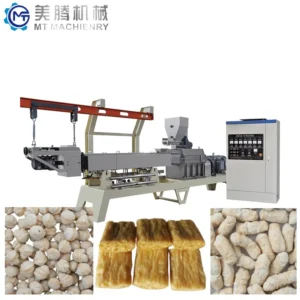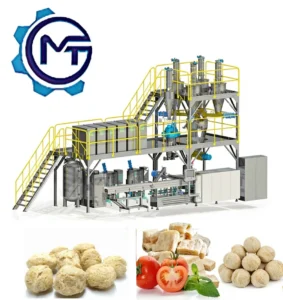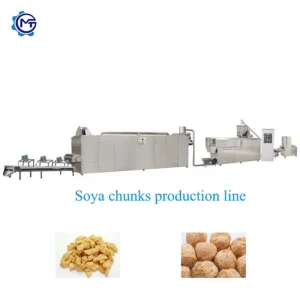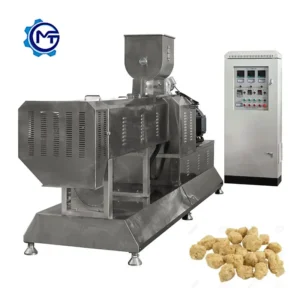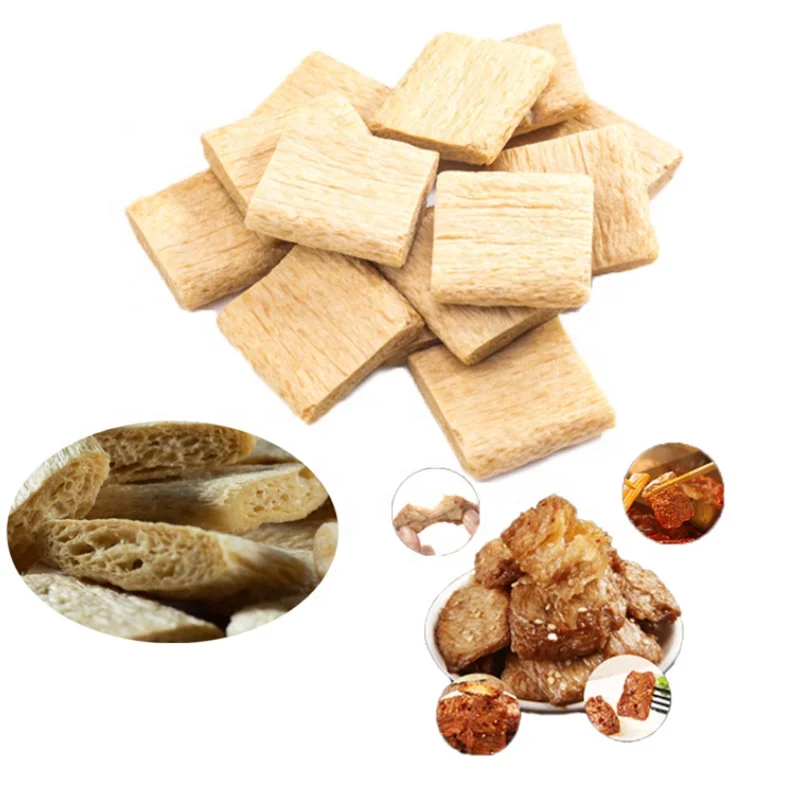
Complete Line Matching — Every station from the powder mixer to the cooling conveyor is sized so throughput holds steady across the entire Textured Vegetable Protein Production Line equipment range instead of bottlenecking at one machine.
Technical Specifications
| Parameter | Value |
|---|---|
| Model | MT65 / MT70 / MT85 |
| Product Type | Textured Vegetable Protein (TVP) Extrusion Production Line |
| Extruder Type | Twin-screw |
| Installed Power | MT65: 85 kW; MT70: 120 kW; MT85: 195 kW |
| Actual Power Consumption | MT65: 65 kW; MT70: 90 kW; MT85: 165 kW |
| Output Capacity | MT65: 150–200 kg/h (basis to be confirmed); MT70: 200–300 kg/h (basis to be confirmed); MT85: 600–800 kg/h (basis to be confirmed) |
| Overall Line Dimensions | MT65: 18000×1300×2300 mm; MT70: 20000×1500×2400 mm; MT85: 24000×3500×4300 mm |
| Mixer Tank Volume | 150 kg |
| Mixer Power | 4 kW |
| Roaster Effective Belt Length | 3.5 m |
| Roaster Heater Configuration | Far infrared, 3.9 kW × 24 units |
| Material of Construction | Stainless steel (food-grade contact parts) |
| Control System | PLC / MCC available (configuration to be confirmed) |
| Certification | CE, ISO |
| Warranty | 1 year complete, lifetime maintenance |
Application Suitability
| Application | Material or Output |
|---|---|
| Soybean meat analogue production | Low-temperature soybean meal |
| Peanut-based protein meat | Peanut meal |
| Ham and sausage ingredient supply | Textured soy protein chunks and shreds |
| Canned food protein filler | Rehydratable TVP granules |
| Quick-frozen food ingredient | Plant-based meat strips and mince |
Why Nominal Capacity Figures Mislead Buyers on a Textured Vegetable Protein Production Line Equipment Range
The extruder nameplate is only half the story; every downstream station must match that number on your exact formulation.
When a buyer receives a quotation listing a headline output figure, it rarely accounts for the specific soybean-to-peanut meal ratio, moisture addition rate, or target fibre density. I have watched lines that looked generous on paper lose half their throughput once the actual recipe hit the barrel. The screw profile, die geometry, and dryer belt speed all shift when raw material changes, and a Textured Vegetable Protein Production Line equipment range that ignores those variables will underperform from day one [NEED_CITE: extrusion throughput dependency on raw material formulation].
How Twin-Screw Geometry Shapes the Fibre Structure
The intermeshing screw elements create controlled shear and residence time that single-screw designs cannot replicate on high-protein meals. Within this Textured Vegetable Protein Production Line equipment range, barrel sections can be heated or cooled independently, letting operators manage starch gelatinisation and protein denaturation in distinct zones. That separation is what produces the layered, meat-like bite buyers in the plant-based sector demand.
Matching Dryer Capacity to Extruder Output
A high-temperature roaster with a 3.5 m effective belt and far infrared heaters dries extruded TVP without case-hardening the surface. If the belt speed is too slow, material piles up at the extruder die; too fast and moisture stays trapped inside, leading to spoilage during storage. The roaster’s 24 infrared elements deliver even heat distribution across the belt width, yet the real test is whether the drying curve matches the moisture profile leaving the extruder [NEED_CITE: moisture migration challenges in high-protein extrudate drying].
Reading the Power and Dimension Data Correctly
The installed power figures — 85 kW for MT65, 120 kW for MT70, 195 kW for MT85 — represent peak electrical draw across motors, heaters, and conveyors combined. Actual consumption sits lower because heater banks cycle and motors rarely run at full load simultaneously. Line length stretches from 18 m on the MT65 to 24 m on the MT85, which matters when buyers plan factory floor layout. Overlooking the 3.5 m width on the MT85 line has caused more than one installation delay where the cooling conveyor could not clear a structural column.
When Undersized Stations Create Hidden Costs
An extruder running at full capacity while the mixer upstream can only blend partial batches forces operators into stop-start production, increasing screw and die wear from thermal cycling. Similarly, a cooling conveyor that cannot keep pace traps residual heat in packed bags, accelerating lipid oxidation in the finished TVP. Buyers who discover these mismatches after installation face weeks of downtime while sourcing larger auxiliary equipment [NEED_CITE: downstream bottleneck impact on extrusion line availability].
Why Buyers Source This Textured Vegetable Protein Production Line Equipment Range Here
Every station from batching through packing is configured under one supplier, eliminating the finger-pointing that happens when separate vendors blame each other for throughput shortfalls. Screw and die combinations are specified against the buyer’s raw material rather than copied from a generic template. The in-house testing workshop runs trial batches on the customer’s own soybean or peanut meal before the line ships, so fibre texture and expansion ratio are validated in advance. Electrical schematics and voltage are confirmed against the destination facility before assembly begins. Stainless steel construction on all food-contact surfaces meets hygiene standards expected by European and North American ingredient buyers.
Documentation & Verification
- Line layout drawing with capacity calculation matched to your soybean or peanut meal ratio
- Screw and die configuration record specifying element profile for your target fibre structure
- Electrical schematic confirming voltage, frequency, and control language before production
- Trial run report produced on your raw material in the testing workshop prior to dispatch
- CE declaration of conformity and ISO certificate included with shipping documents
- Wear parts list identifying screw elements, die plates, and seals with replacement intervals
Installation, Commissioning & Support
- MT85 line requires 24 m clear floor length plus 1 m service clearance on each side
- Dedicated power circuit sized to 195 kW installed capacity with voltage confirmed on-site
- Extruder barrel sections ship separated and are reassembled during commissioning
- First production run includes screw speed and temperature profiling on your formulation
- Operator training covers die changeover and mixer batching sequence for consistent output
- Spare screw elements and die plates stocked and dispatched within standard lead times
Before You Request a Quotation
Send your exact soybean meal and peanut meal formulation, target TVP fibre structure, and expected hourly output. Confirm your facility voltage, frequency, and available floor length including ceiling height. Let us know whether you need PLC or MCC control and which language the HMI should display. If you want a trial run on your raw material before shipment, state that requirement up front so the testing schedule is reserved.
Frequently Asked Questions
Q: How is output capacity verified against my specific soybean meal or peanut meal formulation?
A: We run your raw material through the testing workshop on the exact extruder model you are considering. Screw speed, barrel temperatures, and die geometry are adjusted until the target fibre density is achieved, and the verified throughput at those settings is recorded in the trial report before quotation.
Q: What supporting stations are included and how is throughput matched across each one?
A: The line covers mixing, conveying, twin-screw extrusion, high-temperature roasting, cooling, and packing. Each station’s capacity is calculated against the extruder output on your recipe so material flow stays continuous without upstream starvation or downstream accumulation.
Q: Can I see the full machine specification sheet and dimensional footprint before ordering?
A: Yes. The specification sheet lists every station’s power, dimensions, and capacity alongside the overall line layout drawing. This lets your engineering team verify floor space, utility connections, and ceiling clearance before the order is confirmed.
Q: What certifications and factory test records ship with the line?
A: The CE declaration of conformity and ISO certificate accompany the shipment. A factory test record documenting the trial run on your raw material, including screw configuration and temperature profile, is included in the documentation package.
Q: How are wear parts such as screws and dies stocked and replaced?
A: A wear parts list is provided with every line, identifying screw elements, die plates, and seals with expected service intervals. Replacement components are stocked at the factory and can be dispatched to your facility within typical multi-week lead times.