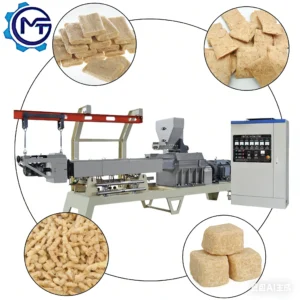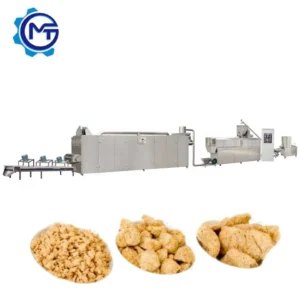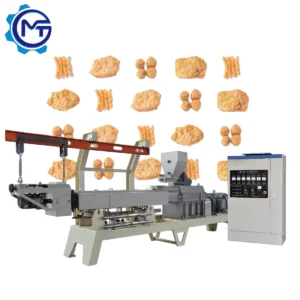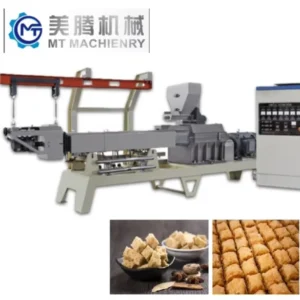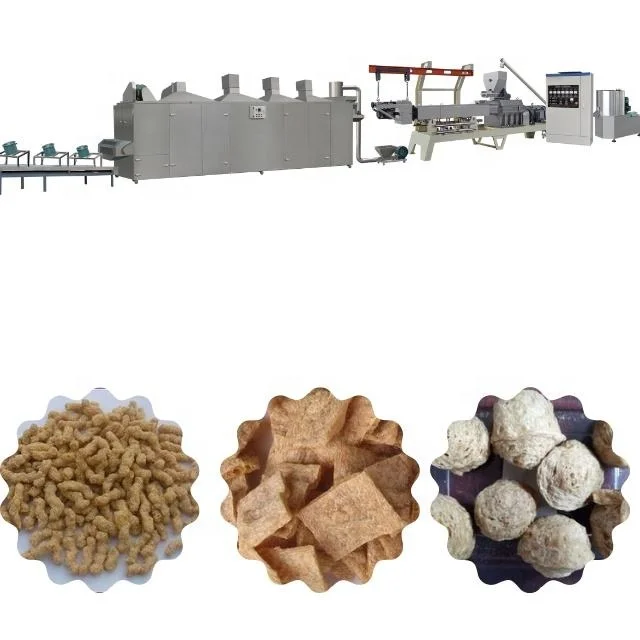
Matching Stations, One Supplier — Every unit from the powder mixer through the twin-screw extruder to the roaster and cooler is sized to the same throughput target, so no single machine chokes the line when running your actual soybean or peanut meal formulation.
Technical Specifications
| Parameter | Value |
|---|---|
| Product Type | Textured Vegetable Protein (TVP) Production Line |
| Model Options | MT65 / MT70 / MT85 |
| Extruder Type | Double Screw Extruder (twin-screw) |
| Installed Power | MT65: 85 kW | MT70: 120 kW | MT85: 195 kW |
| Real Power Consumption | MT65: 65 kW | MT70: 90 kW | MT85: 165 kW |
| Output Capacity | MT65: 150–200 kg/h (basis to be confirmed against raw material formulation and moisture) | MT70: 200–300 kg/h (basis to be confirmed) | MT85: 600–800 kg/h (basis to be confirmed) |
| Overall Dimensions (L×W×H) | MT65: 18000×1300×2300 mm | MT70: 20000×1500×2400 mm | MT85: 24000×3500×4300 mm |
| Mixer Type / Tank Volume | Powder Mixer / 150 kg |
| Mixer Rotary Speed | 385 rpm |
| Mixer Power | 4 kW |
| Roaster Type | High-temperature Roaster (far infrared / gas options) |
| Roaster Effective Belt Length | 3.5 m |
| Roaster Far Infrared Heater | 3.9 kW × 24 units |
| Roaster Gas Consumption | 6.8 m³/h (gas type and heating value to be confirmed) |
| Cooling Machine Capacity | 200–300 kg/h (inlet and discharge temperatures to be confirmed) |
| Line Process Flow | Raw material prep → mixing → conveying → extrusion → conveying → drying → cooling → packing |
| Material of Construction | Stainless steel (all machinery contact surfaces) |
| Warranty | 1 year complete line |
Application Suitability
| Application | Material or Output |
|---|---|
| Plant-based meat alternative chunks and strips | Low-temperature soybean meal, soy protein isolate blends |
| Textured protein granules for sausage and ham filler | Peanut meal, soy flour mixtures |
| Meat extender for canned and quick-frozen food | Defatted soybean meal at controlled moisture |
| Fibrous TVP for fast food and ready meal formulation | Blended legume and cereal protein sources |
What "600 kg per Hour" Leaves Out About a Plant Based Meat Processing Line
Capacity only matters when the extruder, roaster, and cooler all agree on the number.
A textured soy protein production line quoted at a headline figure often hides a mismatch further downstream. The extruder may push material out at a certain rate, but if the roaster belt cannot carry that load with enough residence time to reach the target moisture, product piles up or exits under-dried. I have stood in workshops where a roaster bottleneck forced the operator to throttle the extruder back, cutting actual output well below what was promised. Every plant based meat processing line we configure starts with a throughput calculation across every station, not just the extruder nameplate [NEED_CITE: matching throughput across extrusion and drying stations].
How Twin-Screw Mechanics Restructure Protein
A twin-screw extruder generates the high-temperature, high-pressure, and high-shear environment needed to unfold spherical protein molecules and realign them into a chain-oriented fibrous structure. The screw configuration — the sequence of conveying, kneading, and reverse elements — determines how much shear each particle experiences. Change the arrangement and you change the texture from a dense chunk to a loose, open granule.
Screw Configuration Is Not a Copy-Paste Exercise
Every soybean meal and peanut meal blend behaves differently under heat and shear. Protein content, fat residue, and particle size all shift the melting point inside the barrel. Last year I spent four days on-site in the Middle East reworking a screw stack because the local soybean meal had a different lipid profile than the standard test material, and the fiber alignment simply would not hold [NEED_CITE: raw material lipid content influence on extrusion texture]. Running a trial on your actual raw material in our testing workshop before shipment catches this kind of mismatch early.
Reading the Power and Dimension Numbers
The installed power figures (85 kW, 120 kW, 195 kW) represent the sum of every motor and heater on the line, while the real power values (65 kW, 90 kW, 165 kW) reflect typical running draw — the difference matters when you size your transformer and cable runs. The mixer’s 385 rpm rotary speed is fast enough to break up minor clumps in soy flour without generating heat that could start premature denaturation. The roaster’s 3.5 m effective belt length sets the maximum residence time; a shorter belt would require higher temperatures that risk case-hardening the TVP surface while leaving internal moisture high. Line footprint scales accordingly — the MT85 configuration reaches 24 m in length and requires a ceiling clearance above 4.3 m, which rules out low-roof workshops without structural modification.
When a Generic Screw Stack Ruins the First Production Run
Ordering a textured soy protein production line without specifying the screw and die combination to your raw material is the most common route to a disappointing first run. The texture comes out spongy or mealy, the fiber tears instead of stretching, and your customer rejects the sample batch. Correcting this after installation means shipping replacement screw elements overseas, waiting for them to clear customs, and burning raw material on trial-and-error adjustments — all while the line sits idle [NEED_CITE: downtime cost from post-installation screw reconfiguration].
Why Sourcing the Full Line from One Supplier Matters
Throughput matching across every station eliminates the blame game when output falls short — one supplier owns the calculation from mixer to packing. Screw configuration and die design are documented against your raw material, not copied from a generic build. An in-house testing workshop lets us run your soybean or peanut meal before the line ships, so adjustments happen at our cost, not yours. Pre-sales engineering through on-site commissioning and operator training stays under one project timeline. Stainless steel construction on all contact surfaces meets food-grade expectations without requiring a separate specification negotiation [NEED_CITE: food-grade stainless steel requirements for protein processing equipment].
Documentation & Verification
- Line layout and capacity calculation showing throughput at each station for your target TVP format
- Screw configuration and die design record matched to your soybean or peanut meal formulation
- Trial run report on your raw material from our testing workshop before dispatch
- Electrical schematic with voltage, frequency, and control language confirmed for your market
- Machine specification sheet listing rated and real power for every motor and heater
Installation, Commissioning & Support
- MT85 line requires a clear floor span of 24 m with level foundation and anchor points per layout drawing
- Main extruder motor draws up to 165 kW real power; dedicated circuit with soft-start recommended
- Equipment ships in modular sections; roaster belt and extruder barrel assembled on-site
- First-run parameter setting covers barrel temperature zones, screw speed, and roaster belt rate
- Operator training includes screw stack changeover procedure for switching between chunk and granule dies
- Wear parts list covers screw elements, die plates, and mixer blades with recommended stock quantities
Before You Send an Inquiry
Share your raw material type — soybean meal, peanut meal, or a custom blend — along with protein content and moisture level. Tell us the target product form: chunk, strip, or granule, and the texture you need. Confirm your workshop’s available floor length and ceiling height, plus local voltage and frequency standards. If you have existing upstream milling or downstream packing equipment, list those so we can match interface points.
Frequently Asked Questions
Q: How is line capacity verified against my specific soybean meal formulation?
A: We calculate throughput for each station — mixer batch cycle, extruder screw fill rate, roaster belt loading — based on your material’s bulk density and target moisture. A trial run in our testing workshop on your actual raw material validates the numbers before we finalize the quotation and build schedule.
Q: What screw and die combination suits my target fiber structure?
A: The screw stack is assembled from conveying, kneading, and reverse elements in a sequence that controls shear and residence time. Chunk products need higher compression; granules need shorter dwell. We record the configuration and supply it with the line so you can replicate or adjust it later.
Q: Will the electrical system match my local supply?
A: Voltage, frequency, and control panel language are confirmed during the specification stage before production starts. The electrical schematic is included in the documentation package and verified during on-site commissioning to avoid startup delays.
Q: Can I test my raw material before the line ships?
A: Yes. Our in-house testing workshop runs your soybean or peanut meal through a twin-screw extruder configured to the proposed screw and die setup. You receive a trial run report showing texture, expansion, and moisture data before the full line enters final assembly.
Q: How do you prevent bottlenecks between stations?
A: Each station is selected so its practical throughput equals or slightly exceeds the extruder output. The roaster belt length, cooler airflow, and conveyor transfer rates are all calculated together. One supplier owns the full line, so no vendor can point to another when output falls short.