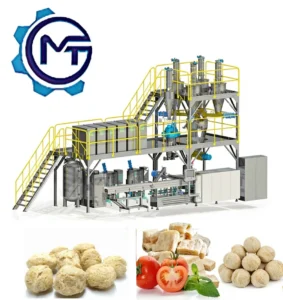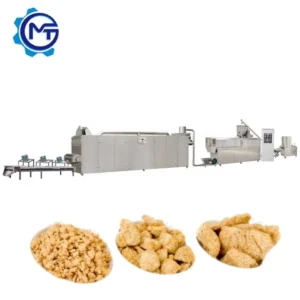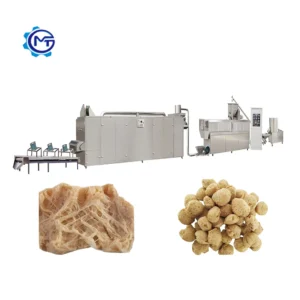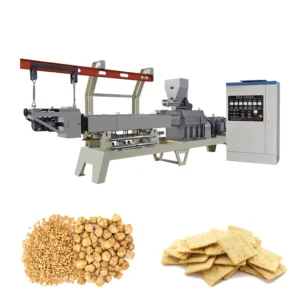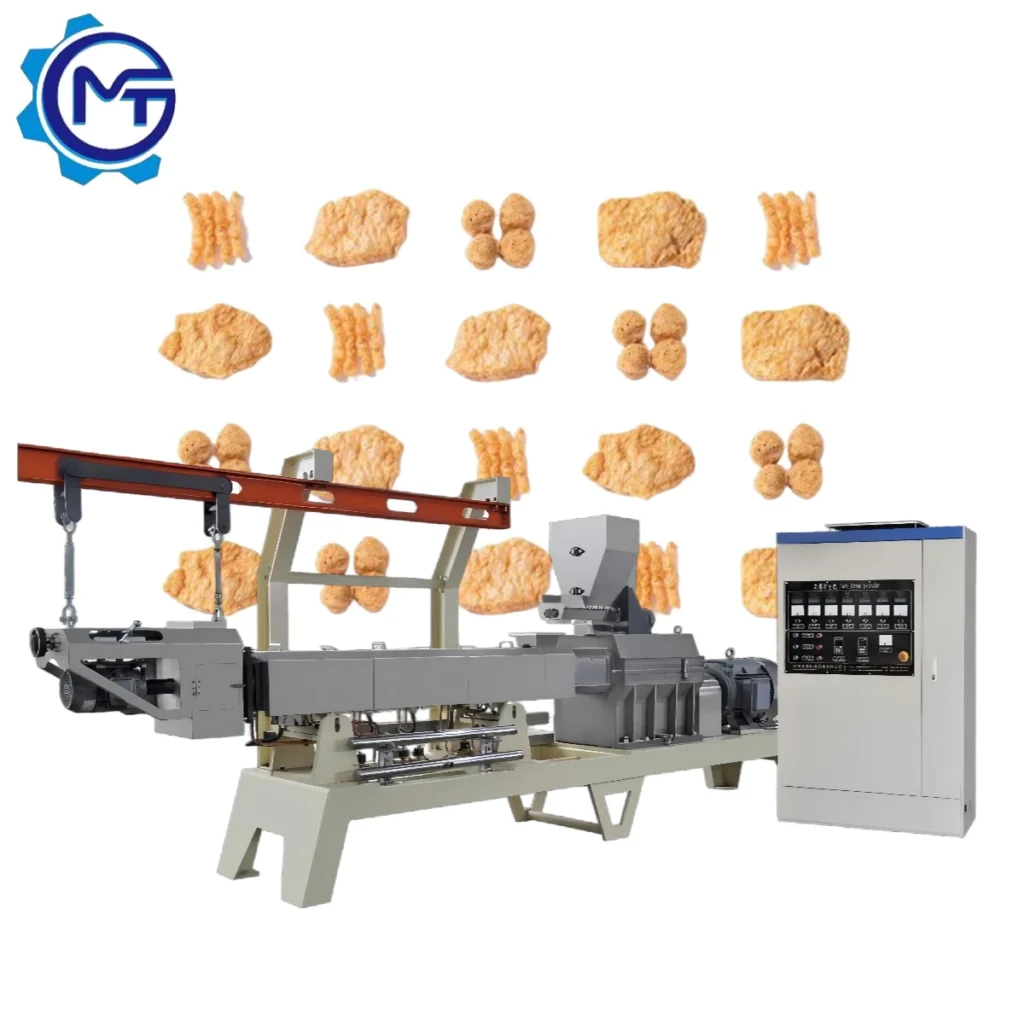
Throughput-Matched Stations — Every station from batching to packing is sized to hold line output on your actual plant protein formulation rather than nominal ratings.
Technical Specifications
| Parameter | Value |
|---|---|
| Product Type | Textured Soy Protein Production Line |
| Extruder Type | Twin-screw |
| Control System | PLC intelligent control |
| Raw Material Compatibility | Soy protein concentrate, soy protein isolate, plant protein blends |
| Product Application | Textured soy protein, vegetarian meat nuggets, plant-based meat alternatives |
| Line Configuration | Batching, mixing, extrusion, drying, cooling, packing |
| Standards | CE, ISO |
Application Suitability
| Application | Material or Output |
|---|---|
| Vegetarian meat nugget manufacturing | Soy protein concentrate and isolate blends |
| Textured vegetable protein production | Defatted soy flour, soy protein isolate |
| Plant-based meat alternative lines | Pea protein, wheat gluten, soy protein blends |
| Meat analog chunks and granules | Mixed plant protein sources with starch carriers |
What "Rated Capacity" Leaves Out When Buying a Textured Soy Protein Production Line for Sale
A line only holds its rated throughput when every downstream station is matched to the extruder output on your specific protein formulation.
I have watched buyers sign off on a twin-screw extruder rated for a certain hourly output, only to find the dryer cannot keep up once real soy protein material runs through the barrel at the moisture levels required for proper fibrous texture. The extruder pushes product faster than the dryer can remove moisture, and suddenly the entire textured soy protein production line for sale backs up with wet, structurally weak output that crumbles before it reaches the cooler. This mismatch is not visible on a spec sheet — it only surfaces when actual material meets actual conditions [NEED_CITE: twin-screw extrusion moisture balance requirements for high-protein formulations].
Station-by-Station Equipment Coverage
When surveying equipment for a plant-based meat line, buyers often evaluate the extruder in isolation and treat downstream stations as afterthoughts. The mixing system must hydrate protein blends uniformly before they enter the barrel; uneven moisture distribution causes inconsistent fiber formation inside the twin-screw extruder. The dryer must be sized to handle the specific moisture content exiting the die, which varies depending on whether the formulation is soy concentrate, isolate, or a blend with starch carriers. Our equipment range catalogs every station — batching, mixing, extrusion, drying, cooling, and packing — so you can see the full chain before committing to a configuration.
Why Throughput Matching Matters More Than Extruder Size
A larger extruder does not solve a line bottleneck if the dryer and cooler remain undersized. Plant protein formulations demand longer residence times in the drying stage than simple starch-based snacks, because the fibrous matrix retains moisture differently. When the dryer falls behind, operators slow the extruder to compensate, and the line never reaches the throughput originally discussed during quotation. Sourcing all stations from one catalogue means the drying capacity, cooling conveyor length, and packing speed are calculated against the extruder output on your specific textured soy protein production line for sale rather than against a generic benchmark [NEED_CITE: drying residence time requirements for textured plant protein products].
How Screw Configuration and Die Design Shape Fibrous Texture
The twin-screw extruder at the heart of this line uses screw elements arranged to generate the shear and temperature profile needed to align plant protein molecules into meat-like fibers. Barrel zones are independently heated, allowing the operator to build a temperature gradient that progressively denatures and cross-links the protein as it moves toward the die. The die plate geometry controls expansion rate and strand thickness, which directly affects whether the final product tears like chicken breast or crumbles like overcooked tofu. PLC control stores the complete recipe — screw speed, barrel temperatures, feed rate, moisture dosing — so each batch of textured soy protein production line for sale repeats the same fibrous structure without manual guesswork between runs [NEED_CITE: twin-screw shear and temperature profiles for protein texturization].
The Hidden Cost of Mismatched Downstream Equipment
When the dryer cannot handle the moisture load from the extruder, operators face a choice: run the extruder slower and accept lower output, or push wet product through and deal with texture failures downstream. Wet textured soy protein that enters the cooler too early develops surface case-hardening — the outside dries and seals while the inside remains soft and prone to microbial growth. Packing stations then seal product with residual moisture inside the bag, leading to spoilage complaints from end customers weeks after shipment. These failures trace back to a line assembled from separate vendors who never calculated throughput as a single system [NEED_CITE: moisture content targets for shelf-stable textured vegetable protein].
Why Source the Full Equipment Range Here
Every station in this catalogue is cross-referenced for throughput compatibility, so the mixer capacity, extruder output, dryer evaporation rate, and packing speed are documented as a matched set rather than sold as standalone units. Screw configurations and die designs are specified to your raw material and target product format — whether nuggets, chunks, or granules — before the line enters production. An in-house testing workshop runs your actual soy protein formulation through the extruder before shipment, so fiber structure and density are confirmed on real material rather than assumed from generic trial data. Electrical schematics, voltage, frequency, and PLC language are confirmed for your target market before fabrication begins. CE and ISO documentation accompanies every line, supporting customs clearance and local compliance requirements in your destination country.
Documentation & Verification
- Line layout drawing showing throughput balance across every station from batching to packing
- Screw configuration record matched to your soy protein formulation and target fiber texture
- Trial run report on your actual raw material conducted in the in-house testing workshop
- Electrical schematic with confirmed voltage, frequency, and PLC control language for your market
- CE declaration of conformity and ISO certificate for customs and regulatory submission
Installation, Commissioning & Support
- Foundation plan based on the complete line footprint including extruder, dryer, and cooler stations
- Dedicated power circuit sizing for the twin-screw main drive motor and barrel heating zones
- Modular station assembly sequence so the extruder and dryer are aligned before utilities connect
- First-run parameter setup on your soy protein material with screw speed and barrel temperature tuning
- Operator training covering PLC recipe storage, die changeover, and moisture dosing adjustment
- Wear parts list with lead times for replacement screws, dies, and barrel segments
Before You Request a Quotation
To configure a line that holds throughput on your actual material, share your protein source — soy concentrate, isolate, pea protein, or a blend — along with the target product format such as nuggets, chunks, or mince. Specify your local voltage, frequency, and preferred PLC control language so electrical design begins correctly from the start. If you have existing upstream batching or downstream packing equipment, provide the make and capacity so the new stations integrate without creating a bottleneck.
Frequently Asked Questions
Q: How is output capacity verified before the line ships?
A: We run your actual soy protein formulation through the extruder in our in-house testing workshop and measure throughput at the die exit under production moisture and temperature conditions. The trial run report documents screw speed, barrel temperatures, and output rate on your specific material, not on a generic reference blend.
Q: What screw configuration is specified for my soy protein raw material?
A: Screw elements are arranged based on your protein content, fat level, and target fiber texture. The configuration record is documented before production and included in your delivery package so replacement elements match the original setup when first wear parts are needed.
Q: Which voltage and PLC language options are available?
A: Voltage, frequency, and control language are confirmed during the specification stage to match your facility electrical supply and operator requirements. The electrical schematic is reviewed and approved before fabrication begins, preventing commissioning delays on site.
Q: Can additional downstream stations be added later without bottlenecking?
A: The line layout accounts for future expansion points at the dryer exit and before packing. When you add coating, flavouring, or additional cooling capacity later, throughput is recalculated across the full chain so no single station becomes a constraint.
Q: What spare wear parts ship with the line and what is the reorder lead time?
A: A starter set of screws, dies, and barrel segments is listed in the wear parts schedule included with your documentation. Reorder lead times for replacement elements are confirmed at quotation stage so you can plan inventory around your production schedule.