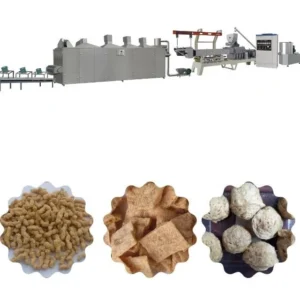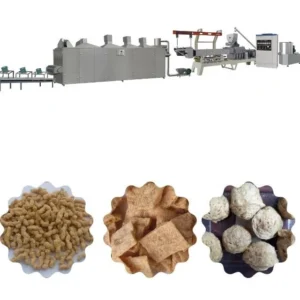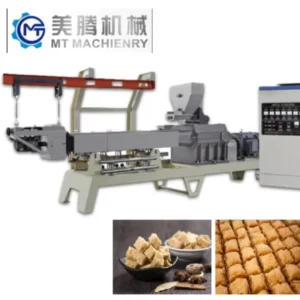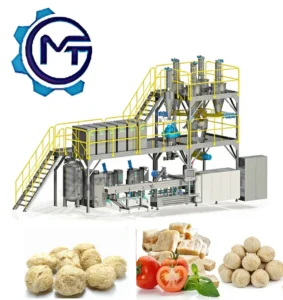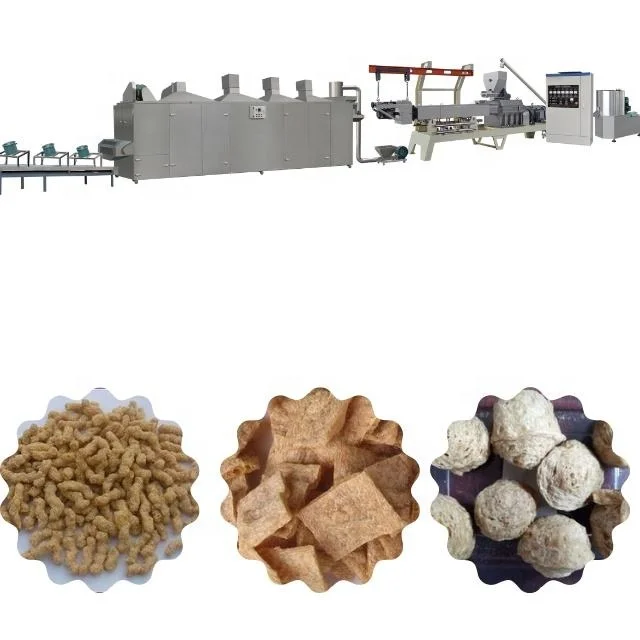
Integrated Station Throughput — Every mixer, extruder, dryer, and cooler in the TVP line is sized as a matched set, eliminating the bottleneck that arises when stations are sourced from separate vendors.
Technical Specifications
| Parameter | Value |
|---|---|
| Product Type | Textured Vegetable Protein Extrusion Line |
| Model | MT65 / MT70 / MT85 |
| Screw Type | Twin-screw (Double Screw Extruder) |
| Installed Power | 85 kW (MT65) / 120 kW (MT70) / 195 kW (MT85) |
| Actual Power Consumption | 65 kW (MT65) / 90 kW (MT70) / 165 kW (MT85) |
| Output Capacity | 150–200 kg/h (MT65) / 200–300 kg/h (MT70) / 600–800 kg/h (MT85) (basis not stated in source — confirm raw material formulation and moisture content) |
| Overall Dimensions (Line) | 18000×1300×2300 mm (MT65) / 20000×1500×2400 mm (MT70) / 24000×3500×4300 mm (MT85) |
| Powder Mixer Output | 300–600 kg/h |
| Powder Mixer Tank Volume | 150 kg |
| Powder Mixer Rotary Speed | 385 rpm |
| Powder Mixer Power | 4 kW |
| High-temperature Roaster Effective Belt Length | 3.5 m |
| Roaster Far Infrared Heater Power | 3.9 kW × 24 |
| Roaster Gas Consumption | 6.8 m³ |
| Cooling Machine Capacity | 200–300 kg/h |
| Control System | Available with PLC or MCC control |
| Construction Material | Food-grade stainless steel (304) |
| Line Stations | Raw material preparation → Mixing → Conveying → Extrusion → Conveying → Drying → Cooling → Packing |
| Standards | CE, ISO |
Application Suitability
| Application | Material or Output |
|---|---|
| Textured soy protein for retail plant-based meat | Low-temperature soybean meal, peanut meal |
| Soya chunks and granules for food service | Defatted soy flour, protein concentrate blends |
| TVP ingredients for ham, sausage, and canned food | Soy and peanut meal formulations with varying protein content |
| Fortified meat analogues for quick-frozen products | Multi-grain protein blends with added fiber and starch |
What the Quoted Output Figures Leave Out About Your Raw Material
Capacity numbers are meaningless without the exact formulation, protein percentage, and moisture content you plan to run.
I have seen lines quoted at a nominal throughput that simply cannot hold that output once the buyer switches from the supplier’s standard test material to their own defatted soybean meal. The screw combination and barrel temperature profile that works perfectly on one protein ratio can produce a sticky, broken fiber structure on another. Before any Textured Vegetable Protein Production Line full equipment range is finalized, the raw material must be defined precisely — otherwise the extruder, dryer, and cooler will all be sized against a guess [NEED_CITE: raw material moisture and protein content impact on extrusion throughput].
How Station Matching Prevents Line Bottlenecks
A common failure in assembled lines is an extruder that outpaces its downstream dryer, forcing the entire Textured Vegetable Protein Production Line full equipment range to idle while moisture is slowly removed. On this line, the powder mixer, twin-screw extruder, high-temperature roaster, and cooling machine are all specified as a throughput-matched set. The mixer’s 300–600 kg/h output feeds the extruder without surge, and the roaster’s 3.5-meter effective belt length provides sufficient residence time for the extrudate volume. This station-to-station balance is documented in the line layout and capacity calculation before production begins.
Why Screw and Die Configuration Must Follow Your Material
The twin-screw extruder in this line is not shipped with a generic screw build. The screw configuration and die design are specified after reviewing the buyer’s raw material — soybean meal, peanut meal, or a custom blend — and the target fiber structure, whether chunk, granule, or shredded flake. Barrel temperature profiling across the zones, combined with moisture conditioning at the mixer stage, controls starch gelatinisation and protein alignment inside the barrel. A misconfigured screw set will produce dense, under-expanded output that fails the texture test in the buyer’s end market [NEED_CITE: twin-screw extrusion screw configuration for plant protein fiber formation].
Reading the Power and Dimension Specs for Your Factory Floor
The installed power ranges from 85 kW on the MT65 to 195 kW on the MT85, but actual consumption sits lower — 65 kW, 90 kW, and 165 kW respectively — which matters when sizing your electrical supply and transformer. Line length stretches from 18 meters to 24 meters, with the MT85 requiring 3.5 meters in width, so factory floor planning must account for operator walkways and maintenance access on both sides. The roaster alone draws significant thermal energy through 24 far infrared heaters rated at 3.9 kW each, plus gas consumption of 6.8 m³, so utility planning must cover both electrical and gas infrastructure before installation week arrives.
The Hidden Cost of Skipping a Pre-Shipment Trial Run
When a line ships without a trial run on the buyer’s actual formulation, product development starts only after installation — burning weeks of raw material and engineer time on-site. Screw combinations get swapped, temperature profiles get rewritten, and the dryer settings get adjusted repeatedly while production deadlines slip. A pre-shipment trial in the testing workshop catches these issues early, confirming that the fiber structure, density, and moisture content meet specification before the equipment leaves the factory floor [NEED_CITE: pre-shipment equipment testing and trial run standards for food processing machinery].
Why Procurement Here Differs from Assembling Separate Stations
Every station on this Textured Vegetable Protein Production Line full equipment range comes from one supplier, so throughput calculations are coordinated rather than guessed across vendors. The twin-screw extrusion expertise covers soy protein, peanut protein, and multi-grain blends, meaning the screw and die specification is drawn from actual application experience rather than a catalogue default. Food-grade 304 stainless steel is used across all contact surfaces, meeting hygiene requirements for food ingredient production. The in-house testing workshop allows trial runs on your raw material before shipment, reducing on-site commissioning time. Documentation — from electrical schematics to screw configuration records — is issued as a single integrated package, simplifying maintenance planning and spare part ordering.
Documentation & Verification
- Line layout and capacity calculation confirming throughput match across mixer, extruder, roaster, and cooler
- Screw and die configuration record matched to your soybean meal or peanut meal formulation
- Electrical schematic with voltage and frequency confirmation for your target market
- Trial run report on your raw material produced in the testing workshop before dispatch
- CE declaration of conformity and ISO certificate for the complete line
- Operation and maintenance manual with wear parts list for screws, dies, and mixer blades
Installation, Commissioning & Support
- Floor space of up to 24000×3500 mm for the MT85 requires a level concrete slab with anchor points
- Electrical supply must match confirmed voltage and frequency, with dedicated circuits for the 195 kW installed power draw
- Line arrives in modular sections for staged assembly, starting with the mixer and extruder, then roaster and cooler
- On-site commissioning includes barrel temperature profiling and screw speed tuning for your raw material
- Operator training covers PLC or MCC control interface, daily cleaning, and screw wear inspection
- Wear parts list identifies screws, dies, and mixer blades with reorder specifications
What We Need to Configure Your Line
To move from inquiry to a matched line proposal, provide your raw material type — soybean meal, peanut meal, or a blend — along with protein content and target moisture percentage. Share your daily or hourly production target so the correct model from MT65 through MT85 can be selected. Confirm your factory’s voltage, frequency, and preferred control language, and indicate whether you want a trial run on your material in the testing workshop before shipment.
Frequently Asked Questions
Q: How is the output capacity of this line verified before quotation?
A: Quoted throughput depends on your specific raw material formulation, protein content, and moisture level. We confirm capacity by running your material in our testing workshop and documenting actual output, fiber structure, and density in a trial run report. This ensures the extruder, dryer, and cooler are all sized against real data rather than generic assumptions.
Q: Which supporting stations are included, and how is throughput balanced?
A: The line includes a powder mixer, twin-screw extruder, high-temperature roaster, cooling machine, and conveying systems between each station. Each station’s capacity is calculated to match the extruder output so material flows continuously without surge or idle time. The line layout document shows the throughput match for your specific model configuration.
Q: What voltage and control options are available?
A: Voltage and frequency are confirmed during the specification stage to match your local power supply. The control system is available with PLC or MCC integration, and the interface language can be set to your preference before shipment. Electrical schematics are provided for your facility’s engineering team to plan the connection.
Q: Can you run a trial on our soybean or peanut meal blend before we commit?
A: Yes. Our in-house testing workshop conducts trial runs using your raw material before the line ships. We test screw configuration, barrel temperature profile, and die design against your formulation, then share the trial run report. This step identifies any adjustments needed and confirms the fiber structure meets your product specification.
Q: What factory floor footprint and utilities should we plan for?
A: Line dimensions range from 18000×1300 mm for the MT65 to 24000×3500 mm for the MT85, with additional space needed for operator access and maintenance. Utilities include electrical supply matched to confirmed voltage, gas supply for the roaster, and water for the cooling station. We provide a detailed utility requirement sheet with your line layout proposal.