Throughput-matched station design — Every mixer, extruder, dryer and cooler in the line is sized against the others so no single unit chokes the flow when running soy or peanut meal at your target moisture.
Technical Specifications
| Parameter | Value |
|---|---|
| Product Type | Textured Vegetable Protein Production Line |
| Available Models | MT65 / MT70 / MT85 |
| Output Capacity | 150–200 kg/h (MT65) / 200–300 kg/h (MT70) / 600–800 kg/h (MT85) (basis not stated in source — confirm raw material formulation and moisture content) |
| Installed Power | 85 kW (MT65) / 120 kW (MT70) / 195 kW (MT85) |
| Actual Power Consumption | 65 kW (MT65) / 90 kW (MT70) / 165 kW (MT85) |
| Overall Dimensions | 18000×1300×2300 mm (MT65) / 20000×1500×2400 mm (MT70) / 24000×3500×4300 mm (MT85) |
| Screw Type | Twin Screw |
| Extruder Main Motor Power | 30 kW (basis not stated in source — confirm model mapping) |
| Extruder Dimensions | 2800×830×1875 mm (basis not stated in source — confirm model mapping) |
| Mixer Tank Volume | 150 kg |
| Mixer Power | 4 kW |
| Mixer Dimensions | 1000×630×1100 mm |
| Mixer Output | 300–600 kg/h (basis not stated in source — confirm batch cycle) |
| Dryer Type | High-temperature Roaster (Far Infrared / Gas) |
| Dryer Effective Belt Length | 3.5 m |
| Dryer Power | 3.9 kW × 24 (far infrared heaters) |
| Dryer Gas Consumption | 6.8 m³ (basis not stated in source — confirm fuel type) |
| Dryer Dimensions | 4500×1500×1600 mm |
| Dryer Output | 300–400 kg/h (basis not stated in source — confirm material moisture) |
| Cooling Machine Capacity | 200–300 kg/h (basis not stated in source — confirm ambient conditions) |
| Construction Material | Stainless Steel (food-grade contact materials) |
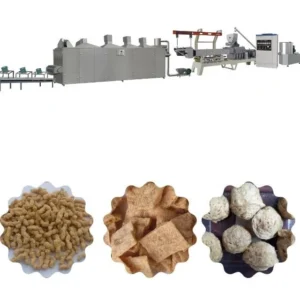
| Process Flow | Raw material preparation → Mixing → Conveying → Extrusion → Conveying → Drying → Cooling → Packing |
| Certification | CE |
| Warranty | 1 year |
Application Suitability
| Application | Material or Output |
|---|---|
| Soy chunk and TVP production for meat extenders | Low-temperature soybean meal |
| Vegetarian meat alternatives and plant-based patties | Defatted soy flour blends |
| Protein-fortified ham, sausage and canned food ingredients | Soy and peanut meal blends |
| Quick-frozen food and fast-food protein components | Textured soy granules and flakes |
| Institutional nutrition and meal-replacement programmes | High-protein legume formulations |
Why Extruder Capacity Alone Tells You Nothing About Line Output
A Textured Vegetable Protein Production Line full equipment range only performs as well as its slowest station.
I spent years in Southeast Asia commissioning food processing lines, and the most common argument on the factory floor was never about the extruder itself — it was about everything downstream. An extruder running at full barrel capacity pushes wet, expanded protein into a dryer that cannot evaporate moisture fast enough, or a cooler that cannot bring the temperature down before packing. The result is a pile of warm, tacky soy chunks blocking the belt while the extruder keeps running. That bottleneck is invisible on a spec sheet that only lists extruder throughput. When you survey a Textured Vegetable Protein Production Line full equipment range, you need the dryer effective belt length, the cooler airflow, and the mixer batch cycle written next to the extruder figure so you can see where the constraint actually sits [NEED_CITE: line balancing methodology for continuous food extrusion plants].
How Each Station Fits the TVP Production Flow
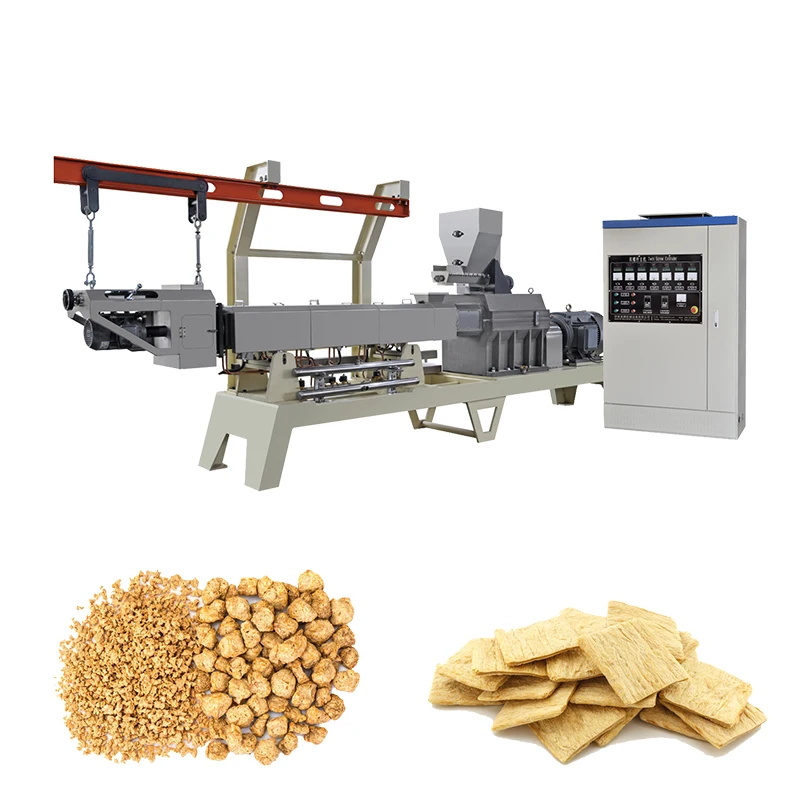
The process begins with the mixer, where soybean meal or peanut meal is blended with water and minor ingredients to reach the moisture level the extrusion stage demands. The twin-screw extruder then applies heat and shear to denature and align the protein molecules, forcing them through a die that shapes the textured chunks. A Textured Vegetable Protein Production Line full equipment range must show the mixer batch output matched against the extruder feed rate so the screw never starves or floods.
After extrusion, the product travels into the high-temperature roaster where surface moisture is driven off and the fibrous structure sets. The choice between far infrared electric heating and gas heating affects both utility planning and running cost, so the station specification must confirm which energy source is available at the installation site.
Reading Dryer and Cooler Capacity Against Extruder Output
The dryer in this range carries an effective belt length of 3.5 m and an array of 24 far infrared heater elements. That belt length determines how long each piece of extruded protein stays in the hot zone — too short and the core moisture remains above a safe storage threshold, too long and the surface case-hardens and cracks. Gas-heated versions list a consumption figure that still needs confirmation against your local fuel type and supply pressure.
The cooler downstream is rated at 200–300 kg/h (basis not stated in source — confirm ambient conditions), which matters because tropical packing halls can push ambient temperature above the point where warm product causes condensation inside the bag. Every capacity number in the Textured Vegetable Protein Production Line full equipment range should be checked against your local climate and shift pattern before you sign off on the layout [NEED_CITE: ambient temperature impact on post-dryer cooling in tropical food plants].
What the Screw, Die and Power Figures Mean on the Floor
The twin-screw design across the MT65, MT70 and MT85 models gives operators control over shear intensity and residence time by changing screw element order and spacing. Low-temperature soybean meal requires a different screw profile than peanut meal because the fat residue and particle size change how the material conveys through the barrel. Main motor power is listed at 30 kW, though the model mapping needs confirmation — what matters is that the motor can sustain peak torque when a cold batch of dense meal enters the feed zone.
Installed power ranges from 85 kW on the MT65 to 195 kW on the MT85, while actual consumption figures are lower at 65 kW and 165 kW respectively. That gap tells you the heaters and drives do not run at full draw continuously; the real electricity cost depends on your shift length, product moisture target, and how often the line idles between batches. Stainless steel contact materials across every wetted surface keep the line compliant with food-grade hygiene expectations and simplify wash-down between formulation changes.
What Happens When Stations Are Not Matched
I once watched a soy chunk line where the extruder was swapped for a larger model without anyone recalculating the dryer load. Within the first hour, half-dried protein piled up on the cooling conveyor, sticking to the belt and tearing when the scraper tried to release it. The operator had to slow the extruder to match the dryer, and the rated output was never reached for the rest of the trial. This kind of mismatch does not show up in a brochure; it shows up on the first production day [NEED_CITE: common commissioning failures in extruded food lines].
A second hidden cost comes from voltage and frequency assumptions. If the control panel is wired for a supply that does not match the local grid, the motor overload settings trip unpredictably and the PLC cannot hold barrel temperature within the narrow window that textured protein demands. Confirming electrical schematics and control language before the machines leave the factory avoids weeks of on-site rework.
Reasons Buyers Survey the Full Range Here
The station catalogue is published with individual dimensions, power draws and output notes so you can compare units before committing to a line layout. Screw configuration and die design are documented against the buyer’s raw material rather than copied from a generic build, which prevents the texture and density surprises that force reformulation after installation.
An in-house machine testing workshop allows trial runs on your actual soybean meal or peanut meal before the line ships, catching protein-content or particle-size issues early. Electrical schematics, voltage confirmation and control language are finalised before production so the PLC and MCC panels arrive ready for local power. Pre-sales consultation continues through on-site installation, commissioning and operator training, so the people running the line understand why each station is set where it is.
Documentation & Verification
- Machine specification sheet with twin-screw and die configuration recorded for your soy or peanut meal
- Line layout showing every station footprint and throughput balance calculation
- Electrical schematic confirming voltage, frequency and control language for your grid
- Trial run report produced on your supplied raw material before shipment
- Factory test record documenting barrel temperature profile and product texture achieved
- Wear parts list covering screws, dies and dryer belts with reorder codes
Installation, Commissioning & Support
- MT85 overall footprint of 24000×3500×4300 mm dictates concrete pad length and ceiling clearance
- Installed power up to 195 kW requires a dedicated supply circuit with verified earthing
- Stainless steel contact surfaces are pre-assembled; field joints sealed to food-grade standard
- First-run commissioning includes screw profile adjustment against your actual meal batch
- Operators trained on mixer batch timing and dryer belt speed relative to extruder feed rate
- Spare screw elements and die plates stocked for first replacement cycle
Before You Request a Quote
To match the right extruder model and supporting stations to your output target, share the soybean meal or peanut meal specification including protein content and particle size, your planned shift pattern and daily volume, and the voltage and frequency available at the installation site. If you already have upstream milling or downstream packing equipment, note the interface dimensions so the conveyor heights can be aligned before the layout is drawn.
Frequently Asked Questions
Q: How is output capacity verified for each extruder model, and on what raw material basis?
A: Capacity figures for the MT65, MT70 and MT85 are listed with a note that the raw material formulation and moisture content must be confirmed. We run a trial on your supplied soybean or peanut meal in the testing workshop and record the actual throughput, texture and density achieved before the line ships.
Q: How do I ensure the dryer and cooler throughput matches the extruder to avoid bottlenecks?
A: We compare the extruder feed rate against the dryer effective belt length and heater capacity, and the cooler airflow against local ambient conditions. The line layout document shows the calculated throughput at every station so you can see the constraint before purchase.
Q: What voltage, frequency and control language options are confirmed before shipment?
A: Electrical schematics are finalised after you confirm the local grid supply and preferred PLC language. The motor overload settings, heater contactors and HMI text are all matched to your specification before the panel is wired, avoiding on-site rework.
Q: How are screw configuration and die design specified for soybean meal versus peanut meal?
A: Each formulation has a different fat content and particle size, which changes how the material conveys and shears inside the barrel. We select screw element order and die aperture based on your trial results and document the configuration so replacements can be ordered with the same profile.
Q: What spare wear parts are available, and what are typical lead times for reorder?
A: Screws, dies and dryer belts are listed on the wear parts sheet shipped with the line. Reorder codes are included so you can request replacements directly, and typical multi-week lead times apply depending on the part and destination.