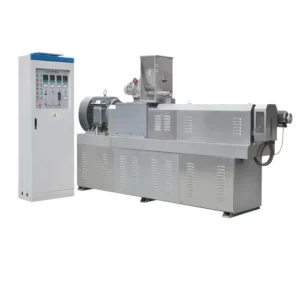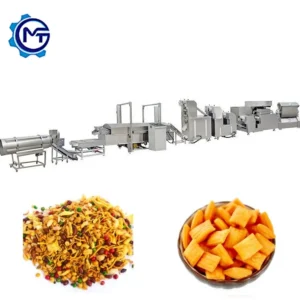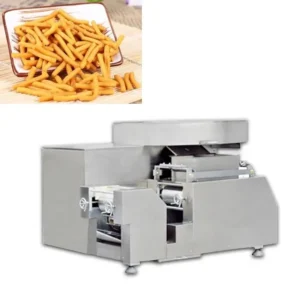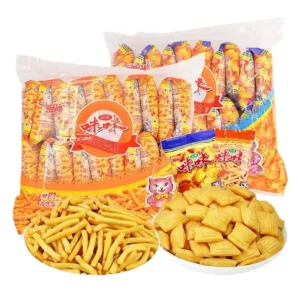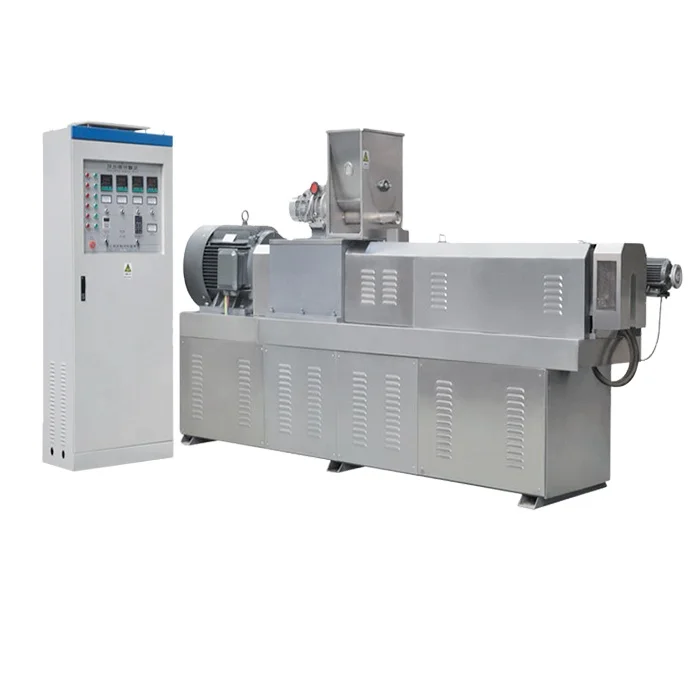
Throughput Matching Across Stations — every mixer, extruder, fryer and flavoring drum is sized so one station never starves or flood another.
Technical Specifications
| Parameter | Value |
|---|---|
| Product Type | Fried Snack Processing Line (Bugles / Crisp Corn Chips) |
| Models Available | MT65, MT70, MT85, MT75, MT95 |
| Extruder Type | Twin-screw |
| Installed Power (MT65) | 142 kW |
| Real Power (MT65) | 100 kW |
| Installed Power (MT70) | 185 kW |
| Real Power (MT70) | 130 kW |
| Installed Power (MT85) | 240 kW |
| Real Power (MT85) | 180 kW |
| Installed Power (MT75) | 245 kW |
| Real Power (MT75) | 185 kW |
| Installed Power (MT95) | 370 kW |
| Real Power (MT95) | 280 kW |
| Overall Dimensions (MT65) | 22000 × 1200 × 2200 mm |
| Overall Dimensions (MT85) | 26000 × 1500 × 2300 mm |
| Overall Dimensions (MT95) | 30000 × 1500 × 2800 mm |
| Powder Mixer Tank Volume | 150 kg |
| Powder Mixer Mixing Time | 10 min per batch |
| Powder Mixer Rotary Speed | 385 rpm |
| Fryer Temperature Range | 0–260 °C |
| Fryer Dimension | 4500 × 1350 × 2350 mm |
| Flavor Line Output | 400 kg/h (basis to be confirmed) |
| Control System | PLC and MCC |
| Construction Material | Food-grade stainless steel contact surfaces |
| Certification | CE, ISO |
| Warranty | 1 year complete |
| Product Shapes | Bugles, triangles, small fish, golden horns, small gourds, ducks, Christmas trees, rice crust |
Application Suitability
| Application | Material or Output |
|---|---|
| Bugles and crisp corn chip production | Corn flour, wheat flour, and blended grain bases |
| Rice crust and rice-based fried snacks | Rice flour with starch modifiers |
| Fried pasta-style snacks (small fish, horns, gourds) | Wheat flour and semolina blends |
| Seasoned triangle chips and tortilla-style chips | Corn masa and composite flour formulations |
| Small-batch contract manufacturing | Shape changeovers on a single die and cutting station |
What "300 kg/h Output" Really Means When Your Flour Changes
Nominal capacity means nothing unless it holds on the exact flour blend, moisture level, and product shape you will run every day.
I watched an Indonesian snack producer lose an entire trial batch because their line was commissioned on standard potato starch while their daily recipe relied on tapioca starch — expansion collapsed and oil absorption spiked beyond market tolerance. Capacity numbers printed on a brochure assume a reference material that rarely matches what arrives at your factory dock. A fried snack processing line for sale should be quoted with throughput tied to your actual recipe, not a generic benchmark [NEED_CITE: material-specific throughput verification in extrusion snack lines].
When you evaluate a fried snack processing line for sale, ask whether the supplier has run your specific flour on the twin-screw extruder, recorded the screw speed and barrel temperature profile, and matched fryer residence time to the resulting pellet density. Without that data before shipment, you are paying for a guess.
How Screw Configuration Defines Your Chip Texture
The twin-screw extruder in this line uses interchangeable screw elements and die plates matched to the raw material and the target shape. Corn flour demands a different compression ratio and shear history than a rice-flour or wheat-blend recipe. Changing the screw arrangement shifts gelatinisation behaviour, which controls how much the sheet expands through the pressing roller and ultimately determines the bite and oil uptake after frying.
Why the Fryer Cannot Be Sized in Isolation
Fryer capacity must track the extruder output precisely. If the extruder pushes sheet pellets faster than the fryer can carry them through the 0–260 °C oil bath, pellets queue up, stick together, and produce a batch with uneven colour and moisture. The PLC and MCC control panel coordinates extruder screw speed with the fryer belt rate so throughput stays balanced across both stations [NEED_CITE: throughput synchronisation between extrusion and frying stations].
Reading the Power Figures Correctly
Installed power on the MT65 is 142 kW while real running power sits at 100 kW; the gap reflects start-up surges, heater headroom, and the mixer cycle. For the MT95, installed power reaches 370 kW with a real draw of 280 kW. These differences matter when sizing your main breaker and dedicated circuit. The powder mixer runs at 4 kW per batch cycle with a 150 kg tank, meaning you will draw intermittent peak loads on top of the steady extruder and fryer draw. The fryer alone occupies a 4500 × 1350 × 2350 mm footprint and must sit on a level, heat-resistant floor with adequate ventilation clearance for oil vapour exhaust. Voltage and frequency remain configurable to your destination market and should be confirmed before production begins.
The Hidden Cost of Skipping a Raw-Material Trial
Buyers who skip the pre-shipment trial on their own flour blend often spend the first weeks after installation chasing density and expansion problems that should have been solved in the supplier’s testing workshop. Screws configured for a generic recipe produce chips that either float in the fryer too long — absorbing excess oil — or sink and scorch. Shape consistency also suffers: triangles come out warped, horns collapse flat, and the flavouring drum cannot coat uneven pieces properly. Sorting out these issues on-site costs far more in wasted oil, flour, and labour than a trial run ever would [NEED_CITE: on-site commissioning delays from untested screw configurations].
Why Procurement Consolidation Matters Here
Every station on this line — mixer, extruder, pressing roller, shape cutter, fryer, flavouring drum, dryer, and packing conveyor — comes from one supplier, which means throughput calculations are cross-checked rather than assembled from separate vendor brochures. Screw configuration and die design are documented against your target product, not copied from a default build. The in-house testing workshop runs your actual flour blend before the line ships, generating a trial report that travels with the machines. Electrical schematics arrive with voltage and frequency locked to your facility, and PLC language is set before the control cabinet leaves the factory. Documentation, spare screws, dies, and cutting blades ship in the first crate so replacements are on hand when the first wear interval arrives.
Documentation & Verification
- Line layout drawing with throughput calculation matched to your flour blend and shape
- Trial run report on your raw material produced before shipment leaves the workshop
- Screw and die configuration record specific to your product shape and expansion target
- Electrical schematic with confirmed voltage, frequency, and PLC display language
- CE declaration of conformity and ISO certificate included in shipping documentation
- Operation and maintenance manual with wear parts list and replacement intervals
Installation, Commissioning & Support
- Floor plan must accommodate up to 30000 × 1500 × 2800 mm line length depending on model selected
- Dedicated circuit required matching confirmed kW draw and local voltage and frequency
- Line ships in sectional modules; on-site assembly aligns extruder, fryer, and flavouring drum
- First production run sets screw speed, barrel temperature, and fryer belt rate on your recipe
- Operator training covers PLC interface, shape changeover, and daily cleaning of fryer and dies
- Wear screws, dies, and cutting blades ship with initial spare set for first replacement cycle
- Ongoing maintenance support available for periodic screw inspection and fryer element servicing
What to Include in Your Inquiry
To size the right model and configure the screw and die set, share your flour type, typical batch recipe with moisture content, the product shapes you plan to run, and your target daily output. Confirm your facility voltage and frequency, available floor length and ceiling height, and whether you need the PLC interface in a specific language. If you can send a sample of your actual raw material, the testing workshop can run a trial before quotation so capacity figures reflect your real production conditions rather than a generic baseline [NEED_CITE: raw material sample requirements for extrusion trial runs].
Frequently Asked Questions
Q: How is output capacity verified on my specific raw material and product shape?
A: Your flour blend and target shape are run in the testing workshop before shipment. Screw speed, barrel temperature profile, and die selection are recorded, and the resulting throughput is documented in a trial report. This means the capacity figure you receive reflects your actual recipe, not a generic laboratory benchmark.
Q: What voltage, frequency and control language options are available for my market?
A: Voltage and frequency are configured to match your facility supply before production begins. The PLC interface language is set to your preference, and the electrical schematic confirms all values. This avoids commissioning delays that occur when control panels arrive set to a default standard that does not match local power infrastructure.
Q: Can I run a trial production on my own flour blend before the line ships?
A: Yes. The in-house testing workshop accepts your raw material sample and runs a full extrusion, frying, and flavouring cycle. You receive a trial run report showing expansion, density, oil absorption, and shape consistency. Adjustments to screw configuration or die design are completed before the machines leave the factory.
Q: How is throughput balanced between the extruder, fryer and flavoring stations?
A: Each station is sized during the line layout stage so the extruder output matches fryer belt capacity and flavoring drum residence time. The PLC coordinates screw speed with fryer rate to prevent pellet queuing or starvation, ensuring consistent colour, moisture, and seasoning coverage across every production batch.
Q: What spare wear parts are included and how are replacements sourced?
A: The initial shipment includes a spare set of screws, dies, and cutting blades matched to your product shape. A wear parts list documents each component with ordering codes. Replacements are supplied directly from the factory, and the operation manual specifies inspection intervals so you can plan reorder timing before production is interrupted.