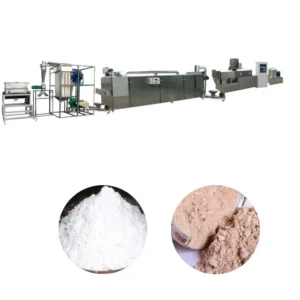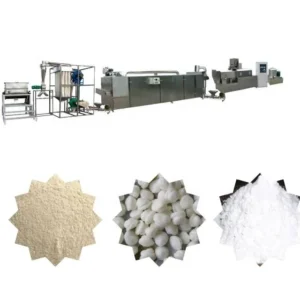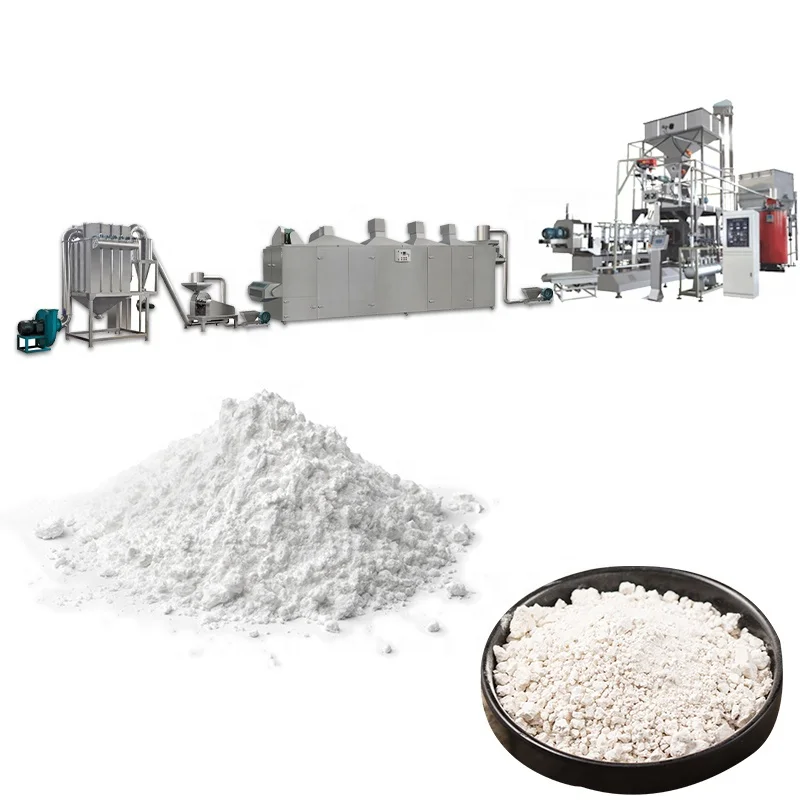
Screw and die geometry specified to your starch feedstock — trial runs on customer-supplied corn, cassava, or tapioca starch confirm gelatinisation degree and water absorption before the line leaves our Shandong workshop.
Technical Specifications
| Parameter | Value |
|---|---|
| Model | MT75 / MT70 / MT70C |
| Product Type | Modified Starch Processing Line |
| Screw Type | Twin-screw |
| Installed Power | MT75: 180 kW; MT70: 120 kW; MT70C: 150 kW |
| Power Consumption | MT75: 135 kW; MT70: 120 kW; MT70C: 125 kW |
| Output Capacity | MT75: 200–250 kg/h (basis to be confirmed); MT70: 100–150 kg/h (basis to be confirmed); MT70C: 250–300 kg/h (basis to be confirmed) |
| Overall Dimensions (L×W×H) | MT75: 32000×3500×4300 mm; MT70: 30000×1500×2200 mm; MT70C: 34000×3500×4300 mm |
| Control System | Frequency conversion speed regulation for feeding, driving and rotary cutting |
| Voltage & Frequency | 380 V 50 Hz Three Phase (verify against target market supply) |
| Mixer Capacity | 20–30 / 70–80 / 170–180 kg per batch depending on mixer model |
| Mixer Material | 201 Stainless Steel or 304 Stainless Steel |
| Dryer Type | Multi-layer conveyor dryer, double pitch roller chain, round-trip drying |
| Pulverizer Drive Motor | 15 kW |
| Pulverizer Mesh | 100–120 mesh |
| Pulverizer Feature | Integrated dust removal system |
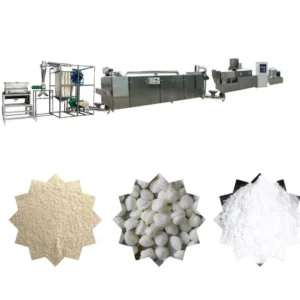
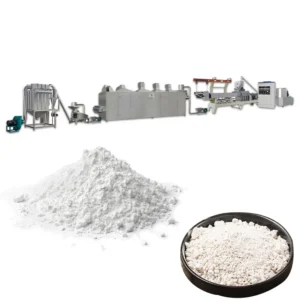
| Line Stations | Mixer → Twin-screw extruder → Dryer → Pulverizer → Packaging machine |
| Certification | CE |
Application Suitability
| Application | Material or Output |
|---|---|
| Pregelatinized starch for oil drilling fluid loss agents | Corn starch, cassava starch requiring high-temperature stability |
| Modified food-grade starch production | Maize starch, tapioca starch for thickening and binding |
| Denatured industrial starch processing | Potato starch, cassava starch for adhesive and papermaking use |
| Fortified and instant starch powder blending | Corn and tapioca starch with nutritional additive incorporation |
Why "Nominal Capacity" Misleads Starch Buyers on Every Modified Starch Processing Line Manufacturer Quotation
Throughput figures are meaningless unless they reference your exact starch variety and moisture content.
I once watched a buyer in Shandong province commission a pregelatinized starch line that had been quoted at full rated capacity on corn starch. When the plant switched to cassava starch — their actual commercial feedstock — the gelatinisation degree dropped outside specification and water absorption fell well below target. The extruder ran fine mechanically, but the product was unsaleable. This scenario repeats across the industry because capacity numbers are generated on generic feedstocks, not on the raw material the buyer actually sources [NEED_CITE: starch gelatinisation behaviour varies by amylose-amylopectin ratio across corn, cassava, and potato varieties]. A responsible modified starch processing line manufacturer will always insist on running trial batches on the buyer’s real material before confirming output.
Barrel Segmentation and Shear Control for Starch Modification
Twin-screw extrusion modifies starch by combining thermal energy with mechanical shear across segmented barrel zones. Each zone can be set to a different temperature profile, allowing operators to control the degree of gelatinisation, dextrinisation, or cross-linking depending on the target application. Frequency conversion speed regulation on the main drive lets the process engineer dial in screw RPM independently of feeder speed, which is critical when shifting between high-amylose corn starch and high-amylopectin tapioca starch. This level of independent control is what separates a true modified starch processing line from a repurposed snack extruder.
How Dryer and Pulverizer Sizing Prevents Downstream Bottlenecks
The multi-layer conveyor dryer uses a double pitch roller chain with round-trip material travel, giving each starch particle sufficient residence time for uniform moisture removal. If the dryer is undersized relative to extruder output, partially dried starch accumulates on the belt, creating clumps that block the pulverizer feed. Conversely, an oversized dryer wastes energy and occupies floor space without adding throughput. The pulverizer’s 15 kW drive motor and 100–120 mesh screen must also be matched so that the powder fineness stays consistent at whatever rate the dryer delivers [NEED_CITE: industrial starch powder fineness standards by application sector].
What the Power and Dimension Figures Actually Mean for Your Facility
The MT75 model draws 135 kW in operation and occupies a 32-metre line footprint with a ceiling clearance requirement above 4.3 metres. The MT70 is more compact at 30 metres long and 2.2 metres tall, suitable for facilities with lower headroom. Installed versus consumed power differentials across the three models indicate where drive headroom exists for heavier-viscosity starch types. Cassava starch, for example, develops higher melt viscosity inside the barrel than maize starch, demanding more torque from the main drive. Buyers sourcing modified starch for industrial applications should cross-reference these power values against their facility’s transformer capacity before ordering. The 380 V 50 Hz three-phase default must be confirmed against local grid specifications, as many Southeast Asian and African facilities operate on different voltage standards [NEED_CITE: voltage and frequency standards by export market].
The Hidden Cost of Generic Screw Configurations in Starch Processing
When an extruder ships with a screw configuration copied from a standard food snack build rather than designed for starch modification, the consequences appear gradually. Gelatinisation is incomplete in some barrel zones and excessive in others, producing a powder with inconsistent cold-water solubility. The pulverizer then receives material of variable hardness, causing screen wear to accelerate unevenly and mesh blockages to occur at unpredictable intervals. Buyers who skip the pre-shipment trial run often discover these problems only after three or four production days, when the cumulative off-spec output outweighs the cost of a factory visit [NEED_CITE: twin-screw wear rates in starch versus cereal applications].
Why Procurement Teams Choose This Shandong-Based Supplier
Our testing workshop runs your actual corn, cassava, or tapioca starch through the MT75 or MT70 before shipment, generating a trial report that documents gelatinisation degree, expansion ratio, and powder fineness. The screw and die configuration record is written specifically for your feedstock, not borrowed from a generic template. Every station — from the mixer batch capacity through the dryer belt speed to the pulverizer feed rate — is calculated so throughput stays balanced across the entire modified starch processing line. Electrical schematics are confirmed against your facility voltage and frequency before production begins, preventing commissioning delays. Wear parts including replacement screws, dies, and pulverizer screens are catalogued with lead times so your first changeover does not halt production.
Documentation & Verification
- Line layout drawing showing all stations from mixer through packaging with throughput calculations
- Screw and die configuration record matched to your specific starch feedstock and modification target
- Trial run report documenting gelatinisation and fineness results on your supplied raw material
- Electrical schematic with voltage and frequency confirmed for your facility grid
- CE declaration of conformity covering the complete processing line
Installation, Commissioning & Support
- Foundation plan accounting for the MT75’s 32-metre length and 4.3-metre height clearance
- Dedicated power circuit sizing based on 180 kW installed load for the MT75 model
- Sectional delivery and on-site assembly sequence for the multi-layer conveyor dryer
- First-run parameter setting on your starch feedstock with frequency conversion calibration
- Operator training covering screw speed adjustment for different starch moisture levels
- Wear parts list specifying screws, dies, and pulverizer screens with replacement intervals
What to Prepare Before Requesting a Quotation
Share your starch variety — corn, cassava, potato, or tapioca — along with a representative sample for trial runs, your target daily output in tonnes, and your facility’s available floor length and ceiling height. Confirm your local voltage and frequency so the electrical package is built correctly from the start, and let us know whether the end product is destined for food-grade or industrial applications, as this determines mixer material selection and contact surface specifications.
Frequently Asked Questions
Q: How is output capacity verified on the buyer’s specific starch raw material before shipment?
A: We run your supplied corn, cassava, or tapioca starch through the extruder in our testing workshop, measuring actual throughput, gelatinisation degree, and powder fineness. The results are documented in a trial report, and the capacity figure in the quotation references your material rather than a generic benchmark.
Q: What screw and die configuration is selected for different starch types?
A: Corn starch, cassava starch, and potato starch each have different amylose-amylopectin ratios and gelatinisation temperatures. We adjust screw element sequencing, compression ratio, and die aperture to match the specific feedstock, ensuring consistent modification degree across the production run.
Q: How are voltage, frequency, and control language confirmed before production begins?
A: We request your facility’s electrical supply certificate and operator language preference during the inquiry stage. The electrical schematic, motor nameplates, and control panel labels are then built to match, preventing rewiring work or miscommunication during commissioning.
Q: How is throughput matched between the extruder, dryer, and pulverizer to prevent line bottlenecks?
A: Each station is sized against the extruder’s confirmed output on your starch type. The dryer belt speed and residence time are calculated to handle peak extruder discharge, and the pulverizer feed rate is calibrated so screen loading stays within the 100–120 mesh capacity range.
Q: What spare wear parts are included and what is the replacement lead time?
A: The initial shipment includes replacement screw elements, die plates, and pulverizer screens sized to your mesh specification. A wear parts list with part numbers and typical multi-week lead times is provided so you can plan reorder points before the first changeover is due.