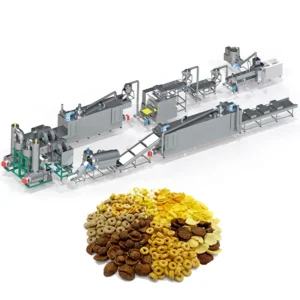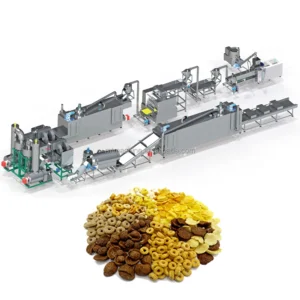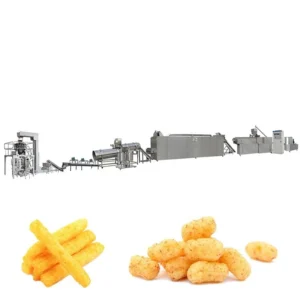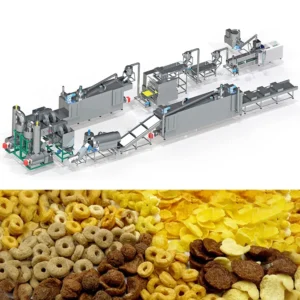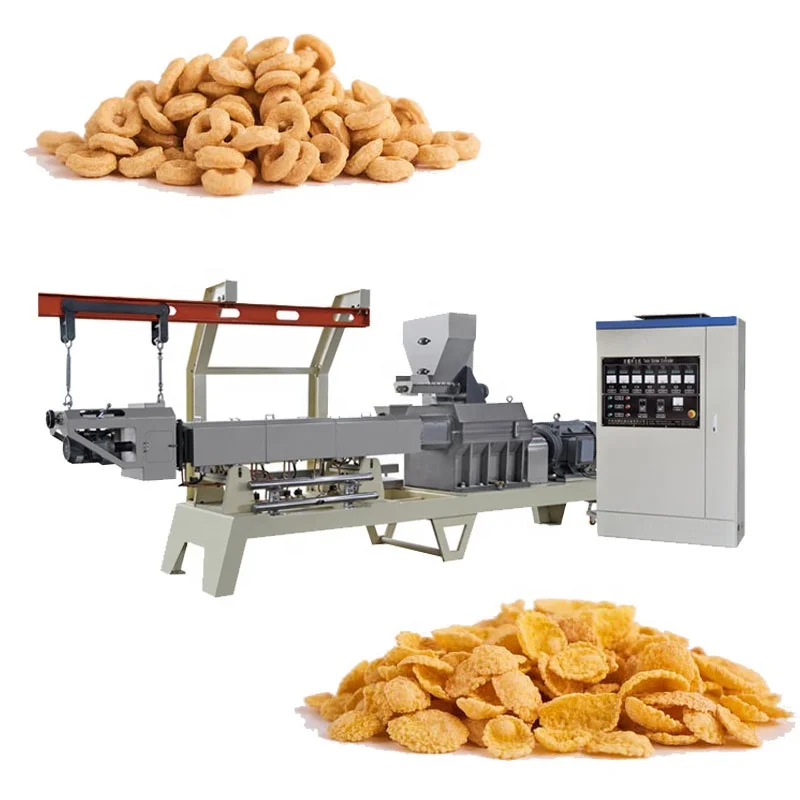
Integrated Line Throughput — Every station from the mixer to the packing machine is specified and matched under one supplier, ensuring the corn flakes production line equipment holds its rated output without bottlenecks between extrusion, flaking, and baking.
Technical Specifications
| Parameter | Value |
|---|---|
| Product Type | Corn Flakes Production Line / Breakfast Cereal Extrusion Line |
| Model Options | MT-65, MT-70, MT-85, MT-75 |
| Screw Configuration | Twin-screw, co-rotating sectional modules |
| Output Capacity (MT-65) | 120–150 kg/h (basis not stated in source — confirm raw material, moisture, flake thickness) |
| Output Capacity (MT-70) | 200–250 kg/h (basis not stated in source — confirm raw material, moisture, flake thickness) |
| Output Capacity (MT-85) | 300–400 kg/h (basis not stated in source — confirm raw material, moisture, flake thickness) |
| Output Capacity (MT-75) | 400–500 kg/h (basis not stated in source — confirm raw material, moisture, flake thickness) |
| Installed Power (MT-65) | 84 kW |
| Real Power (MT-65) | 59 kW |
| Installed Power (MT-70) | 132 kW |
| Real Power (MT-70) | 92 kW |
| Installed Power (MT-85) | 239 kW |
| Real Power (MT-85) | 167 kW |
| Installed Power (MT-75) | 186 kW |
| Real Power (MT-75) | 140 kW |
| Overall Dimensions (MT-65) | 21000 × 1200 × 2200 mm |
| Overall Dimensions (MT-70) | 23000 × 1500 × 2200 mm |
| Overall Dimensions (MT-85) | 28000 × 3500 × 4300 mm |
| Overall Dimensions (MT-75) | 24000 × 1500 × 2800 mm |
| Flaking Press | Stainless steel big roller with cooling system, adjustable gap, 16.12 kW, 1550 × 1300 × 2000 mm |
| Oven | High-temperature gas oven, dual-side baking, 4.5 × 1.4 × 1.8 m, 3.75 kW |
| Control System | PLC and MCC |
| Raw Material Form | Powder (flour) or grits |
| Certifications | CE, ISO |
Application Suitability
| Application | Material or Output |
|---|---|
| Corn flakes manufacturing | Corn grits or corn flour, yellow or white varieties |
| Rice and multigrain flakes | Rice flour, millet, blended cereal grains |
| Wheat and oat breakfast cereal | Wheat flour, oat grits, barley |
| Fortified nutritional flakes | Cereal blends with added vitamin and mineral premix |
Why "Rated Capacity" Means Nothing Without the Raw Material Spec
A capacity number divorced from your actual grain variety and moisture content is just a guess.
I once watched a line stall for two weeks because the trial was run on yellow corn grits while the buyer’s factory used white corn flour from a local African supplier. The extrusion behavior was completely different — the flakes came out thick and brittle, and the dryer backed up. When sourcing corn flakes production line equipment, the first question should never be "how many kilos per hour" but rather "how many kilos per hour on my specific material at my target moisture." [NEED_CITE: starch gelatinisation differences between corn varieties] Without that premise, every downstream station — the flaking press, the oven, the cooling conveyor — may be sized wrong for what you actually intend to run.
How the Extrusion Stage Shapes Flake Integrity
The twin-screw extruder in this breakfast cereal extrusion machine for sale uses co-rotating sectional modules, allowing the screw profile to be reconfigured for different grain compositions. The barrel is divided into independently heated zones, so the temperature curve can be adjusted from the feed section through the cooking and die zones. This matters because corn flour and corn grits demand different residence times and shear levels to achieve full gelatinisation without over-expansion. Getting this stage right determines whether the pellets entering the flaking press are uniform in density and moisture — which is the foundation for consistent flake thickness downstream.
Matching Every Station to Prevent Line Bottlenecks
A frequent failure in assembled lines is that one station runs faster than the next, creating material pile-ups or starvation gaps. This corn flakes production line equipment sequences nine stations — mixer, screw conveyor, twin-screw extruder, air conveyor, dryer, hoister, flavouring drum with oil sprayer, cooling machine, and packing machine — each sized to handle the throughput of the preceding unit. The high-temperature gas oven, for instance, features a dual-side baking system across a 4.5-meter chamber to ensure the pellet residence time matches extruder output without compromising crispness. When the flaking press, oven, and cooling conveyor are balanced against the extruder, you avoid the scenario where one machine idles while another is overloaded. [NEED_CITE: throughput balancing in continuous cereal processing lines]
What the Specifications Actually Mean for Production
The distinction between installed power and real power across the MT-65, MT-70, MT-85, and MT-75 models reflects the difference between peak motor draw and typical running consumption. The MT-85, for example, has an installed power of 239 kW but a real power draw of 167 kW — a gap that affects your transformer sizing and utility cost projections. The flaking press uses a stainless steel big roller with an integrated cooling system and adjustable roller gap, which directly controls the final flake thickness; too wide a gap yields a chewy flake, too narrow crushes the pellet. The PLC and MCC control architecture centralizes the line so that temperature zones, conveyor speeds, and press pressure can be monitored and adjusted from a single interface. For operators, this reduces the reliance on manual judgment during batch changeovers.
The Hidden Cost of Mismatched Dryer and Coating Capacity
When an extruder is supplied without confirming that the dryer and flavouring drum can keep pace, the line’s real output drops below the quoted figure. Wet pellets pile up before the oven, coating distribution becomes uneven, and the cooling conveyor receives product that is still warm — causing flakes to stick together in the packing stage. [NEED_CITE: common causes of post-extrusion bottlenecks in cereal lines] These issues rarely surface during the factory acceptance test because the trial runs for a short duration, but they become daily losses once continuous production begins.
Why Source the Full Equipment Range Here
Every station in this line is manufactured under one roof, meaning the conveyor heights, utility connections, and control signals are designed to interface without field improvisation. The screw configuration and die design are specified against your raw material sample rather than copied from a generic template. An in-house testing workshop allows trial runs on your actual grain supply before the equipment leaves the factory. Food-grade contact materials are used throughout all product zones. The documentation package includes the line layout, capacity calculation, and screw configuration record matched to your product, not a generic brochure. [NEED_CITE: machinery directive compliance for food extrusion equipment]
Documentation & Verification
- Line layout drawing showing station spacing and utility drop points for your floor plan
- Screw and die configuration record matched to your grain type and target flake density
- Electrical schematic with voltage, frequency, and control language confirmed for your market
- Factory trial run report produced on your raw material sample before shipment
- CE declaration of conformity and ISO certificate included in shipping documents
- Operation and maintenance manual covering daily checks and wear part replacement intervals
Installation, Commissioning & Support
- Floor space requirement mapped to the line dimensions, from 21 m for the MT-65 up to 28 m for the MT-85
- Dedicated electrical circuit sized to the real power draw of your selected model and local voltage standard
- Modular station delivery with assembly sequence documentation for on-site reconnection
- On-site commissioning including extruder barrel temperature profiling and flaking press gap calibration
- Operator training covering PLC interface navigation, recipe storage, and emergency stop procedures
- Wear parts list identifying screws, dies, and roller surfaces with recommended replacement intervals
Before You Request a Quotation
To size a corn flakes production line equipment correctly, share your raw material specification — whether you use corn grits, corn flour, or a multigrain blend — along with the moisture content you plan to run. Confirm your local voltage and frequency so the motor and control panel are built for your grid. If you have an existing packing format or upstream silo system, provide those details so the line interfaces correctly at both ends.
Frequently Asked Questions
Q: How is the output capacity verified and what raw material premise is it based on?
A: The rated capacities listed for each model are based on specific raw material, moisture, and flake thickness conditions that must be confirmed during the quotation stage. We conduct a trial run in our testing workshop using your actual grain sample, and the verified output becomes the basis for the final line configuration and downstream station sizing.
Q: Which voltage, frequency, and control language options are available for my market?
A: The electrical system is configured to your local grid standard before production begins. Voltage, frequency, and the PLC interface language are confirmed during the specification review so that the breakfast cereal extrusion machine for sale arrives ready to connect without transformer adaptation or software reflash on site.
Q: How is the flaking press roller gap set to achieve the target flake thickness?
A: The stainless steel flaking press features an adjustable roller distance mechanism that is calibrated during commissioning based on your target flake specification. The integrated cooling system prevents roller thermal expansion from altering the gap during continuous runs, maintaining consistent thickness throughout the production shift.
Q: What is included in the complete line from batching to packing?
A: The line covers nine stations: mixer, screw conveyor, twin-screw extruder, air conveyor, dryer, hoister, flavouring drum with oil sprayer, cooling machine, and packing machine. Each station is capacity-matched to the extruder model you select, so throughput remains balanced across the entire corn flakes production line equipment.
Q: Can I run a trial with my own raw material before shipment?
A: Yes. Our in-house testing workshop is equipped to run your grain sample through the extruder and flaking press before dispatch. The trial run report documents the screw configuration, temperature profile, and resulting flake characteristics, giving you verified data before the line is crated for shipping.