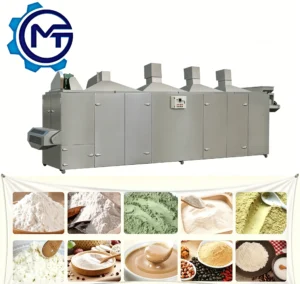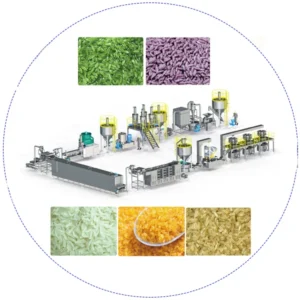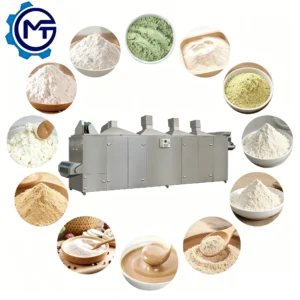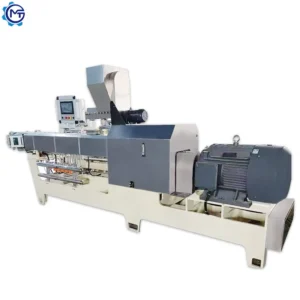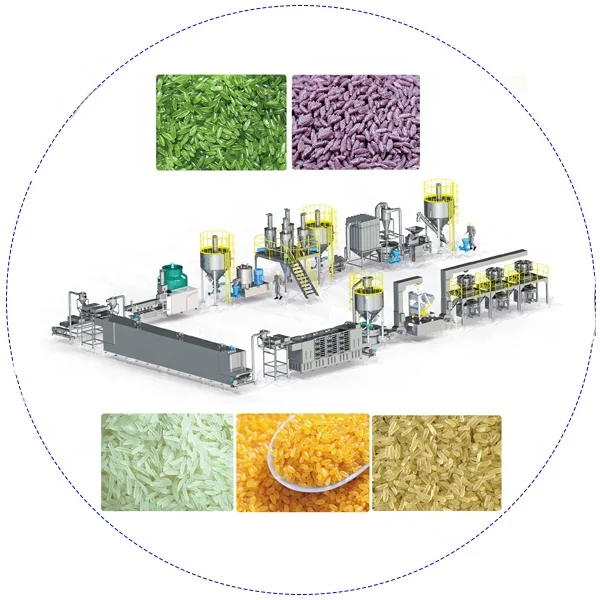
Throughput-balanced artificial rice line — every station from mixer to cooling belt is sized against the extruder’s real output on your formulation, not a catalog number.
Technical Specifications
| Parameter | Value |
|---|---|
| Product Type | Fortified Artificial Rice Extrusion Line |
| Extruder Type | Twin-screw, co-rotating, sectional modules |
| Screw Length | 2500 mm |
| Extruder Main Motor Power | 110 kW (frequency control) |
| Feeder Motor Power | 1.5 kW (frequency control) |
| Cutting Motor Power | 2.2 kW (frequency control) |
| Oil Pump Power | 0.75 kW |
| Mixer Power | 15 kW |
| Mixer Batch Capacity | 130–150 kg/batch (basis not stated in source — confirm material bulk density and moisture) |
| Mixer Dimension | 1450 × 1550 × 980 mm |
| Mixer Weight | Approx. 200 kg |
| Vibrating Screen Power | 0.2 kW |
| Vibrating Screen Dimension | 1700 × 1210 × 740 mm |
| Dryer Heating Type | Electric (gas / diesel / steam available on request) |
| Cooling Dryer Power | 2.2 kW |
| Cooling Dryer Dimension | 5000 × 1500 × 1900 mm |
| Cooling Dryer Belt Width | 1 m |
| Control System | Frequency control on main drives; PLC and MCC available on request |
| Material of Contact Parts | Food-grade |
| Certification | CE |
| Assembly State | Complete line (mixing → extrusion → vibrating screen → drying → cooling) |
Application Suitability
| Application | Material or Output |
|---|---|
| Fortified artificial rice for nutrition programmes | Rice flour, corn flour, micronutrient premixes (vitamins, minerals) |
| Extruded rice kernels for staple-food markets | Blended grain flours with fortification additives |
| Breakfast cereal rice formats | Rice and corn flour blends at varying moisture levels |
| Pilot-to-commercial extruded rice production | Customer-specific formulations requiring pre-shipment trial runs |
What "400–500 kg/h" Leaves Out About Fortified Artificial Rice Production Line Equipment
Capacity only means something when you know what raw material it was measured on.
A fortified artificial rice production line equipment manufacturer will often quote a headline output number based on a standard rice flour blend running at optimal moisture. Swap in a locally sourced broken-rice flour with higher fibre content, introduce a micronutrient premix that changes the dough rheology, and that same extruder can behave like a completely different machine. I have stood in workshops where the screw configuration was set for one formulation and the buyer’s actual blend caused the barrel to choke within the first twenty minutes. The throughput number on the nameplate does not survive contact with real-world raw material variation [NEED_CITE: extruder throughput dependency on raw material formulation and moisture content].
How Screw Configuration Shapes the Rice Kernel
The co-rotating twin-screw extruder on this Fortified Artificial Rice Production Line uses sectional screw modules rather than a fixed one-piece screw. This matters because the ratio of conveying elements to kneading blocks determines how much shear the dough experiences before it reaches the die. Too much shear and the starch gelatinises early, producing a dense kernel that will not cook properly. Too little and the micronutrient premix never distributes evenly through the matrix. The screw configuration is selected after reviewing the buyer’s specific flour blend and fortification targets, not copied from a generic build.
Why Throughput Matching Prevents Downstream Bottlenecks
Every station on this line — the 15 kW mixer, the vibrating screen, the 5000 mm cooling dryer — is sized relative to the extruder’s confirmed output rather than sourced as independent catalog items. A mixer that batches too slowly starves the feeder. A dryer with insufficient residence time leaves kernels tacky, causing them to clump on the cooling belt. I have seen lines where the extruder ran fine but the cooling section could not keep up, forcing the operator to cut extruder speed and run the entire Fortified Artificial Rice Production Line well below its designed rate. Matching throughput across stations at the design stage eliminates that class of problem before the machines leave the factory [NEED_CITE: production line bottleneck analysis in food extrusion systems].
Reading the Specs That Actually Matter
The 2500 mm screw length gives the dough a longer residence time inside the barrel, which is necessary when working with rice flour blends that require thorough starch gelatinisation before the die. Shorter screws push material through too quickly for proper cooking, leaving a raw centre in the finished kernel. Frequency control on the feeder, main extruder, and cutter drives means the operator can adjust feed rate and screw speed independently, holding output stable when switching between a plain rice formulation and one loaded with a mineral premix that changes dough viscosity. The 110 kW main motor provides the torque headroom needed for high-fibre or high-protein blends that demand more energy to convey through the barrel sections. On the drying side, the electric-heated dryer can be specified with gas, diesel, or steam heating depending on the buyer’s utility infrastructure, and the dedicated 1 m-wide cooling belt brings kernel temperature down gradually to prevent moisture re-absorption before packing.
The Cost of Ignoring Raw Material Behaviour at the Quoting Stage
When a line is configured on a generic screw build and shipped without a trial run on the buyer’s actual material, the first production run becomes an expensive experiment. Kernels come out the wrong density, the die clogs because the formulation generates more fines than expected, and the operator spends days adjusting parameters that should have been set at the factory. I remember one installation where the local rice flour had a noticeably higher ash content than the test sample, and the original die configuration produced kernels that fractured during drying. Reconfiguring on-site costs time and travel that a pre-shipment trial run would have avoided entirely [NEED_CITE: cost of post-installation reconfiguration in food extrusion projects].
What This Supplier Brings to a Fortified Rice Project
Screw configuration and die design are specified to the buyer’s raw material and target kernel shape, not pulled from a standard library. The in-house testing workshop runs the buyer’s actual formulation through the extruder before the line ships, generating a trial run report that documents output, kernel density, and any screw adjustments made during the test. Complete lines from batching through cooling come under one supplier, so throughput at every station is calculated together rather than assembled from separate vendors who each guarantee only their own machine. Electrical schematics are drawn with the destination market’s voltage and frequency confirmed before production starts, avoiding the commissioning delays that happen when a 50 Hz motor lands in a 60 Hz country. Pre-sales consultation carries through to on-site installation, commissioning, and operator training, with a wear parts list provided so the first screw and die replacement does not catch the buyer off guard.
Documentation & Verification
- Line layout showing throughput calculation at each station from mixer to cooling belt
- Screw and die configuration record matched to your rice flour and micronutrient blend
- Trial run report on your raw material performed in the testing workshop before shipment
- Electrical schematic with voltage and frequency confirmed to your destination market
- CE declaration of conformity covering the complete assembled line
- Operation and maintenance manual with wear parts replacement intervals
Installation, Commissioning & Support
- Foundation plan accounts for the 5000 mm cooling dryer footprint and 1 m belt alignment
- Power supply review covers the 110 kW extruder main drive circuit and frequency control wiring
- Line arrives in sectional modules for staged assembly and utility connection on site
- First-run commissioning includes screw speed and feeder calibration on your actual formulation
- Operator training covers PLC interface navigation and parameter adjustment for different blends
- Wear parts list identifies screw segments and die plates with recommended replacement intervals
What to Include in Your First Enquiry
To configure a Fortified Artificial Rice Production Line that matches your actual production conditions, share the raw material specification including flour type, particle size, and any micronutrient premix composition. Confirm the target daily output and the number of operating shifts so the line capacity can be calculated on a realistic basis. Provide your workshop’s voltage, frequency, and available utility connections so the electrical and heating systems are specified correctly before production begins.
Frequently Asked Questions
Q: How is the output capacity verified, and on what raw material formulation?
A: The capacity range is confirmed during a trial run using the buyer’s own rice flour and micronutrient blend in the in-house testing workshop. A report documents the actual throughput, kernel density, and screw configuration used. Numbers quoted before this test are estimates based on standard formulations and must be validated against your specific material.
Q: How are screw configuration and die design matched to my formulation?
A: The sectional screw modules are arranged based on the gelatinisation behaviour and viscosity of your rice flour blend. Die hole diameter and land length are selected to produce the target kernel shape and density. This configuration is recorded and can be replicated for future orders of replacement wear parts.
Q: Is the dryer and cooling belt sized to match extruder output?
A: Yes. The dryer residence time and the 1 m cooling belt speed are calculated against the extruder’s confirmed throughput so kernels have sufficient time to stabilise before packing. No station on the line is specified independently of the others.
Q: Can I send my raw material for a trial run before shipment?
A: The in-house testing workshop is set up for exactly this purpose. You send your rice flour and premix, the line runs your formulation, and you receive a trial run report showing output, kernel quality, and the screw and die configuration that produced it.
Q: What voltage and frequency will be confirmed before the line ships?
A: The electrical schematic is drawn only after the buyer confirms the destination market’s voltage and frequency. The control system language is also agreed at this stage so the PLC interface is ready for the operator on day one of commissioning.