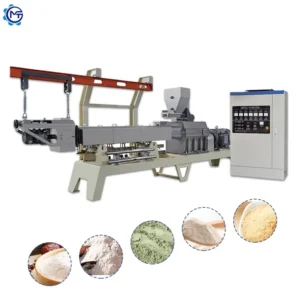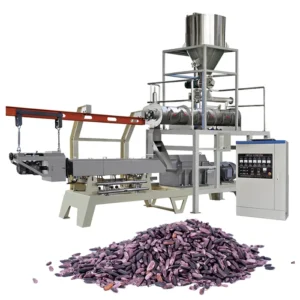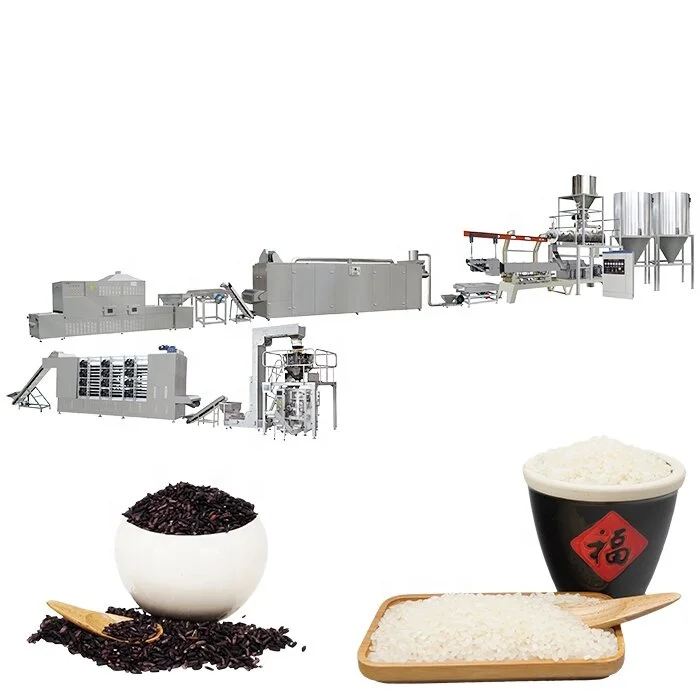
Throughput-Matched Engineering — Every station from powder mixing through extrusion to cooling is sized against the next, preventing the bottleneck that plagues lines assembled from separate vendors.
Technical Specifications
| Parameter | Value |
|---|---|
| Product Type | Fortified Rice Processing Line |
| Output Capacity | 200 kg/h (basis not stated in source — confirm raw material formulation / moisture content) |
| Extruder Type | Twin-screw |
| Extruder Main Drive Power | 110 kW (frequency control) |
| Extruder Feeder Power | 1.5 kW (frequency control) |
| Extruder Cutter Power | 2.2 kW (frequency control) |
| Extruder Oil Pump Power | 0.75 kW |
| Screw Length | 2500 mm |
| Mixing Machine Power | 15 kW |
| Mixing Batch Capacity | 130–150 kg/batch |
| Mixing Tank Thickness | 1.5 mm stainless steel |
| Mixing Cover Thickness | 1.2 mm |
| Vibrating Screen Power | 0.2 kW |
| Vibrating Screen Dimension | 1700 × 1210 × 740 mm |
| Dryer Heating Type | Electric (gas / diesel / steam available on request) |
| Cooling Dryer Power | 2.2 kW |
| Cooling Dryer Dimension | 5000 × 1500 × 1900 mm |
| Control System | Frequency control on main drives |
| Certification | CE |
Application Suitability
| Application | Material or Output |
|---|---|
| Vitamin- and mineral-fortified rice production | Rice flour blended with micronutrient premixes |
| Artificial or reconstituted rice manufacturing | Rice flour and starch blends |
| Nutritional staple food formats | Fortified grain formulations for institutional distribution |
| Breakfast cereal and health-food expansion | Starch-based rice grain shapes via interchangeable dies |
What "200 kg/h" Actually Means on Your Formulation
Rated capacity only holds when every station is balanced to your specific raw material behaviour.
I spent a week in a Southeast Asian plant watching a nutrition line choke on a micronutrient-dense formulation the original supplier never tested. The extruder ran fine on standard rice flour, but once the buyer added their trace element blend, gelatinisation shifted, the dough turned gummy, and output dropped well below the nameplate figure. That line had been quoted on a capacity number that assumed a different recipe entirely. When sourcing a fortified rice processing line equipment for sale, the capacity figure matters less than whether the supplier has validated it against your exact flour blend, moisture target, and additive ratio [NEED_CITE: raw material variability in extrusion throughput].
How Twin-Screw Configuration Handles Fortified Blends
The 110 kW twin-screw extruder at the heart of this line uses a 2500 mm screw length to give fortified rice formulations adequate residence time for complete starch gelatinisation. Frequency control on the feeder, cutter, and main drive lets operators fine-tune feed rate and screw speed independently, which is critical when switching between a plain rice flour recipe and one loaded with iron, zinc, or vitamin premixes. Each additive changes the rheology of the dough inside the barrel, and independent drive control is what keeps grain formation consistent across those recipe changes.
Matching Dryer and Cooling Capacity to Extrusion Output
A common failure point in nutritional powder processing lines is an undersized dryer that cannot keep pace with the extruder. This line pairs the twin-screw extruder with a dedicated cooling dryer measuring 5000 × 1500 × 1900 mm, providing enough belt length and airflow volume to bring moisture down to packing-safe levels before grains reach the bagging station. The vibrating screen stage between extrusion and drying, equipped with fan-assisted cooling at 0.2 kW, prevents freshly cut rice grains from sticking together before they enter the dryer — a detail that matters when grain surface moisture is high.
Reading the Specification Sheet Like a Process Engineer
Screw length directly governs how long material stays inside the barrel. At 2500 mm, this twin-screw configuration provides the shear and residence time needed for rice flour and starch blends to fully gelatinise, which determines whether the final grain holds its shape during drying or collapses into fragments. The mixing batch capacity of 130–150 kg per cycle, driven by a 15 kW motor in a 1.5 mm stainless steel tank, sets the upstream rhythm — each batch must be fully homogenised before the next one is called down to the extruder feeder, otherwise formulation drift shows up as density variation in the finished grain. Dryer heating type selection — electric, gas, diesel, or steam — affects both operating cost and temperature ramp behaviour; steam offers the most even heat distribution for high-volume continuous runs, while electric suits smaller facilities with limited boiler infrastructure [NEED_CITE: industrial dryer heating method comparison for food extrusion].
The Cost of Skipping a Trial Run
Buyers who accept shipment without a factory trial on their own raw material often discover problems during commissioning — gelatinisation degree off-spec, grain density outside market tolerance, or a formulation that simply will not extrude cleanly through the selected die. Debugging these issues on-site adds days or weeks to startup, and every day of delayed production is revenue the buyer will not recover. A trial run in the supplier’s testing workshop locks screw configuration, die selection, moisture targets, and barrel temperature zones before the line leaves the factory [NEED_CITE: pre-shipment extrusion trial run protocols].
Why Sourcing the Full Line from One Supplier Matters
Matching throughput across mixing, extrusion, drying, and cooling stations is difficult when each machine comes from a different vendor, because each supplier sizes their equipment to their own nameplate, not to the actual flow rate of the station before or after it. This line is configured as a single system where the 130–150 kg mixing batch feeds the twin-screw extruder at a rate the 5000 mm cooling dryer can handle, so no station waits idle and no station overflows. Screw and die configurations are specified to the buyer’s raw material rather than copied from a generic build, and the in-house testing workshop runs the buyer’s actual formulation before shipment to confirm grain shape, density, and gelatinisation targets are met.
Documentation & Verification
- Line layout and capacity calculation matched to your rice flour formulation and target grain specification
- Screw and die configuration record documented for your specific micronutrient blend
- Factory trial run report on your raw material before dispatch
- Electrical schematic with confirmed voltage, frequency, and control language
- CE declaration of conformity and ISO certificate for customs and regulatory filing
- Wear parts list with screw element and die replacement schedule
Installation, Commissioning & Support
- Foundation plan accounts for the 5000 × 1500 mm cooling dryer footprint and extruder vibration isolation
- Dedicated electrical circuit sized for the 110 kW extruder main drive plus all auxiliary motors
- Frequency-controlled drives calibrated on-site to match local voltage and Hz supply
- Barrel temperature zones and screw speed profiles set during first production run with your formulation
- Operator training covers die changeover procedure for different rice grain sizes and shapes
- Spare screw elements and dies stocked against the documented wear parts list
What to Include in Your Inquiry
Provide your rice flour source, micronutrient premix composition, and target moisture content so the line can be configured and trial-run on material that matches your production reality. Specify your factory voltage, frequency, and preferred control language to avoid rewiring or reprogramming during commissioning. Confirm your target rice grain dimensions and whether you need multiple die plates for product variety on the same fortified rice processing line equipment for sale.
Frequently Asked Questions
Q: What raw material formulations and moisture levels is the 200 kg/h capacity based on?
A: The rated output depends on your specific rice flour blend, micronutrient additives, and target moisture content. Capacity can shift when formulation changes alter dough rheology inside the barrel. We validate throughput during a trial run on your actual raw material in the testing workshop, and the confirmed figure is documented before shipment.
Q: Which dryer heating type best fits my factory utilities?
A: Electric heating suits facilities without boiler infrastructure, while steam provides the most even heat for continuous high-volume runs. Gas and diesel options are available for regions where those fuels are cost-advantaged. The choice affects temperature ramp speed and operating cost, so we confirm your local utility availability before specifying the dryer.
Q: Can the die configuration produce different rice grain sizes on the same line?
A: Yes. The twin-screw extruder accepts interchangeable die plates, and the cutter speed is frequency-controlled to match different grain lengths. During the trial run we test each die option against your formulation and document which screw configuration pairs with each grain shape for consistent density and gelatinisation.
Q: How is throughput balanced across mixing, extrusion, drying, and cooling?
A: Each station is sized to the actual flow rate of the station before and after it. The 130–150 kg mixing batch cycle is timed to the extruder feed rate, and the 5000 mm cooling dryer belt length provides sufficient residence time to handle the extruder output without backlog. This prevents both idle time and material overflow at any point.