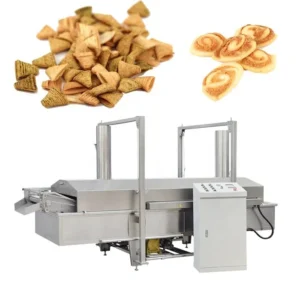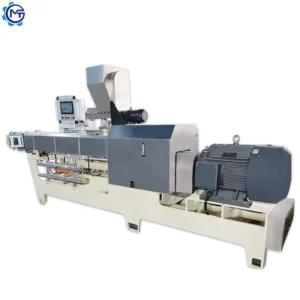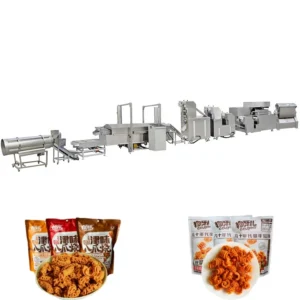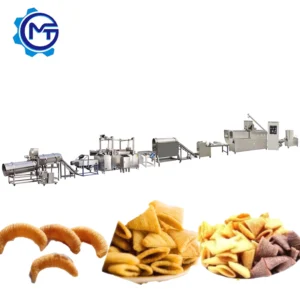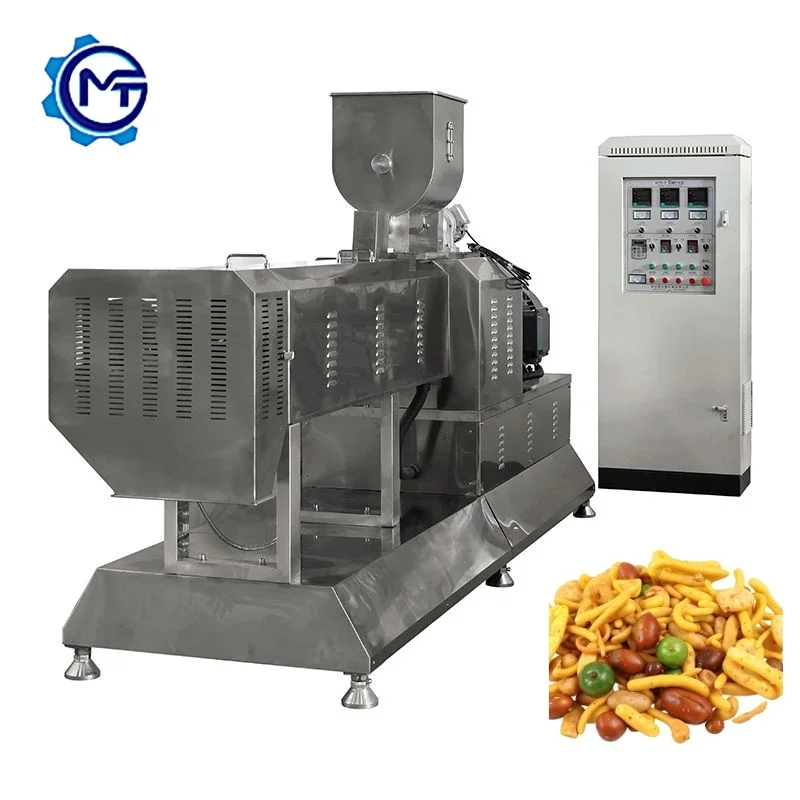
Balanced Throughput Across Every Station — A snack frying line only works when the fryer keeps pace with the extruder, so this unit is sized and configured to match upstream and downstream output rather than sold as an isolated machine.
Technical Specifications
| Parameter | Value |
|---|---|
| Product Type | Continuous Deep Fryer for Snack Production Line |
| Heating Method | Electricity / Gas (configurable) |
| Rated Power | 60 kW heating tube power (source value — verify against manufacturer catalog) |
| Drive Power | 2.6 kW |
| Voltage & Frequency | 380V / 50Hz (configurable to site requirements) |
| Control System | PLC |
| Oil Capacity | 320 L |
| Output Capacity | 100–1000 kg/h (basis not stated in source — confirm raw material type, moisture content and product format) |
| Overall Dimensions (L×W×H) | 6700 × 2200 × 1200 mm |
| Net Weight | 2000 kg |
| Construction Material | Food-grade 304 Stainless Steel |
| Belt System | Upper and lower double-layer mesh belt with frequency conversion stepless speed regulation |
| Oil Filtration | Continuous oil circulation filtration system |
| Slag Discharge | Bottom-mounted residue discharge system |
| Lifting System | Automatic lifting of upper hood and mesh belt for cleaning |
| Assembly State | Fully assembled continuous line unit |
| Warranty | 1 Year (core components: 1 Year) |
| Standards | CE; ISO; Machinery Test Report provided; Video outgoing-inspection provided |
Application Suitability
| Application | Material or Output |
|---|---|
| Extruded pellet snack frying | Corn, potato, and wheat-based snack pellets before de-oiling and flavouring |
| Nimko production | Fried traditional nimko from dough-based formed pieces |
| Fried chip processing | Sliced or formed potato, sweet potato, and plantain chips |
| Integrated snack line | Continuous operation between extrusion or forming upstream and de-oiling downstream |
Why Frying Capacity Often Becomes the Line Bottleneck
A continuous deep fryer for sale might quote an attractive hourly number, but that figure means little if the fryer cannot absorb the full output of your extruder or forming station on the product you actually run.
I have seen snack producers invest in high-output extruders only to find the fryer running two shifts just to keep up, while raw pellets pile up on the cooling belt losing moisture and texture. [NEED_CITE: throughput mismatch between extrusion and frying stages in snack processing] The issue is rarely the machine itself but the failure to match fryer belt speed, oil volume, and heat recovery rate to the specific product density and moisture content entering the oil bath. A 100–1000 kg/h range on paper covers an enormous spread — the real question is where your product falls within it once oil temperature, immersion time, and product load are factored in.
Oil Temperature Recovery and Product Load
When cold or room-temperature pellets enter hot oil, the temperature drops. The 60 kW heating system is designed to recover that loss quickly so the oil stays within the target range throughout the frying zone. With a 320 L oil volume and continuous circulation, thermal mass helps stabilise temperature between product batches, though actual recovery speed depends on product moisture and feed rate — variables that differ between nimko, extruded pellets, and sliced chips.
Mesh Belt Control and Fry Time Consistency
The upper and lower double-layer mesh belt keeps product fully submerged, which matters because floating pieces fry unevenly. Frequency-controlled stepless speed regulation means the operator adjusts belt travel speed to dial in exact fry time. This is critical when switching between products — a dense nimko piece needs a longer oil residence than a thin extruded pellet, and the continuous deep fryer for sale must accommodate both without manual intervention.
Oil Life and Filtration Under Continuous Use
Snack frying generates fine particulates and free fatty acids that degrade oil quality. The continuous oil circulation filtration system removes sediment in real time, and the bottom-mounted residue discharge pulls heavier slag before it carbonises on heating elements. [NEED_CITE: oil degradation rates in continuous industrial frying operations] Extending oil service life is not just a cost issue — burnt sediment creates dark spots on product surfaces and off-flavours that customers notice immediately.
How Core Parameters Shape Your Frying Results
The 6700 mm overall length defines the frying zone, which together with belt speed determines maximum residence time in oil. For products requiring extended frying — dense dough pieces or thicker chips — a longer belt path ensures thorough cooking without raising oil temperature to the point where surface browning outpaces internal moisture removal. The PLC control system ties belt speed, oil temperature, and filtration cycle into one interface, reducing the operator variables to monitor during shift changes or product changeovers. Food-grade 304 stainless steel construction handles the combination of hot oil, steam, and daily washdown without corrosion, which matters in a facility running multiple shifts where cleaning chemistry is aggressive. Voltage configurable to site requirements ensures the heating elements deliver rated output — undersized supply voltage reduces heating capacity and slows recovery. [NEED_CITE: industrial voltage tolerance requirements for food processing machinery]
What Happens When the Fryer Is Undersized for Your Line
If the fryer cannot match your extruder output, you face a choice: slow the entire line down, or let product accumulate and degrade before frying. Neither option is acceptable in continuous production. I worked with a producer whose batch fryer created a two-hour backlog of extruded pellets — by the time they reached the oil, surface moisture had dropped and the fried product came out darker and harder than specification. Continuous frying eliminates that gap, but only if the unit is specified against actual product load rather than nominal capacity. [NEED_CITE: effects of pre-fry moisture loss on final snack texture]
Procurement Advantages Beyond the Machine Itself
This continuous deep fryer for sale is designed as part of a complete snack line, meaning throughput is calculated against upstream extrusion or forming capacity and downstream de-oiling and flavouring stations. The screw and die configuration upstream, fryer belt speed, and seasoning drum rotation are all matched before the line ships. An in-house testing workshop allows trial runs on the buyer’s actual raw material before dispatch, catching density and moisture issues early. Pre-sales consultation covers line layout and utility planning so the fryer footprint, exhaust requirements, and oil supply connections are confirmed before installation begins. Ongoing maintenance support includes wear parts availability — mesh belt sections, heating elements, and filtration components — so the first replacement does not require a long procurement cycle.
Documentation & Verification
- Line layout showing fryer throughput matched to upstream extruder and downstream de-oiling stations
- Machine specification sheet confirming voltage, frequency, and PLC language for target market
- Machinery test report documenting oil temperature stability and belt speed range before dispatch
- Video outgoing-inspection recording fryer operation on buyer’s specified product format
- Wear parts list covering mesh belt sections, heating elements, and filtration media
- CE declaration of conformity and ISO certificate for import clearance
Installation, Commissioning & Support
- Floor plan accounting for 6700 × 2200 mm footprint with clearance for hood lifting and maintenance access
- Dedicated electrical circuit sized for 60 kW heating load plus 2.6 kW drive at confirmed site voltage
- Unit arrives fully assembled; oil fill, heating element check, and PLC parameter verification on site
- First production run supervised to set belt speed, oil temperature, and filtration cycle for target product
- Operator training covering daily oil filtration, residue discharge, and automatic hood lifting procedure
- Spare mesh belt sections and heating elements shipped with initial order for first replacement cycle
What to Share Before Requesting a Quote
To configure this fryer correctly within your line, the most useful starting points are the specific snack product format, raw material composition, and moisture content entering the fryer. Share your local voltage and frequency, plus the control language your operators need. If the fryer is joining an existing line, provide the output rate of your extruder or forming station so the belt speed and oil volume can be matched accordingly.
Frequently Asked Questions
Q: How is the fryer output capacity verified against a specific snack product?
A: Output depends on product density, moisture content entering the oil, and target fry level. We run trial batches in the testing workshop using the buyer’s actual raw material to measure real throughput on the mesh belt before the line ships, rather than relying on generic capacity ranges.
Q: What voltage and PLC language options are confirmed before shipment?
A: Voltage and frequency are confirmed against the buyer’s site electrical supply during the specification stage. The PLC interface language is set to match the operator team’s preference, and the electrical schematic is provided in advance so local electricians can prepare connections before the unit arrives.
Q: How is the fryer matched to upstream and downstream stations?
A: Belt speed and oil volume are calculated against extruder or forming station output so product does not accumulate before frying. Downstream, the fryer discharge rate is balanced with de-oiling and flavouring drum capacity to maintain continuous flow through the entire line.
Q: What installation footprint and utility connections are required?
A: The unit occupies 6700 × 2200 mm with additional clearance needed for the automatic hood lifting mechanism. A dedicated circuit must supply the configured heating load, and exhaust ventilation must be planned for steam and oil vapour removal above the frying zone.