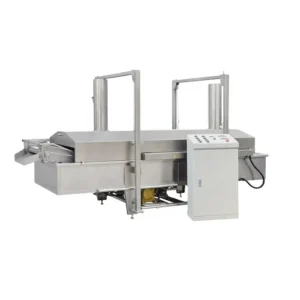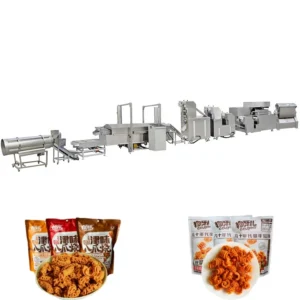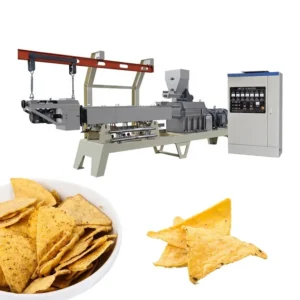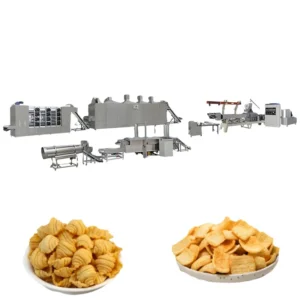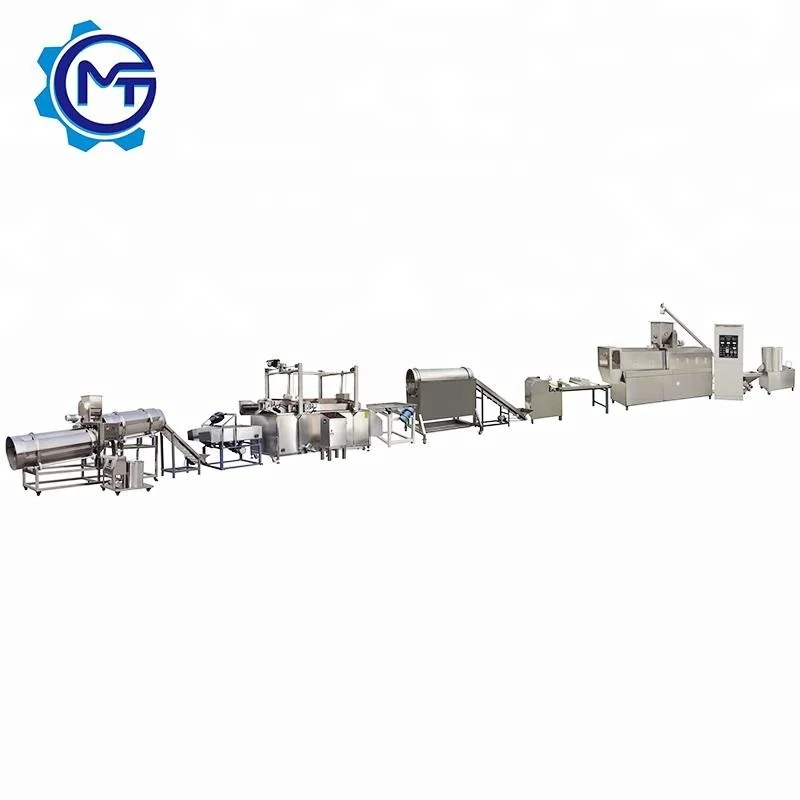
Matched Throughput Across Stations — Every component from the powder mixer through the twin-screw extruder to the fryer and flavouring drum is engineered under one roof, ensuring the MT65, MT70, MT85, MT75, and MT95 configurations deliver balanced capacity without intermediate bottlenecks.
Technical Specifications
| Parameter | Value |
|---|---|
| Model | MT65 / MT70 / MT85 / MT75 / MT95 |
| Product Type | Fried Puffs Snack Food Production Line |
| Installed Power | MT65: 142 kW; MT70: 185 kW; MT85: 240 kW; MT75: 245 kW; MT95: 370 kW |
| Actual Power Consumption | MT65: 100 kW; MT70: 130 kW; MT85: 180 kW; MT75: 185 kW; MT95: 280 kW |
| Output Capacity | MT65: 120–150 kg/h (basis to be confirmed); MT70: 200–250 kg/h (basis to be confirmed); MT85: 300–500 kg/h (basis to be confirmed); MT75: 400–500 kg/h (basis to be confirmed); MT95: 800–1000 kg/h (basis to be confirmed) |
| Overall Dimensions (L×W×H) | MT65: 22000×1200×2200 mm; MT70: 24000×1500×2400 mm; MT85: 26000×1500×2300 mm; MT75: 26000×1500×2800 mm; MT95: 30000×1500×2800 mm |
| Extruder Screw Type | Twin-screw (Double Screw Extruder) |
| Extruder Main Motor Power | 30 kW (MT70 unit) |
| Powder Mixer Tank Volume | 150 kg per batch |
| Powder Mixer Rotary Speed | 385 rpm |
| Powder Mixer Mixing Time | 10 min per batch |
| Fryer Temperature Range | 0–260 °C |
| Fryer Dimensions | 4500 × 1350 × 2350 mm |
| Flavor Line Output | 400 kg/h |
| Control System | PLC and MCC control |
| Material of Construction | Food-grade stainless steel |
| Warranty | 1 year complete warranty |
| Certification | CE, ISO |
Application Suitability
| Application | Material or Output |
|---|---|
| Bugles and tortilla chip production | Corn flour, wheat flour, and masa blends |
| Rice crust and cracker snacks | Rice flour, glutinous rice, and starch bases |
| Shaped fried puffs (sala, golden corners, small fish crisps) | Compound flour blends with varying protein and starch ratios |
| Pellet-based snack formats (triangles, ducks, Christmas trees) | Potato starch, tapioca, and wheat-based pellet raw materials |
| Fortified extruded snacks | Flour bases blended with nutritional premixes |
Why Nominal Capacity Numbers Fail on Real Raw Material
A fried puffs snack food making machine full equipment range quoted on paper capacity often underdelivers the moment the buyer switches from standard test flour to their own formulation. The gap between catalogue output and actual throughput is almost always a screw configuration and moisture mismatch, not a mechanical defect. I have watched lines stall because the extruder was tuned for corn grits while the factory planned to run high-amylopectin potato flour, causing the extrudate to collapse before it ever reached the fryer. When expansion drops, oil absorption spikes, and the chips emerge soft rather than crisp [NEED_CITE: starch gelatinisation behaviour across tuber and cereal flours]. Verifying throughput against the buyer’s specific blend is not optional — it is the entire reason an in-house testing workshop exists.
Station Matching Across the Full Equipment Range
When sourcing a fried puffs snack food making machine full equipment range, buyers typically compare extruder output against fryer capacity as a single ratio. The reality is more layered. The powder mixer must complete a batch within the cycle time the extruder demands, the conveying system must move product without breaking the fragile extrudate, and the flavouring drum must coat at a rate the dryer can sustain. A mismatch at any one station backs up the entire line. This configuration pairs each MT-series extruder model with a corresponding mixer, fryer, and flavour station sized to the same throughput band, so no single unit governs the ceiling.
Screw and Die Specification Over Generic Templates
Extruder builders frequently copy a screw and die layout from a previous customer and apply it to the next order unchanged. For fried snack formats, the screw pitch, compression ratio, and die aperture collectively determine how much mechanical energy transfers into the dough. Potato-heavy blends need longer residence and gentler shear than pure corn, otherwise the gelatinised starch matrix tears before it exits the die. Each configuration here is specified against the buyer’s declared raw material and target shape, with the screw elements sequenced and the die drilled to match [NEED_CITE: twin-screw element arrangement for high-moisture snack doughs].
Reading the Power and Dimension Data
The installed power figures — from 142 kW on the MT65 up to 370 kW on the MT95 — represent the total connected load across every motor and heater on the line, while actual consumption runs lower because not all elements draw simultaneously. The extruder main motor alone accounts for a significant share; on the MT70 it is rated at 30 kW with actual draw between 30 and 35 kW depending on dough viscosity and screw speed. Line length scales with model: the MT65 fits within roughly 22 metres, while the MT95 extends to 30 metres. Buyers planning floor layout should account for the fryer’s 4500 mm length and the flavour line’s 3000 mm footprint as fixed points around which conveying runs must route. The PLC and MCC control architecture centralises these stations into one interface rather than requiring operators to adjust each unit independently.
The Hidden Cost of Assembling from Separate Vendors
Purchasing an extruder from one supplier and a fryer from another often creates a capacity step that only reveals itself during commissioning. The extruder may deliver product faster than the fryer can handle at the required oil temperature, forcing the operator to throttle the extruder down and lose the output they paid for. Conversely, an undersized flavouring drum leaves product passing through without adequate coating contact time. These imbalances compound: higher oil degradation from product backlog, uneven seasoning, and increased reject rates [NEED_CITE: line throughput bottleneck effects in snack food processing].
Why Procurement Through This Catalogue Works
Every station in the fried puffs snack food making machine full equipment range comes from a single manufacturer, meaning throughput calculations are performed across the complete chain before the quotation is issued. Screw configurations and die designs are not carried over from a generic library; they are specified against the buyer’s raw material sample. An in-house testing workshop runs the buyer’s actual flour blend before shipment, generating a trial report that confirms expansion, density, and fry behaviour. CE and ISO certifications cover the full assembly, not just the extruder in isolation. Pre-sales consultation extends through layout engineering, voltage confirmation, installation, and ongoing wear-part supply for screws and dies.
Documentation & Verification
- Line layout and capacity calculation showing matched throughput across mixer, extruder, fryer, and flavour drum
- Screw and die configuration record tied to buyer’s declared flour blend and target snack shape
- Trial run report on customer raw material produced in the testing workshop before dispatch
- Electrical schematic with voltage and frequency confirmed for the destination market
- CE declaration of conformity covering the complete line assembly
- Operation and maintenance manual with wear parts list for screws, dies, and fryer belts
Installation, Commissioning & Support
- Floor space planning based on the selected model’s overall length, from 22 m (MT65) to 30 m (MT95)
- Dedicated electrical circuit sized to the model’s installed power, up to 370 kW for the MT95
- Assembly sequence starting with extruder and fryer positioning before conveying links are installed
- PLC and MCC parameter setup during first run, including barrel zone temperatures and screw speed profiles
- Operator training covering screw element replacement and die changeover for shape variation
- Wear parts inventory recommendation for screws, dies, and fryer mesh belts based on production schedule
Preparing Your Enquiry
To move from a catalogue review to a line proposal, share the specific flour or starch blend you plan to run, including any potato, tapioca, or rice flour proportions. Confirm your local voltage and frequency so the MCC and control panels can be built to match, and note whether PLC interface language needs to be configured for your operators. If you have existing upstream batching or downstream packing equipment, provide the connection heights and throughput expectations so the conveying interfaces align.
Frequently Asked Questions
Q: How is output capacity verified against my specific raw material and product shape?
A: Before shipment, your flour blend is run through the twin-screw extruder in the in-house testing workshop. The trial records expansion ratio, extrudate density, and post-fry texture for your target shape. A written report accompanies the line, confirming which screw configuration and moisture setting achieved the result, so commissioning starts from a known baseline rather than from generic defaults.
Q: What screw and die configuration will be matched to my flour blend and target snack format?
A: The screw elements are sequenced based on your raw material’s starch and protein content. High-potato blends typically need longer compression zones and wider die apertures than pure corn formulations. The die is drilled to match your target shape — bugle, triangle, rice crust, or custom profile — and the configuration record is documented for future reference and repeat orders.
Q: How do you ensure the fryer and flavouring drum capacity matches the extruder output?
A: Each station is sized as a matched set during the layout phase. The fryer’s belt speed and oil volume are calculated against the extruder’s confirmed throughput on your material, and the flavouring drum’s rotation rate and residence time are set to coat at the same rate. The capacity calculation document shows every station’s rated flow so no single unit bottlenecks the chain.
Q: Can I run a trial on my own raw material before the line ships?
A: Yes. You send a sample of your production flour blend to the testing workshop, and the line configuration is assembled for a trial run. You receive the extruded and fried product sample along with a report detailing screw speed, barrel temperatures, moisture addition, and die used, giving you confidence the line will perform on your material from day one.