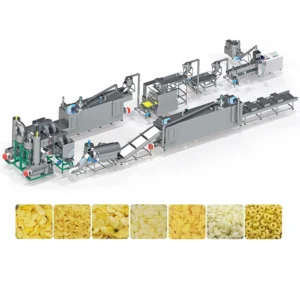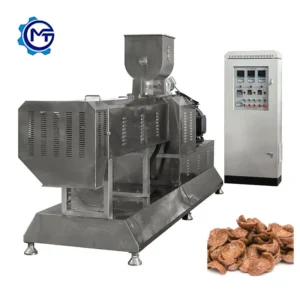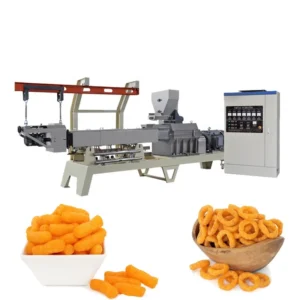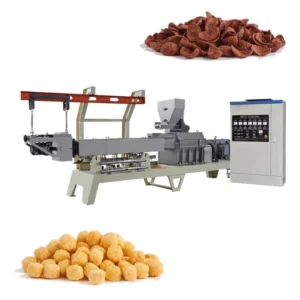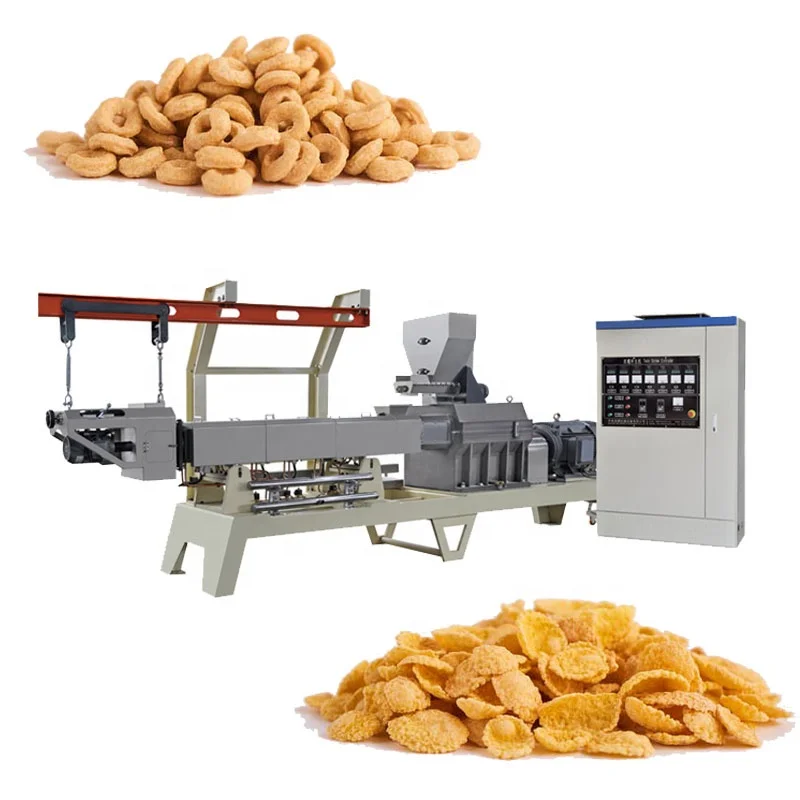
Matched Line Throughput — Every station from mixing to packing is specified to run at the same verified capacity, so your corn flakes line never stalls at a bottleneck created by mismatched equipment.
Technical Specifications
| Parameter | Value |
|---|---|
| Product Type | Corn Flakes and Breakfast Cereals Production Line |
| Model Options | MT70 / MT85 / MT75 |
| Screw Type | Twin-screw |
| MT70 Installed Power | 160 kW |
| MT70 Power Consumption | 120 kW |
| MT70 Output Capacity | 150–200 kg/h (basis not stated in source — confirm raw material, moisture content, and product format) |
| MT70 Overall Dimensions | 41 × 1.5 × 2.2 m |
| MT85 Installed Power | 190 kW |
| MT85 Power Consumption | 140 kW |
| MT85 Output Capacity | 300–400 kg/h (basis not stated in source — confirm raw material, moisture content, and product format) |
| MT85 Overall Dimensions | 43 × 1.5 × 3.2 m |
| MT75 Installed Power | 210 kW |
| MT75 Power Consumption | 150 kW |
| MT75 Output Capacity | 300–500 kg/h (basis not stated in source — confirm raw material, moisture content, and product format) |
| MT75 Overall Dimensions | 45 × 1.5 × 3.5 m |
| Extruder Working Principle | Feeding, extruding, cutting, heating, gearing, and controlling systems |
| Extruder Feature | Automatic lubricating and cooling function |
| Flaking Machinery Control | PLC control system, hydraulic system for double rollers, double motors for separate roller driving, infrared sensor temperature control |
| Dryer Heating Source | Gas or Electric (configurable) |
| Hot Air Roasting Oven | Vibrating pan with high-temperature spraying tubes, conciliation burner, dual circulating fans, cyclone dust removal |
| Coating System | Double tumble for sugar melting, elevator, coating drum, spraying nozzle |
| Control System | PLC |
| Standards | CE, ISO |
Application Suitability
| Application | Material or Output |
|---|---|
| Natural corn flakes production | Corn grits and corn flour blends |
| Sugar-coated corn flakes | Corn base with sugar syrup coating |
| Variety-shaped breakfast cereals | Rice, wheat, oat, and barley powder mixes |
| Fruit loops and ring cereals | Multi-grain flour with sugar glaze |
| Partial line for extruded snacks | Corn, rice, and oat-based formulations |
What Capacity Numbers Leave Out When Raw Materials Change
A line rated on standard corn flour behaves differently the moment oats enter the mix.
I remember a breakfast cereal project where our workshop trial ran perfectly on pure corn grits, yet the same corn flakes machine full equipment range struggled at the customer’s site because their actual recipe contained a significant oat percentage. The flakes collapsed after flaking, thickness varied across the batch, and it took two weeks of on-site screw and temperature adjustments to recover. Capacity figures quoted on a single reference material rarely survive contact with real production recipes, and assuming they will is where most commissioning delays begin [NEED_CITE: impact of oat inclusion on extrusion expansion and flake integrity].
Station Matching Across the Breakfast Cereal Production Line Equipment
A corn flakes machine full equipment range only delivers its rated throughput when every station — mixing, extruding, flaking, drying, roasting, sugar coating, cooling, and packing — is sized to handle the same mass flow. When the dryer is undersized relative to the extruder, wet flakes pile up and lose crispness before they reach the roasting oven. The line we supply is configured so that each piece of breakfast cereal production line equipment passes product forward without queuing, which is the difference between a steady run and a shift spent clearing blockages.
How the Hot Air Roasting Oven Controls Final Texture
The roasting stage determines whether flakes arrive at the packing station crisp or leathery. Our hot air roasting oven uses a conciliation burner paired with two independent circulating fans and a cyclone dust removal device, giving operators separate control over heat intensity and air velocity across the vibrating pan. This level of regulation matters when you switch between natural and sugar-coated variants in the same shift, because sugar-coated flakes scorch at temperatures that barely toast a natural flake [NEED_CITE: Maillard reaction temperature thresholds in cereal roasting].
Reading the Specs: What Actually Affects Your Daily Run
The twin-screw extruder in this line runs with automatic lubricating and cooling, which directly influences how long you can push continuous shifts before stopping for barrel temperature stabilization. Installed power ranges from 160 kW on the MT70 to 210 kW on the MT75, and the gap between installed and consumed power tells you how much thermal and mechanical headroom exists for heavier formulations. The flaking machinery uses a hydraulic system with double motors driving each roller independently, letting you set different gap pressures for thick-cut versus thin-cut flakes without changing hardware. Infrared sensor temperature control on the flaking rollers means the surface temperature stays within a narrow band, preventing the edge-of-flake sticking that shows up when roller heat drifts during a long run.
The Cost of Mismatched Downstream Equipment
When the extruder pushes product faster than the coating drum can tumble, you end up with partially glazed flakes that fail quality checks and must be reworked or scrapped. I have walked into plants where the roasting oven sat idle half the shift because the dryer upstream could not deliver enough dried flakes to keep it fed, effectively cutting line output without anyone touching the extruder speed. These imbalances are invisible in individual machine spec sheets and only appear when the full breakfast cereal production line equipment runs together under real conditions [NEED_CITE: throughput imbalance losses in multi-stage food processing lines].
Why Source the Entire Corn Flakes Line from One Supplier
Matching throughput across every station is only possible when one party owns the line layout and capacity calculation from the start. We specify screw configuration and die design against your actual raw material rather than a generic template, and we run your material in our testing workshop before the equipment ships. The PLC control system across the corn flakes machine full equipment range means one operator interface covers mixing ratios through packing weight, reducing the handoff errors that occur when each station speaks a different control language. Electrical schematics are confirmed to your site voltage and frequency before production begins, so commissioning is not delayed by a transformer mismatch. Wear parts lists for screws, dies, and flaking rollers ship with the line, and replacements are sourced from the same facility that built your machine.
Documentation & Verification
- Line layout and capacity calculation matched to your factory footprint and target output
- Machine specification sheet with screw and die configuration recorded for your raw material
- Electrical schematic confirming voltage, frequency, and PLC language for your market
- Trial run report on customer-supplied raw material from our in-house testing workshop
- CE declaration of conformity and ISO certificate with full packing photographs
- Operation and maintenance manual with wear parts list for extruder and flaking stations
Installation, Commissioning & Support
- Foundation and floor space planned around MT75 overall dimensions of 45 × 1.5 × 3.5 m
- Dedicated electrical circuits sized for up to 210 kW installed power at confirmed voltage and frequency
- Extruder barrel and screw assembly performed on site with alignment verification before first run
- PLC control system parameters set and calibrated using your actual raw material during commissioning
- Operator training covering screw configuration changes, flaking gap adjustment, and roasting temperature profiles
- Spare wear parts including screws, dies, and flaking rollers cataloged and available for reorder
Before You Request a Quote
To configure the right breakfast cereal production line equipment for your facility, we need your target product format, the raw material blend you plan to run (including any oat, barley, or multi-grain additions), your expected daily output, and the voltage and frequency standard at your plant. If you can ship us a sample of your actual production flour, we will run it through our testing workshop and base the line proposal on real data rather than assumptions.
Frequently Asked Questions
Q: How is the output capacity verified, and what conditions does it assume?
A: The capacity figures listed for the MT70, MT85, and MT75 are reference ranges. Actual throughput depends on your specific raw material blend, moisture content, and target flake format. We verify capacity by running your supplied raw material in our testing workshop and documenting the result before the line is finalized for production.
Q: How are extruder, dryer, and coating stations matched to prevent bottlenecks?
A: Each station is selected based on the mass flow calculated from your target output. The dryer capacity is set to handle peak extruder discharge, the roasting oven is sized for the dried flake volume, and the coating drum tumble speed is synchronized so no station queues product from another.
Q: What voltage, frequency, and control language options are confirmed before shipping?
A: We confirm your site voltage and frequency during the proposal stage and record them on the electrical schematic. The PLC control system is programmed in your preferred operator language before factory testing, so the interface is ready the moment the line powers up at your facility.
Q: Can this line produce cereal formats beyond standard corn flakes?
A: Yes. By adjusting the extruder die, the same line can produce ball, tube, ring, star, and other shapes. Some formats use a partial line configuration that skips the flaking station, and we specify which stations are active for each product in your line layout document.
Q: What spare wear parts ship with the line, and how are replacements sourced?
A: The initial shipment includes a documented wear parts list covering extruder screws, dies, and flaking roller components. Replacement parts are manufactured at the same facility that built your line, ensuring dimensional compatibility when the first changeover is due.