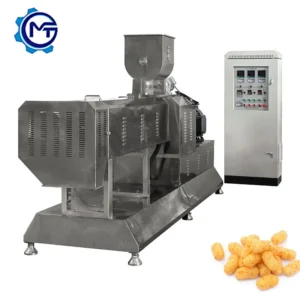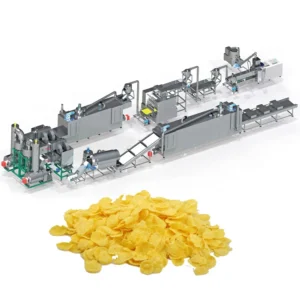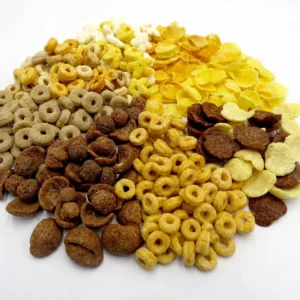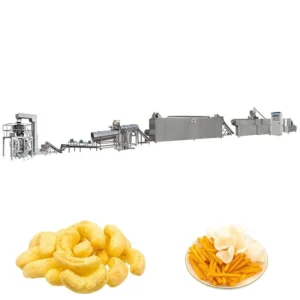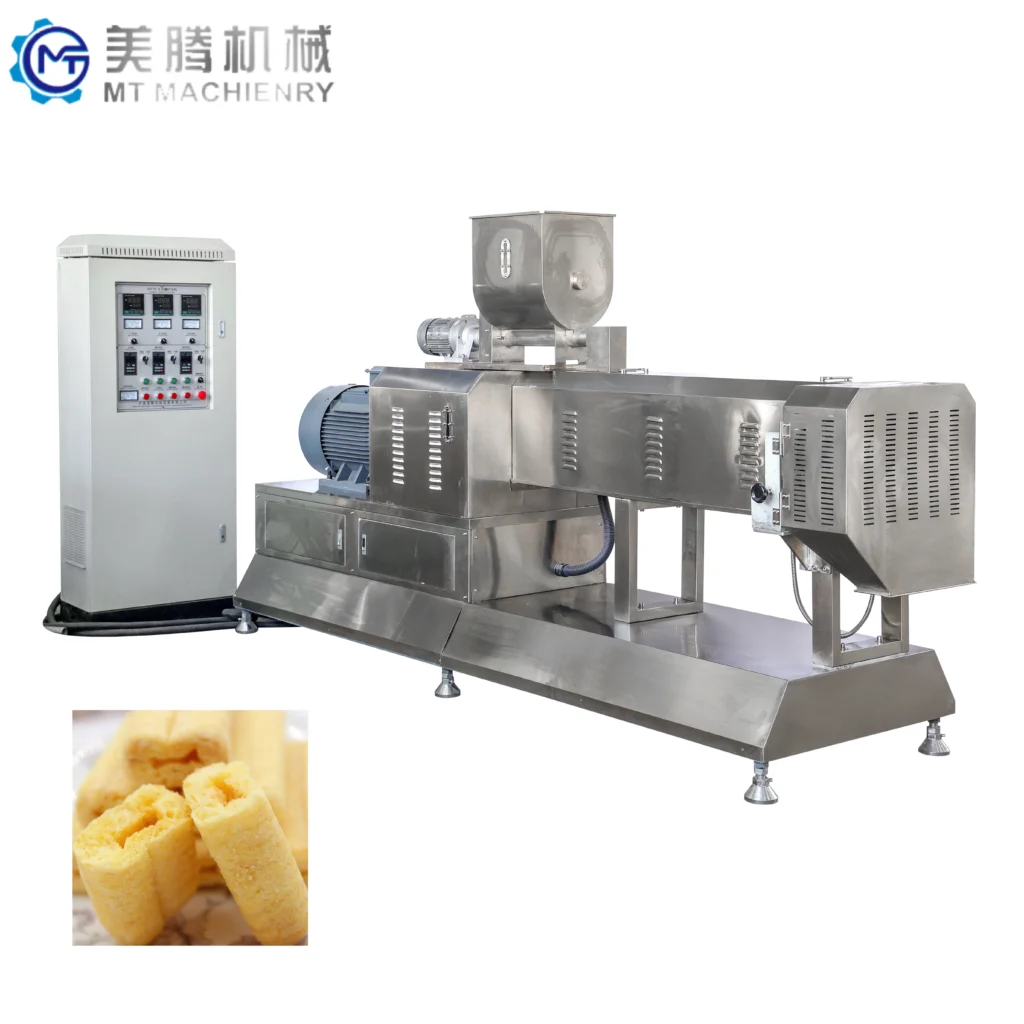
Station-Matched Line Design — Every station from mixing through packing is sized to the extruder’s real output so no bottleneck appears on the corn puff snack food machines full equipment range.
Technical Specifications
| Parameter | Value |
|---|---|
| Product Type | Twin Screw Extruder Corn Puff Snack Production Line |
| Models Available | MT65, MT70, MT85, MT100 |
| Screw Type | Twin Screw |
| Installed Power | MT65 — 130 kW; MT70 — 180 kW; MT85 — 220 kW; MT100 — 240 kW |
| Real Consumption | MT65 — 95 kW; MT70 — 120 kW; MT85 — 130 kW; MT100 — 160 kW |
| Output Capacity | MT65 — 120–150 kg/h (basis not stated in source); MT70 — 200–300 kg/h (basis not stated in source); MT85 — 300–500 kg/h (basis not stated in source); MT100 — 600–800 kg/h (basis not stated in source) |
| Speed Control | Frequency speed controlling system |
| Lubrication | Automatic lubricating and cooling system |
| Line Stations | Mixing → Batching → Extruding → Drying → Coating / Flavoring → Cooling → Packing → Stacking |
| Dryer Heating Source | Electric / Steam / Gas (configurable to local conditions) |
| Flavoring System | Double drum flavoring line with sugar melting and spraying nozzle |
| Core Filling Option | Available with added core filling machine and cutting machine |
| Die Configuration | Interchangeable dies (cheese ball, tube, stick, ring, fruit loop, star, wheel, flower, heart, etc.) |
| Raw Materials | Corn, rice, wheat, oat, barley flour, etc. |
| Warranty | 1 year |
| Delivery Time | Approx. 20 working days (extruder line); approx. 35 working days (with packing and stacking) |
| Standards | CE certified, ISO certified |
Application Suitability
| Application | Material or Output |
|---|---|
| Corn puffs and cheese balls | Corn flour, corn grits, rice flour blends |
| Extruded rings, sticks and tubes | Wheat flour, oat flour, multi-grain blends |
| Fruit loops and star shapes | Corn and rice flour with sugar coating |
| Core-filled puffed snacks | Grain flour shell with cream, chocolate or jam filling |
| Multi-grain extruded snacks | Barley, oat, wheat and corn composite formulations |
Why the Nameplate Capacity Rarely Survives Contact With Your Raw Material
Real throughput depends on the exact flour blend, moisture level and fat content running through the barrel — not on the number painted on the machine.
A buyer once specified a twin screw extruder based on a published output figure, only to find the line stalled well below that number once their local corn grits — slightly higher in fat than the test standard — entered the hopper. The downstream dryer then sat half-empty while the extruder struggled to maintain pressure. Mismatched station capacity is one of the most common reasons new snack lines underperform in the first six months [NEED_CITE: common causes of extrusion line underperformance in first-year operation]. Sourcing the corn puff snack food machines full equipment range from a single supplier means the mixer, dryer and flavoring drums are all calculated against the same raw material profile rather than pulled from generic catalog pages.
How Screw Geometry Meets Raw Material Behaviour
The twin screw configuration on MT65 through MT100 models allows the screw elements to be rearranged along the shaft, changing the shear profile and residence time inside the barrel. Corn flour gelatinises at a different temperature window than oat or barley flour, so the barrel heating zones and screw pitch must be set to match. When a buyer switches from a pure corn recipe to a multi-grain blend, the frequency speed controlling system adjusts screw RPM to maintain expansion without altering the die. This flexibility is what lets a single corn puff snack food machines full equipment range cover cheese balls, rings and core-filled formats without a second extruder.
Matching the Dryer and Flavoring Drums to Extruder Output
An extruder that pushes product faster than the dryer can remove moisture will leave puffs soft and prone to collapse during packing. The dryer on this line is specified after the extruder model is chosen, with belt length and heating source — electric, steam or gas — selected to hold the required dwell time at the confirmed throughput. Downstream, the double drum flavoring line with sugar melting and spray nozzle applies coating evenly across the full output band, preventing the under-seasoned batches that appear when a drum is undersized [NEED_CITE: flavoring drum capacity matching in snack extrusion lines]. Cooling conveyors then bring the product to ambient temperature before packing, avoiding condensation inside the bag.
Reading the Specification Sheet Beyond the Headline Numbers
Installed power and real consumption tell different stories. The MT85, for example, carries 220 kW of connected load but draws around 130 kW during steady-state extrusion — the gap accounts for start-up surges, heater ramp-up and the automatic lubricating and cooling system that circulates oil through the gearbox during operation. Interchangeable dies determine the final product shape, but die selection also affects back-pressure inside the barrel; a small-orifice die for thin sticks creates more resistance than a large cheese ball die, which in turn influences motor load and barrel temperature settings. Understanding these relationships before commissioning prevents the trial-and-error phase that otherwise consumes the first week of production.
The Cost of Skipping the Pre-Shipment Trial Run
Lines that ship without a test run on the buyer’s actual raw material often require days of on-site adjustment, with the extruder die changed multiple times before expansion and density reach specification. During that period, the dryer runs empty, the flavoring drums sit idle and the packing line waits — every station is paid for but not earning. A trial run in the supplier’s testing workshop catches screw configuration mismatches, confirms the right die geometry and produces a baseline report the buyer can reference during commissioning [NEED_CITE: benefits of pre-shipment extrusion trial runs on buyer raw material]. Skipping this step is the single largest avoidable cost in turnkey snack line projects.
Why Buyers Consolidate the Full Line Under One Equipment Source
Every station on this corn puff snack food machines full equipment range — batching, extruding, drying, flavoring, cooling and packing — is specified together so throughput is matched end-to-end, eliminating the bottleneck that appears when stations are sourced separately. Screw and die configurations are recorded against the buyer’s raw material and target shape before production begins. The in-house testing workshop runs the buyer’s actual flour blend through the selected model before shipment, producing a trial report that travels with the machine. Electrical schematics, voltage and frequency are confirmed in advance so the control panel speaks the local language on day one. CE and ISO certifications accompany every line, simplifying customs clearance and regulatory filing in the destination market.
Documentation & Verification
- Line layout drawing showing station-by-station throughput matching for the selected model
- Screw and die configuration record tied to buyer’s raw material and target shape
- Electrical schematic with confirmed voltage, frequency and control language
- Trial run report produced on buyer’s actual flour blend before dispatch
- CE declaration of conformity and ISO certificate included with shipping documents
- Wear parts list identifying screws, dies and seals for first replacement cycle
Installation, Commissioning & Support
- Foundation plan provided for extruder and dryer footprint, including anchor bolt positions
- Dedicated circuit required for MT85 or MT100 models drawing 130–160 kW real consumption
- Extruder ships partially disassembled; barrel sections reassembled and aligned on site
- First run supervised by commissioning engineer who sets screw speed and barrel temperature profile
- Operator training covers die changeover, automatic lubrication checks and frequency drive adjustment
- Spare screw elements and dies shipped with line to cover initial replacement window
- Maintenance schedule tied to automatic lubricating and cooling system service intervals
What to Prepare Before Requesting a Quotation
To size the right model and configure every downstream station, share the raw material formulation — including flour types, fat content and target moisture — along with the desired product shapes and daily output target. Provide the workshop floor area and ceiling height so the line layout accounts for dryer length and cooling conveyor run. Confirm the local voltage and frequency standard, the preferred dryer heating source and the language needed on the control panel interface. If core-filled snacks are part of the plan, note the filling type so the additional filling machine and cutting station can be included in the proposal.
Frequently Asked Questions
Q: How is output capacity confirmed for my specific raw material?
A: Capacity figures for each model are reference ranges. The actual throughput depends on flour composition, moisture and fat content. Before shipment, your raw material is run through the selected extruder in the testing workshop, and a trial report documents the verified output, expansion ratio and product density achieved under those exact conditions.
Q: How are downstream stations matched to the extruder model I choose?
A: Once the extruder model and raw material are confirmed, the dryer belt length, flavoring drum volume and cooling conveyor speed are all calculated to handle the extruder’s verified throughput. This prevents any station from becoming a bottleneck or sitting underutilised during steady production.
Q: What dryer heating options can I select for my facility?
A: The dryer supports electric, steam or gas heating. The choice depends on local utility cost and availability. Steam is common where boilers already exist on site, while gas suits facilities with natural gas infrastructure. The heating source is confirmed before the dryer is built.
Q: Can this line produce core-filled puffed snacks?
A: Yes. A core filling machine and cutting station are added between the extruder and the dryer. The filling type — cream, chocolate, jam or other viscous material — determines the pump and nozzle specification, which is confirmed during the line configuration stage.
Q: What documentation arrives with the shipment?
A: Each line ships with a machine specification sheet, screw and die configuration record, electrical schematic, trial run report on your raw material, CE declaration of conformity, ISO certificate, operation and maintenance manual, wear parts list and packing photographs for customs reference.