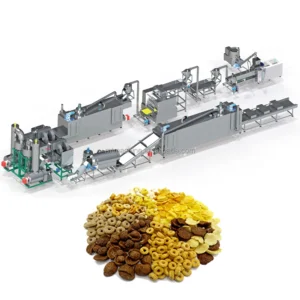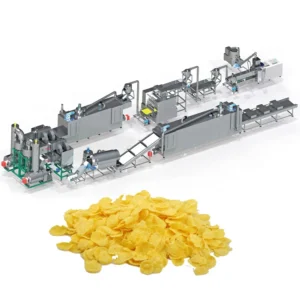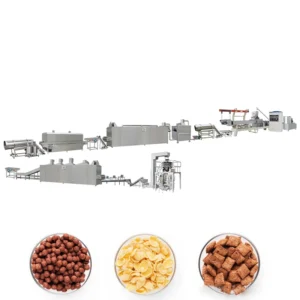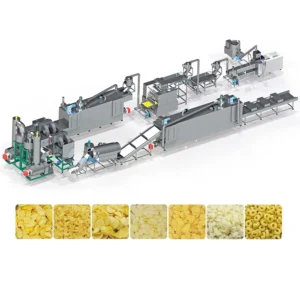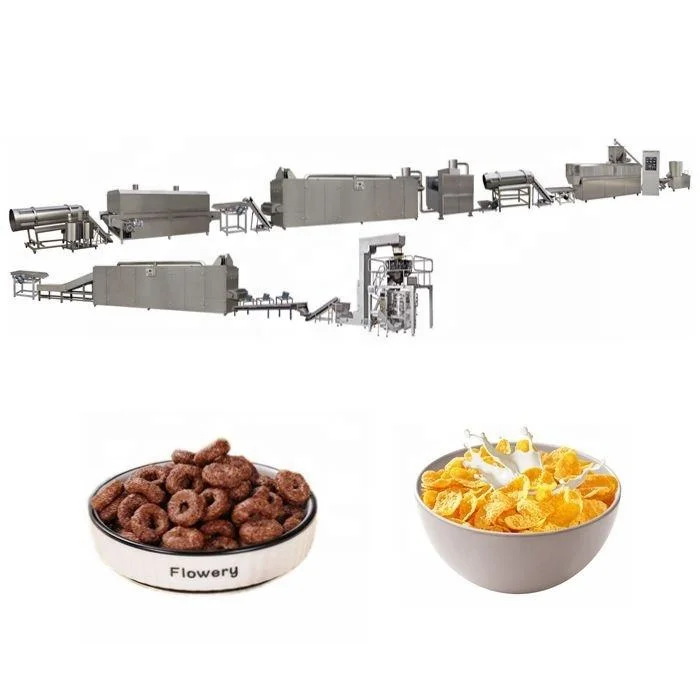
Matched Throughput Across Every Station — we configure each machine in the corn flakes line so extruder output, flaker speed, and dryer capacity align before the first kilogram of grain runs.
Technical Specifications
| Parameter | Value |
|---|---|
| Product Type | Corn Flakes Production Line |
| Model Options | MT70 / MT85 / MT75 |
| Extruder Type | Twin Screw |
| Installed Power | MT70: 160 kW / MT85: 190 kW / MT75: 210 kW |
| Power Consumption | MT70: 120 kW / MT85: 140 kW / MT75: 150 kW |
| Output Capacity | MT70: 150–200 kg/h (basis to be confirmed); MT85: 300–400 kg/h (basis to be confirmed); MT75: 300–500 kg/h (basis to be confirmed) |
| Flaking Machine Capacity | 200–300 kg/h (basis to be confirmed) |
| Flaking Machine Drive | Double motors for separate roller driving; hydraulic system |
| Flaking Machine Temperature Control | Infrared sensor for even temperature pipe control |
| Dryer Heating Source | Gas or Electric |
| Roasting Oven | Hot air roasting with vibrating pan, conciliation burner, dual circulating fans, cyclone dust removal |
| Coating System | Double tumble sugar melter, elevator, coating drum, spraying nozzle |
| Control System | PLC available; MCC available per line configuration |
| Basic Raw Materials | Powder of corn, rice, wheat, oat, barley |
| Overall Dimensions (L×W×H) | MT70: 41 × 1.5 × 2.2 m; MT85: 43 × 1.5 × 3.2 m; MT75: 45 × 1.5 × 3.5 m |
| Certifications | CE (since 2014), ISO certified |
Application Suitability
| Application | Material or Output |
|---|---|
| Natural corn flakes for breakfast cereal retail | Corn grits or corn flour |
| Sugar-coated corn flakes and frosted cereals | Corn, rice, or wheat base with sugar glaze |
| Shaped breakfast cereal pieces (ball, tube, ring, star, heart, fruit loop) | Blends of corn, rice, wheat, oat, or barley powder |
| Expanded grain snacks with light texture | Rice or oat-based formulations |
| Fortified breakfast cereals with added nutrition | Wheat or barley powder with vitamin/mineral premix |
Why Matching Dryer Capacity to Your Extruder Matters More Than You Think
A corn flakes line only runs as fast as its slowest station.
When buyers focus exclusively on extruder output, the downstream dryer and roaster often get sized for a nominal figure that never materialises on the factory floor. I once saw a line where the flaker and hot air roaster were specced to a brochure capacity, but the actual corn grits formulation ran wetter than expected. The result was a bottleneck at the roasting stage — flakes piled up, moisture stayed too high, and the sugar coating station could not adhere properly [NEED_CITE: moisture content impact on downstream cereal coating adhesion].
That mismatch cost weeks of on-site troubleshooting. When evaluating the full equipment range for a corn flakes machine project, every station’s throughput must be calculated against your specific raw material, moisture content, and target flake density. A balanced line is the only kind that runs continuously without manual intervention.
Every Station in the Corn Flakes Workflow
This corn flakes machine full equipment range covers every step from raw material intake to final packing. The workflow begins with a mixing and batching system that blends corn, rice, wheat, oat, or barley powder into a uniform feed. The twin-screw extruder then cooks and forms the dough under controlled temperature and shear. After extrusion, the material passes through the flaking machine, where hydraulic double rollers press it into consistent sheets.
Downstream, the dryer reduces surface moisture before the hot air roasting oven develops the characteristic surface bubbles and crispiness. If sugar coating is required, the double tumble system melts and distributes the glaze evenly across every flake. The line finishes with a cooling conveyor and packing interface. Each station is selected so its rated capacity aligns with the others, preventing the pile-ups and starved feeds that plague mismatched lines.
How the Flaking and Roasting Stations Shape Final Quality
Flake thickness is where many breakfast cereal lines succeed or fail. The flaking machine here uses separate motor drives for each roller and a hydraulic system to maintain consistent gap pressure. An infrared sensor monitors the temperature pipe, ensuring the rollers stay within the range needed for clean separation and uniform compression. If one roller runs hotter or slower, flakes tear or come out uneven — and those uneven flakes will not roast properly [NEED_CITE: roller temperature consistency in cereal flaking operations].
The hot air roasting oven is where the flake gets its final texture. A conciliation burner and two separate circulating fans move heated air through a vibrating pan, while high-temperature spraying tubes deliver direct heat to the product surface. The cyclone dust removal device keeps fines from recirculating, which matters for both product cleanliness and oven maintenance intervals. Getting the roast profile right is what separates a crisp, blistered flake from one that tastes raw in the centre.
Reading the Specs: What the Numbers Mean for Your Floor
The twin-screw extruder is the core of this corn flakes machine full equipment range, and the installed power figures — 160 kW to 210 kW across the three models — reflect the torque available for cooking and forming dense grain doughs. Higher installed power generally means the screws can handle thicker formulations and maintain stable barrel pressure at higher feed rates. Power consumption values are lower than installed figures, which is normal; the drive does not run at full load continuously.
The flaking machine’s hydraulic double-roller system matters because mechanical screw-adjusted rollers tend to drift under the cyclic loading of continuous flaking. Hydraulic pressure holds the gap more steadily, which translates to more uniform flake thickness batch after batch. The overall line dimensions — stretching 41 to 45 metres in length — tell you the floor space commitment. Plan for straight-line layout with access corridors on both sides for maintenance and cleaning [NEED_CITE: floor space planning for continuous cereal production lines].
The Hidden Cost of Ordering Stations Separately
I have watched buyers source an extruder from one vendor and a dryer from another, only to discover during commissioning that the dryer’s belt width could not handle the extruder’s actual output spread. The same thing happens when a flaker is ordered without confirming that its roller gap range suits your target flake thickness. These mismatches show up late, when the equipment is already bolted to the floor and utility connections are in place.
Fixing a throughput imbalance after installation means either replacing a station entirely or living with reduced line speed — and reduced line speed means your per-kilogram cost rises whether you account for it or not [NEED_CITE: hidden cost of throughput imbalance in food processing lines]. Sourcing the corn flakes machine full equipment range from a single supplier means the layout drawing accounts for every transition point before metal is cut.
What You Get When the Full Range Comes From One Source
Every station in this line is selected with the others in mind. The extruder’s screw configuration and die design are matched to your raw material and target flake density, not pulled from a generic build sheet. The flaker, dryer, and roaster are sized so that none of them becomes a bottleneck when the line runs at its intended pace.
Before shipment, we run your actual raw material through the testing workshop and document the results in a trial run report. That means product development starts before the line arrives at your facility, not after. The PLC and MCC control systems are specified to your local voltage, frequency, and operator language, so commissioning does not stall over a wiring discrepancy. Wear parts lists for screws, dies, and roller surfaces are included from day one, so your first replacement order is not a scramble.
Documentation & Verification
- Line layout and capacity calculation matched to your target corn flake output and raw material blend
- Screw and die configuration record specific to your grain formulation and target flake density
- Electrical schematic with voltage and frequency confirmation for your facility before production starts
- Trial run report on your actual raw material documenting extrusion, flaking, and roasting results
- Factory test record covering every station from mixer through coating drum before dispatch
- Operation and maintenance manual with wear parts list for screws, dies, and roller surfaces
Installation, Commissioning & Support
- Foundation plan accounts for the 41–45 m line length with utility trench locations for each station
- Power supply must cover up to 210 kW installed load with dedicated circuits for extruder and roaster
- Stations ship in assembly-ready modules; on-site alignment of flaker to extruder discharge is supervised
- First-run parameter setting covers barrel temperature profile, roller gap, and roaster fan speed for your formulation
- Operator training includes PLC screen navigation, hydraulic pressure adjustment, and sugar coating drum operation
- Wear parts supply covers twin screws, extruder dies, flaker roller surfaces, and roaster spraying tubes
What We Need to Configure Your Line
To size the corn flakes machine full equipment range correctly, share your primary raw material — whether that is pure corn grits, a corn-rice blend, or an oat-barley mix — along with your target daily output and final product format. We also need your facility voltage and frequency, available floor space and ceiling height, and whether you want the sugar coating station included. If you have existing upstream milling or downstream packing equipment, tell us the interface points so the line connects without adaptation surprises.
Frequently Asked Questions
Q: What machines are included in the complete corn flakes production line and what does each station do?
A: The line includes a mixing and batching system, twin-screw extruder, flaking machine with hydraulic double rollers, dryer, hot air roasting oven with dual circulating fans, optional sugar coating system with double tumble melter, cooling conveyor, and packing interface. Each station handles a specific stage of the process, and all are sized to match one another for continuous throughput.
Q: How do I confirm the capacity of each station matches my target output and raw material?
A: Capacity depends on your specific grain formulation, moisture content, and target flake density. We run a trial on your actual raw material in the testing workshop before shipment and document the results. The line layout and capacity calculation are then adjusted so every station — extruder, flaker, dryer, roaster — balances at your real output figure rather than a generic brochure number.
Q: What raw materials can this corn flakes equipment range handle?
A: The twin-screw extruder and supporting stations process corn, rice, wheat, oat, and barley in powder or grit form, either as single grains or blended formulations. Screw configuration and die design are adjusted to suit the starch gelatinisation behaviour of your specific material, and the flaker roller gap is set to your target flake thickness.
Q: Can I order individual stations or is the line sold as a complete package?
A: Individual stations such as the flaking machine, hot air roaster, or sugar coating drum can be supplied separately, but throughput matching across the full line is only guaranteed when the configuration is calculated as a complete system. If you are replacing or adding a single station, share your existing line specs so we can confirm compatibility.
Q: How are voltage, frequency, and control language confirmed for each machine before shipment?
A: During the specification confirmation stage, we document your facility’s voltage, frequency, and preferred operator language for the PLC and MCC control systems. The electrical schematic is reviewed and approved before production begins, so the control panels and motor wiring arrive configured for your local power supply and ready for immediate commissioning.