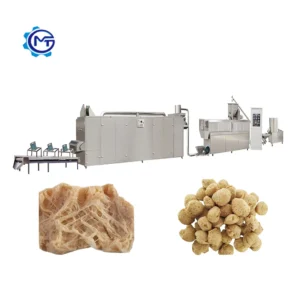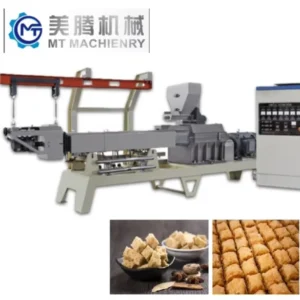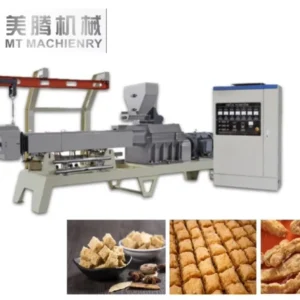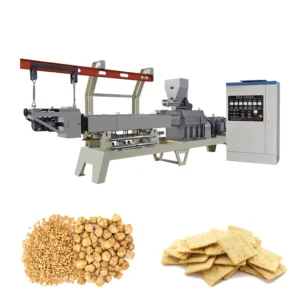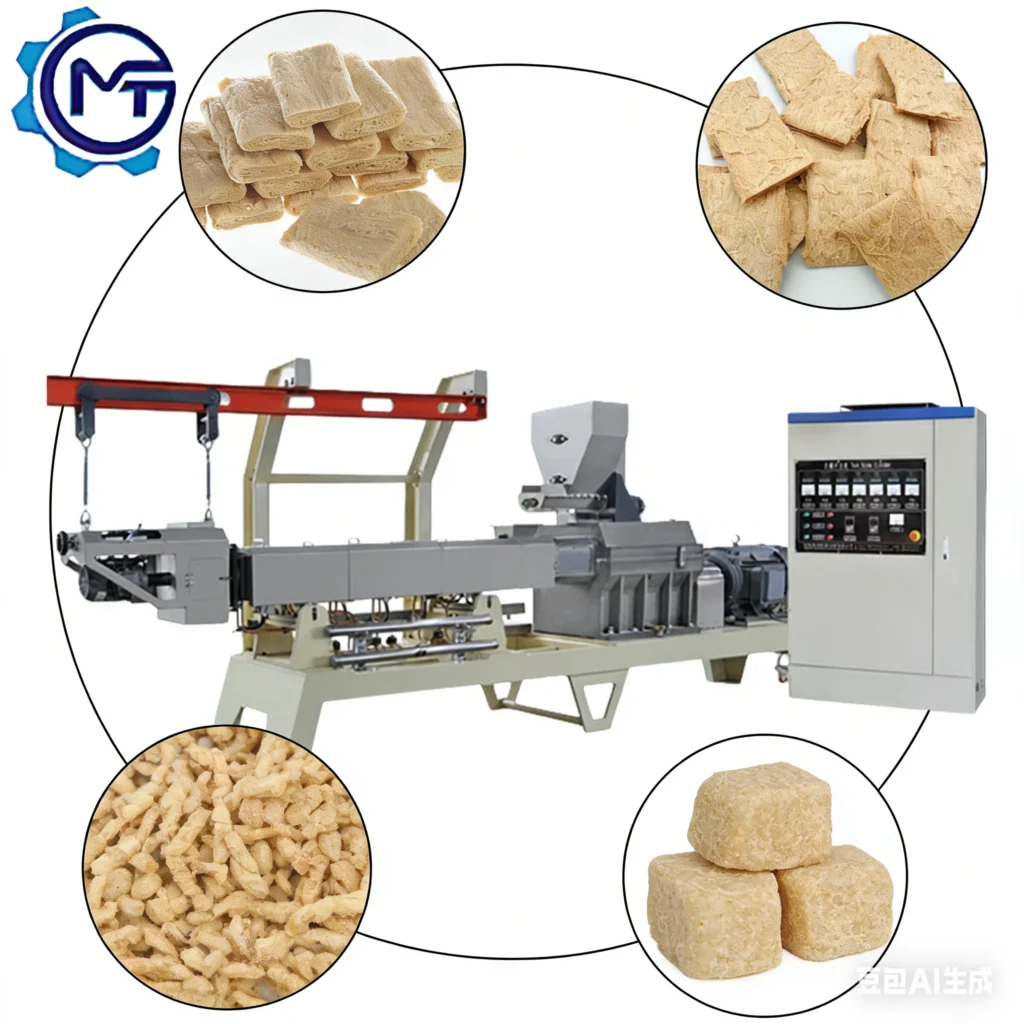
Integrated Extrusion Architecture — every station from the vertical mixer through the twin-screw extruder to the multi-layer dryer is specified as a single system, preventing the throughput mismatches that stall plant based meat processing line equipment for sale projects.
Technical Specifications
| Parameter | Value |
|---|---|
| Model | MT65 / MT70 / MT75 / MT85 |
| Product Type | High Moisture Vegetarian Meat Extrusion Line (TVP/TSP Soy Protein Processing Line) |
| Screw Type | Twin Screw |
| Installed Power | MT65: 84 kW / MT70: 160 kW / MT75: 190 kW / MT85: 210 kW |
| Power Consumption | MT65: 59 kW / MT70: 120 kW / MT75: 140 kW / MT85: 140 kW |
| Output Capacity | MT65: 100–150 kg/h / MT70: 150–200 kg/h / MT75: 150–200 kg/h / MT85: 250–300 kg/h (basis not stated in source — confirm raw material formulation, moisture content, and target product format) |
| Overall Dimensions (L×W×H) | MT65: 40000×1200×2200 mm / MT70: 41000×1500×2200 mm / MT75: 43000×1500×3200 mm / MT85: 45000×1500×3500 mm |
| Line Stations | Mixer → Screw Conveyor → Twin Screw Extruder → Air Conveyor → Multi-layer Dryer → Cooling Machine |
| Extruder Main Motor Power | 22 kW / 30 kW / 45 kW (model-dependent) |
| Extruder Screw Length | 1050 mm / 1520 mm |
| Mixer Type | Vertical mixing machine, stainless steel 304 mixing ruler, carbon steel shelf |
| Mixer Capacity Options | 20–30 kg / 70–80 kg / 170–180 kg |
| Mixer Power Options | 4 kW / 7.5 kW / 15 kW |
| Extruder Heating Power | 10 kW / 14 kW / 14 kW |
| Rotary Cutting Motor | 0.75 kW |
| Feeding Motor | 0.75 kW |
| Pump Motor | 0.37 kW |
| Dryer Drive | Double pitch roller chain drive, round-trip drying |
| Dryer Energy Source Options | Fuel / Gas / Electricity |
| Dryer Features | Adjustable drying temperature and time, multi-layer configurable |
| Control System | PLC and MCC control |
| Raw Materials | Defatted soya flour, low temperature soya flakes, soybean dregs, peanut dregs |
| Standards | CE, ISO |
Application Suitability
| Application | Material or Output |
|---|---|
| Soya nuggets and chunks | Defatted soya flour, low temperature soya flakes |
| Textured vegetable protein (TVP) | Soy protein isolate blends, pea protein mixes |
| Textured soya protein (TSP) | Soya flour and soybean dregs formulations |
| Vegetarian meat analogues with fiber structure | High moisture protein blends with added fats |
| Fortified cereal and snack formats | Grain and starch blends (after screw reconfiguration) |
| Fast food and frozen food protein components | Soya chunks, layered fiber nuggets |
What "150 kg/h" Hides About Your Raw Material
Nominal capacity figures assume a standard formulation that rarely matches what buyers actually run on the floor.
I remember a plant based meat processing line equipment for sale inquiry where the buyer had been quoted a throughput number based on pure soy protein isolate. Their actual recipe included pea protein and coconut oil, and the fiber structure collapsed during the first production run. The extruder was not at fault — the screw profile and barrel temperature zones had simply never been matched to that specific blend. Capacity numbers printed on a spec sheet become unreliable the moment you introduce a secondary protein source or change the fat ratio [NEED_CITE: impact of protein blend composition on extrusion throughput]. When the moisture content shifts by even a few percentage points, the residence time inside the barrel changes, and the downstream dryer may no longer keep pace.
Matching Barrel Zones to Protein Behavior
The twin screw extruder in this plant based meat processing line uses configurable barrel heating across multiple zones, with heating power ranging from 10 kW to 14 kW depending on the model. High moisture protein extrusion demands a precise temperature gradient — too much heat too early denatures the protein before it aligns into fibers, while insufficient heat leaves the mass under-gelatinized and crumbly. The screw length options of 1050 mm and 1520 mm give process engineers the ability to extend residence time for stubborn formulations that require more shear and thermal input before the die plate.
Dryer Sizing Against Extruder Throughput
The multi-layer dryer uses a double pitch roller chain drive for round-trip material travel, and the energy source is selectable between fuel, gas, and electricity. The critical factor is whether the dryer’s belt length and layer count can remove enough moisture from the extrudate to stabilize the fiber structure before cooling. An undersized dryer forces the line to slow the extruder feed rate, turning a plant based meat processing line equipment for sale investment into a bottlenecked system that never reaches its intended throughput [NEED_CITE: moisture removal rates in multi-layer drying of extruded protein].
Why Screw and Die Records Matter Before Shipment
The screw configuration and die geometry determine whether the final product emerges as a dense nugget, an open-structured chunk, or a layered fiber sheet. Each raw material — defatted soya flour, low temperature soya flakes, soybean dregs, peanut dregs — responds differently to shear and compression. Recording the screw element sequence and die aperture matched to your formulation before the machine leaves the factory means you start production with a proven baseline rather than spending weeks adjusting profiles on the shop floor.
The Cost of Unverified Line Balancing
When the vertical mixer delivers batches faster than the extruder can consume them, material sits and moisture migrates. When the air conveyor moves product faster than the dryer can stabilize it, surface case-hardening traps internal moisture and creates texture inconsistencies downstream. These mismatches are not visible in a catalogue — they only appear once the full line is running under load, at which point corrective modifications cost far more than a properly balanced layout would have required initially [NEED_CITE: throughput balancing in continuous food processing lines].
Why Procurement Through a Single Equipment Range Helps
Every station in this catalogue — mixer, screw conveyor, extruder, air conveyor, dryer, cooling machine — is documented under one specification set, so throughput calculations can be cross-checked station by station before commitment. The screw and die configuration is recorded against your specific raw material and target product format, not copied from a generic build. The vertical mixer is available in three capacity tiers with stainless steel 304 contact parts, so upstream batching can be matched to extruder feed rate without guesswork. Trial runs on customer-supplied raw material are conducted in the testing workshop before shipment, providing a documented baseline. The control system integrates PLC and MCC logic, giving operators direct access to barrel zone temperatures, screw speed, and feed rate from a single interface.
Documentation & Verification
- Line layout drawing with throughput calculation per station for your formulation
- Screw and die configuration record matched to your raw material and target texture
- Factory trial run report on your supplied protein blend before dispatch
- Electrical schematic with voltage and frequency confirmed to your facility standard
- Operation and maintenance manual covering all line stations from mixer to cooler
- CE declaration of conformity and ISO certificate for import clearance
Installation, Commissioning & Support
- Overall line length up to 45,000 mm requires confirmed floor plan and utility routing before foundation work
- Installed power up to 210 kW demands dedicated circuit sizing and transformer verification at site
- PLC and MCC panels arrive pre-wired; commissioning includes parameter loading for your specific formulation
- First production run supervised on-site with screw speed, barrel temperatures, and dryer settings calibrated
- Wear parts list provided at shipment covering screws, dies, and mixer components with replacement intervals
- Operator training covers changeover procedures between nugget, chunk, and fiber-structured product formats
Preparing Your Inquiry
To configure the right model from the MT65 through MT85 range, provide your raw material formulation including protein source ratios and target moisture content. Specify the product format — nuggets, chunks, or layered fiber sheets — along with your daily production target. Confirm your facility voltage, frequency, and preferred control language. If you have existing upstream or downstream equipment that this plant based meat processing line equipment for sale must integrate with, include those specifications so the layout accounts for connection points and material handoff heights.
Frequently Asked Questions
Q: How is the output capacity of each model verified against my raw material?
A: Each extruder model carries a nominal capacity range, but actual throughput depends on your protein formulation, moisture level, and target product density. We conduct a trial run using your supplied raw material in the testing workshop, documenting the achievable feed rate, screw speed, and barrel temperature profile. The resulting report becomes the basis for line configuration and dryer sizing.
Q: Which dryer energy source and layer configuration fits my production target?
A: The multi-layer dryer supports fuel, gas, or electricity heating, and the layer count is adjustable. Selection depends on your local energy costs, the moisture removal requirement of your specific formulation, and the extruder output rate. Higher moisture products and larger extruder models typically require more drying layers and longer belt travel to stabilize fiber structure before cooling.
Q: How do I confirm voltage and control language before production starts?
A: Voltage, frequency, and control panel language are documented in the electrical schematic during the specification confirmation stage, before manufacturing begins. This prevents the common situation where a machine arrives on site with the wrong voltage rating or an interface language that operators cannot read, delaying commissioning.
Q: What spare wear parts ship with the line, and what is the replacement schedule?
A: A wear parts list is included at shipment covering screws, die plates, and mixer components. Replacement intervals depend on the abrasiveness of your formulation — blends with high fiber or mineral content accelerate wear. The list specifies which parts to inspect at each maintenance interval so you can plan inventory without unexpected downtime.
Q: Can the same extruder produce cereal or snacks after TVP runs?
A: The twin screw platform supports reconfiguration by changing the screw element arrangement and die geometry. Switching from textured protein to cereal or snack production involves replacing the screw profile, adjusting barrel temperature zones, and potentially changing the dryer settings. The changeover scope and required spare elements are documented during the initial line specification.