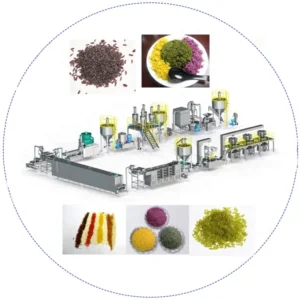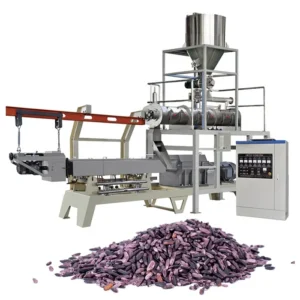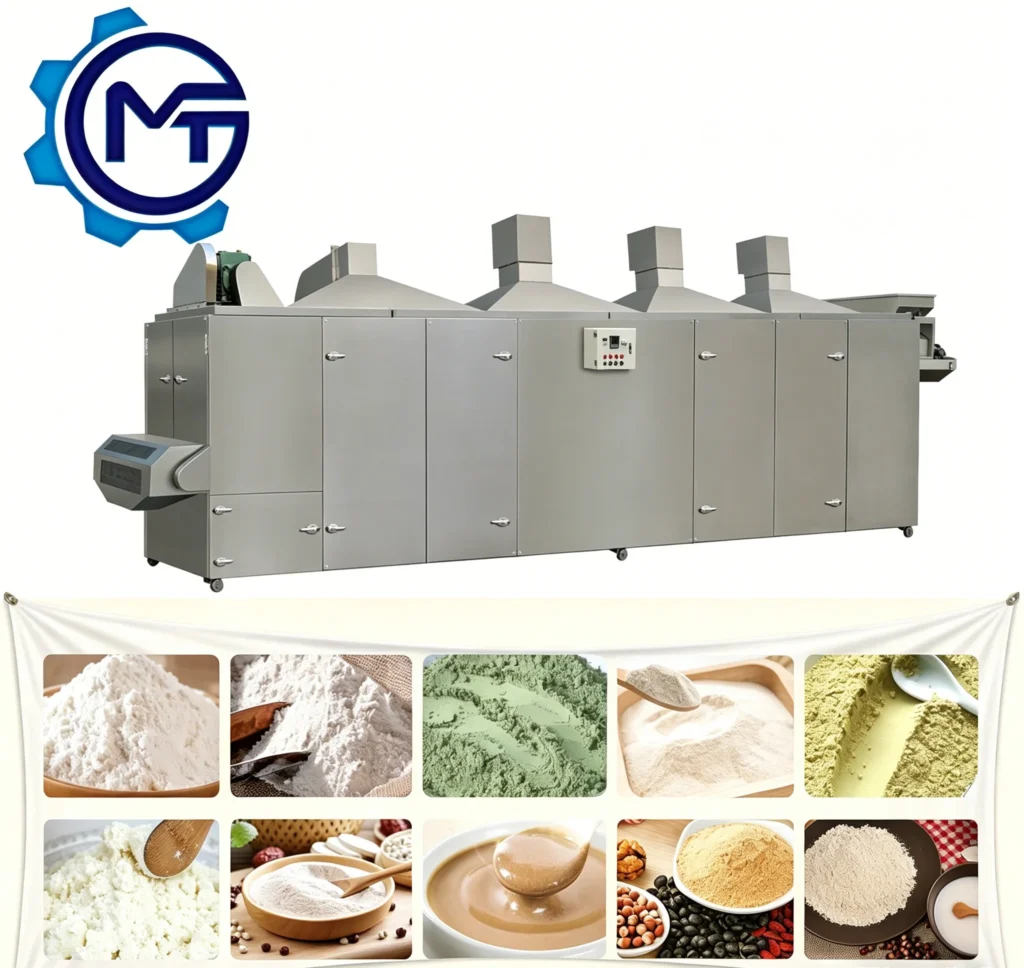
Throughput Matching Across Stations — Every machine in this nutritional powder processing line is sized so extrusion output meets dryer and packing capacity without bottlenecks, validated by factory trial runs on your grain formulation before dispatch.
Technical Specifications
| Parameter | Value |
|---|---|
| Product Type | Nutritional Powder Processing Line |
| Output Capacity | 200–500 kg/h (basis not stated in source — confirm raw material type, moisture content, and formulation) |
| Construction Material | Food-Grade 304 Stainless Steel |
| Control System | Touch control panel with digital system |
| Heat Source Options | Electric / Gas / Steam |
| Screw Type | Twin-screw |
| Line Stations | Mixers, extruders, baking ovens, downstream conveyors, packing interface |
| Assembly State | Complete production line |
| Warranty | 1 year |
| After-Sales Service | Overseas engineer service available |
Application Suitability
| Application | Material or Output |
|---|---|
| Infant nutrition and baby cereal powder | Rice, corn, oat, and mixed grain blends with added micronutrients |
| Fortified porridge and weaning food | Pre-gelatinised cereal bases with vitamin and mineral premix |
| Instant breakfast drink powder | Soy, wheat, and multi-grain formulations requiring controlled gelatinisation |
| Geriatric and clinical nutrition powder | Easily digestible grain matrices with protein and fibre enrichment |
Why Nominal Capacity Figures Mislead Buyers in Nutritional Powder Production
A rated output means nothing if your actual grain blend with乳清蛋白 and trace minerals behaves differently on the screw.
I once watched a Southeast Asian buyer lose two full weeks of commissioning because the line was tested on standard rice flour, while the real production formula included whey protein isolate and a mineral premix. The expansion ratio dropped, gelatinisation was incomplete, and every downstream station had to be re-tuned on-site [NEED_CITE: starch gelatinisation behaviour under protein-enriched extrusion conditions]. That is the gap between a catalogue number and a working nutritional powder processing line full equipment range. When the raw material changes, the screw profile, barrel temperature zones, and die geometry all need to shift — and that shift has to happen in the testing workshop, not on your factory floor.
How Station Sequencing Protects Your Formula Integrity
A nutritional powder processing line is only as reliable as the weakest hand-off between stations. After the twin-screw extruder gelatinises the starch matrix, the product must move into the baking oven at a moisture level the oven was sized to handle. If the mixer batches exceed what the extruder can absorb per hour, material backs up, residence time stretches, and heat-sensitive vitamins begin to degrade. Each station in this line — from ribbon blender through extruder, baking oven, cooling conveyor, and packing interface — is specified so that the mass flow rate stays balanced under the actual formulation you intend to run.
Heat Source Selection and Its Effect on Gelatinisation Uniformity
Choosing between electric, gas, and steam heating is not a cost decision alone; it shapes how evenly the barrel zones reach target temperature. Electric elements offer precise zone control, important when a baby cereal formula demands a tight gelatinisation window to preserve lysine availability [NEED_CITE: thermal sensitivity of amino acids during twin-screw extrusion]. Gas-fired systems respond faster to load changes but require stable supply pressure. Steam heating integrates well where a plant already operates a boiler for other lines. Confirming the heat source early ensures the extruder barrel and baking oven are supplied with the correct utility connections, avoiding field-fabricated adapters that delay commissioning.
Reading the Specs That Matter for Grain-Based Powder Lines
The twin-screw configuration is central here because nutritional powders typically blend multiple grains with varying starch, protein, and fibre ratios — a single-screw design struggles with that variability. The food-grade 304 stainless steel contact surfaces resist the mild acidity common in fortified cereal blends and simplify wash-down between product changeovers. The touch control panel with digital system stores temperature profiles and screw speed recipes, so operators can recall settings for different formulations without manual trial and error. Output capacity is listed at 200–500 kg/h, though this figure must be confirmed against your specific raw material moisture content and formulation density before the line is finalised. Flexible heat source compatibility — electric, gas, or steam — means the line can adapt to the utility infrastructure already present in your facility.
The Hidden Cost of Skipping a Pre-Shipment Trial Run
When a nutritional powder line ships without a trial run on the buyer’s actual formulation, the first production batch becomes the experiment. Screw elements may need re-stacking, die apertures re-cut, and dryer belt speed adjusted — all while raw material is being consumed and delivery deadlines slip [NEED_CITE: commissioning delays caused by untested extrusion parameters]. For infant cereal producers, an incorrect expansion ratio is not merely a cosmetic issue; it alters reconstitution behaviour in the bowl, which parents notice immediately. A pre-shipment trial locks in the screw configuration and temperature curve, so the line arrives ready to run your recipe, not a generic placeholder.
Why Procuring the Full Range from One Supplier Changes the Outcome
Every station in this nutritional powder processing line is sourced and matched under a single technical responsibility, so throughput calculations are not fragmented across vendors who point blame at each other when output falls short. Screw and die configurations are documented against your raw material sample, not copied from a generic build. The in-house testing workshop allows trial runs on your specific grain and protein blend before the line leaves the factory, catching formulation mismatches early. Electrical schematics and voltage specifications are confirmed to your site standard before production begins, preventing rewiring work on arrival. Food-grade 304 stainless steel is used across all product contact points, meeting the hygiene expectations of infant food regulators without requiring post-delivery surface upgrades.
Documentation & Verification
- Line layout showing throughput balance from mixer through extruder to packing station
- Trial run report on your specific grain and protein formulation before dispatch
- Screw and die configuration record matched to target powder density and reconstitution behaviour
- Electrical schematic with voltage and frequency confirmed to your site supply standard
- CE declaration of conformity and ISO certificate for the complete line
- Operation and maintenance manual with wear parts replacement intervals
Installation, Commissioning & Support
- Foundation plan accounts for extruder and baking oven footprint and vibration isolation points
- Dedicated electrical circuit sized to the line’s total rated power with correct voltage and frequency
- Line arrives in modular sections for sequenced assembly matching your workshop access constraints
- First-run parameter setting covers barrel zone temperatures, screw speed, and die clearance for your formula
- Operator training covers recipe recall on the digital touch panel and changeover cleaning procedures
- Wear parts list identifies screw elements, die plates, and mixer blades with recommended first replacement timing
What We Need to Size Your Line Correctly
To move from a general inquiry to a firm proposal, we need your target formulation — including grain types, protein sources, and micronutrient additions — along with the daily output you plan to sustain. Confirming your factory’s voltage, frequency, and available heat source utility lets us specify the correct electrical and thermal components. If you can send a representative raw material sample, we will run a trial in the testing workshop and return a documented screw and die configuration with the quotation.
Frequently Asked Questions
Q: What supporting stations are included and how is throughput matched between them?
A: The line covers mixing, twin-screw extrusion, baking, cooling, and packing interface. Each station is sized so mass flow rate stays balanced — the mixer batch cycle, extruder feed rate, oven belt speed, and packing speed are all calculated against your specific formulation density and moisture content to prevent upstream bottlenecks or downstream starvation.
Q: How are screw configuration and die design selected for different grain-based materials?
A: Screw element arrangement and die aperture are chosen after a trial run on your raw material in our testing workshop. We adjust the kneading block sequence, compression ratio, and die geometry until the expansion ratio and gelatinisation degree match your target powder reconstitution and texture specification.
Q: What voltage, frequency, and control language options are confirmed before shipment?
A: Electrical specifications are confirmed during the proposal stage to match your site supply. The digital touch control panel language is set to your operator preference before dispatch, ensuring the HMI is readable from day one of commissioning without field reprogramming.
Q: Can a trial run be performed on our baby food formulation before the line ships?
A: Yes. We require a representative sample of your actual grain blend, protein source, and micronutrient premix. The trial run is documented in a report that records screw configuration, barrel temperatures, expansion ratio, and moisture content at each station, giving you a proven starting recipe on installation.
Q: What spare wear parts are supplied and when should they first be replaced?
A: The line ships with a documented wear parts list covering screw elements, die plates, mixer blades, and oven belt sections. First replacement timing depends on your raw material abrasiveness and production hours; we provide a schedule based on the trial run data so you can order spares before they are needed.