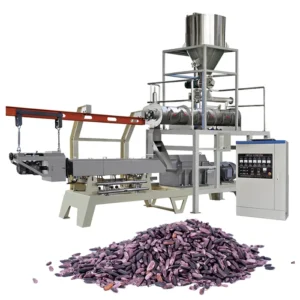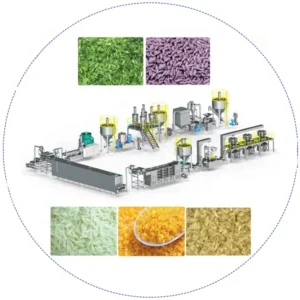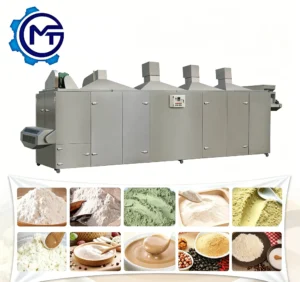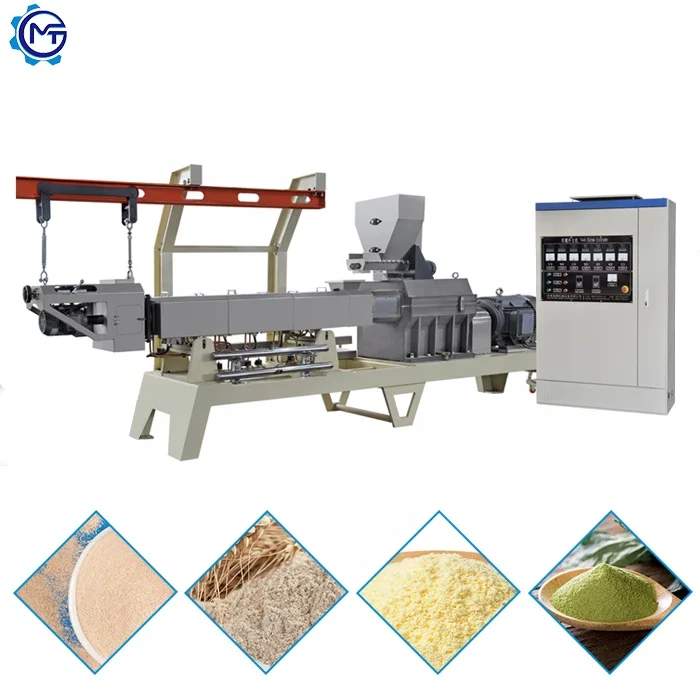
Throughput-Matched Stations — every mixer, extruder, dryer, and pulverizer in the nutritional powder processing line is sized to the same mass flow, so no single station chokes the rest when your specific grain formula runs at full feed rate.
Technical Specifications
| Parameter | Value |
|---|---|
| Product Type | Nutritional Powder Processing Line |
| Line Configuration | Mixing → Extrusion → Drying → Pulverizing → Packing |
| Assembly State | Turnkey complete line |
| Output Capacity | Rated capacity dependent on raw material, moisture content, and target mesh size (basis to be confirmed) |
| Screw Type | Single or twin screw, selected per raw material |
| Screw Configuration | Matched to customer raw material and target powder mesh |
| Control System | Available with PLC or MCC control |
| Voltage & Frequency | Configurable to customer local supply |
| Factory Layout | Customized to customer facility dimensions |
| Formula Support | Basic recipe and machine setting parameters supplied |
| After-Sale Service | On-site installation, testing, and operator training by one or two engineers |
| Standards | CE certified, ISO certified |
Application Suitability
| Application | Material or Output |
|---|---|
| Infant formula and baby food powder | Rice flour, oat flour, whey protein blends |
| Meal replacement powder | Soy, quinoa, germinated brown rice, grain mixes |
| Fortified nutritional powder | Corn, wheat, millet with vitamin and mineral premix |
| Health supplement powder | Grain-based and pulse-based raw materials |
| Institutional nutrition programme supply | Blended cereal and legume formulations |
Why "Nominal Capacity" Means Nothing Without Your Raw Material
A nutritional powder processing line full equipment range quoted at a fixed kg/h number is only valid on the exact grain and moisture level used during that quote.
I have watched lines stall within the first week of commissioning because the buyer switched from standard rice flour to a germinated brown rice and whey protein blend, shifting the gelatinisation window entirely. The extruder choked, die pressure spiked, and two days of production vanished while we re-profiled barrel temperatures and rebuilt the screw stack. That is why every capacity figure we discuss for this nutritional powder processing line full equipment range is tied to your specific formula, moisture level, and target mesh size, verified through an in-house trial run before the machines leave the factory [NEED_CITE: starch gelatinisation temperature variation across grain types].
Station-by-Station Equipment Coverage
This nutritional powder processing line full equipment range covers every stage from raw material intake through to finished bag. The mixing station feeds the extruder at a controlled rate, the dryer removes moisture to the level required for milling, and the pulverizer reduces the extrudate to the target particle size distribution. Each station is selected so its maximum throughput aligns with the others, preventing the common situation where the extruder can produce more than the dryer can handle.
Screw and Die Selection for Powder Target
The screw configuration and die geometry are specified after reviewing your raw material data sheet. Barrel sections are arranged with distinct temperature zones so that starch gelatinisation, protein denaturation, and moisture flash-off happen in controlled sequence. The die opening and land length determine the density and expansion ratio of the extrudate exiting the barrel, which directly affects how the material behaves in the dryer and how easily it pulverizes to the target mesh. Getting this wrong means either oversized particles that fail sieving or excessive fines that create dust issues at packing [NEED_CITE: die land length effect on extrudate density].
What the Specification Sheet Actually Tells You
The screw type — single or twin — determines how aggressively the line handles high-fat or high-fibre formulations. Twin-screw setups self-clean more effectively when processing blends containing whey protein or oilseed meals, while single-screw configurations suit straight starch-based grains at lower cost. The control system option, PLC or MCC, decides whether operators adjust barrel zone temperatures and screw speed from a touch screen or from individual panel instruments. Voltage and frequency must match the destination country grid before the motor and heating elements are ordered; a 380 V 50 Hz extruder motor rewound for a 440 V 60 Hz market loses torque characteristics and can overheat within weeks. The factory layout drawing confirms that dryer length, conveyor transfers, and pulverizer feed height all fit within the buyer’s ceiling clearance and column spacing.
The Cost of Skipping the Trial Run
Running an untested formula on a freshly installed line burns raw material, wastes production days, and erodes buyer confidence before the first saleable bag is filled.
Buyers who skip the pre-shipment trial often discover during commissioning that their actual grain blend gelatinises at a different temperature than the standard test flour, producing undercooked extrudate that the pulverizer cannot reduce to specification. Die blockages, uneven drying, and off-target particle size distribution follow, each adding days of unplanned downtime. These problems surface in our testing workshop at negligible cost compared to resolving them on a live factory floor [NEED_CITE: common extrusion line commissioning delays].
Why Procure This Line Here
Every station is sourced and sized under one responsibility, so throughput mismatches between the mixer, extruder, dryer, and pulverizer are resolved during the layout stage, not during installation. Screw and die configurations are documented per buyer formula, not copied from a generic build sheet. The in-house testing workshop runs your actual raw material before shipment, producing a trial report that becomes the baseline for commissioning. Pre-sales engineering covers factory layout, utility planning, and voltage confirmation so that electrical panels arrive wired for the destination grid. Operator training and a documented wear parts list are included so the first screw or die changeover does not catch the production team unprepared.
Documentation & Verification
- Line layout drawing with matched throughput across mixing, extrusion, drying, pulverizing, and packing stations
- Trial run report generated on customer raw material before shipment
- Machine specification sheet recording screw configuration and die geometry
- Electrical schematic with voltage and frequency confirmed for destination market
- Operation and maintenance manual with illustrated wear parts list
- CE declaration of conformity and ISO certificate
Installation, Commissioning & Support
- Foundation plan aligned to extruder and dryer footprint and weight distribution
- Dedicated circuit sizing for combined heater and motor load at confirmed voltage
- Assembled stations shipped with protective film; spare parts in fumigated wooden cases
- Barrel temperature profiling and screw speed calibration during first production run
- Hands-on operator training covering die changeover and screen replacement on the pulverizer
- Wear parts list with part numbers for screws, dies, and dryer seals
What to Share With Your Inquiry
To size this nutritional powder processing line full equipment range accurately, provide the raw material types and their approximate ratios, the target powder mesh size, and the daily or hourly output you need to hit. Include your factory floor dimensions, ceiling height, and the local voltage and frequency so the electrical package is specified correctly from the start. If you can ship a sample of your grain blend to our testing workshop, we will run a trial and return a full report with the quotation.
Frequently Asked Questions
Q: How is output capacity verified against my specific raw material and formula?
A: We run your actual grain blend through our in-house testing workshop before the line ships. The trial records extruder barrel temperatures, screw speed, die pressure, and resulting extrudate density. That data becomes the confirmed capacity figure written into your quotation, tied to your exact formula and moisture level rather than a generic test flour.
Q: What screw and die configuration is recommended for my grain-based powder target?
A: The screw profile is selected after reviewing your raw material data sheet — fat content, fibre level, and starch type all influence the choice. The die opening and land length are then matched to the expansion ratio needed so the extrudate dries evenly and pulverizes to your target mesh without generating excessive fines.
Q: Which stations are included in the line and how is throughput matched between them?
A: The line covers mixing, extrusion, drying, pulverizing, and packing. Each station is sized during the layout stage so its maximum mass flow aligns with the others. The dryer length, conveyor speed, and pulverizer feed rate are all calculated from the extruder output to prevent bottlenecks.
Q: Can the line accommodate my factory footprint and local voltage requirements?
A: The layout drawing is produced from your floor dimensions and ceiling height. Voltage and frequency are confirmed before the motor and electrical panel are ordered, so heating elements and drives arrive rated for your local grid without the need for on-site rewinding or transformer additions.
Q: Is a trial run on my raw material possible before shipment, and what does the report cover?
A: Yes. Ship a sample of your grain blend to our testing workshop. The trial run report documents barrel temperature settings, screw speed, moisture levels at each stage, extrudate density, and final powder mesh distribution, giving you a production baseline before the equipment arrives at your facility.