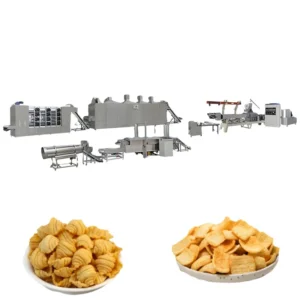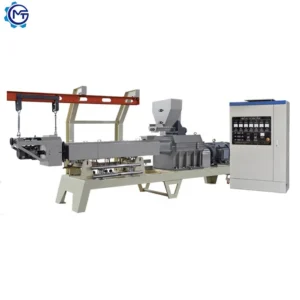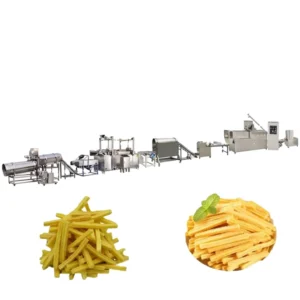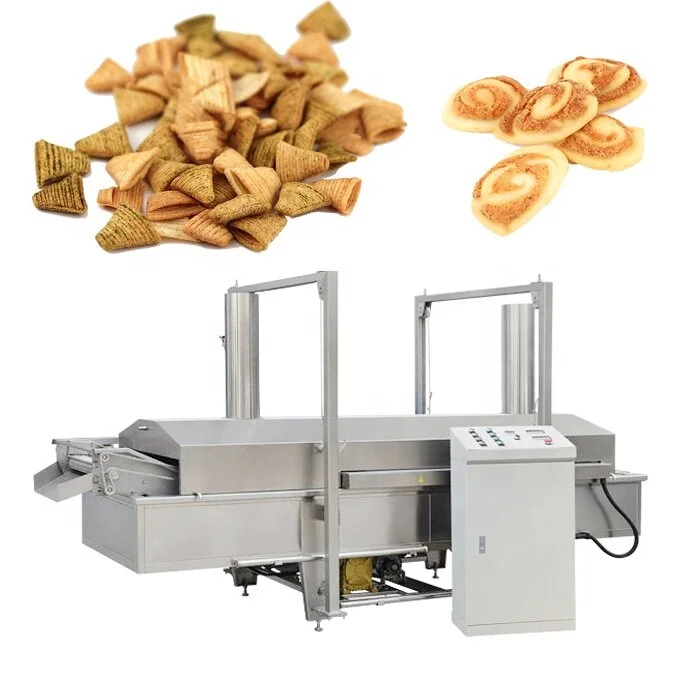
Complete Station Coverage — every machine from mixer to flavoring drum is catalogued individually, so throughput can be matched before a line is committed.
Technical Specifications
| Parameter | Value |
|---|---|
| Product Type | Fried Snack Food Processing Line |
| Production Process Flow | Mixer → Press Machine → Cutting Machine → Fryer → Flavoring Machine |
| Fryer Power | 60 kW |
| Flavoring Drum Power | 0.37 kW |
| Voltage & Frequency | Three phase 380V/50Hz; Single phase 220V/50Hz (customizable to local voltage) |
| Die Configuration | Interchangeable dies for rice crust, chips, bugles, pizza rolls, pillow shapes |
| Fryer Design | Customizable length and layer depending on product type |
| Flavoring Drum Design | Customizable length and layer depending on product type |
| Output Capacity | (basis to be confirmed with raw material, product format and target throughput) |
| Control System | (basis to be confirmed — PLC / MCC / manual options) |
| Overall Dimensions | (basis to be confirmed per line configuration) |
| Net Weight | (basis to be confirmed per line configuration) |
| Assembly State | Complete line with supporting equipment |
| Standards | CE |
Application Suitability
| Application | Material or Output |
|---|---|
| Rice crust chips production | Corn flour and rice flour blends extruded under pressure |
| Bugles and pizza roll manufacturing | Hydrated cereal flour mixtures processed through dedicated dies |
| Mini pillow snacks processing | Rice flour and water blends expanded in the fryer stage |
| Shrimp-flavored puffed snacks | Compound flour formulations with added flavor agents |
| Snack food line expansion projects | Existing manufacturers adding fried puffed formats to product portfolios |
What "Line Capacity" Means When Stations Are Mismatched
A fried snack food processing line equipment range only holds its rated output when every station is balanced to the actual raw material running through it.
Over the years in Shandong workshops, I have seen lines quoted at a nominal throughput where the extruder pushes more than the fryer can handle, or where the flavoring drum becomes the hidden choke point. The buyer takes delivery, runs local corn flour, and suddenly the expansion rate drops. The press machine keeps feeding product that piles up before the fryer conveyor. [NEED_CITE: throughput balancing principles for continuous food processing lines] This is not a defect in any single machine — it is a gap in how the fried snack food processing line equipment range was specified before production started.
Mapping Every Station to Your Target Snack
The fried snack food processing line equipment range presented here covers each machine as a visible, specifiable unit. The press machine shapes the dough through interchangeable dies, producing rice crust, bugles, pizza roll, or pillow geometries. The cutting machine sections the continuous extrudate before it enters the fryer. Each station can be reviewed on its own power rating, footprint, and drive configuration, rather than buried inside a bundled quotation. This matters when a snack manufacturer is comparing supporting equipment specifications before committing to a full project layout.
Fryer and Flavoring Configurations That Match the Product
A 60 kW fryer with customizable length and layer design determines how long the cut pieces remain in oil, which directly controls the final moisture content and crunch texture. Rice crust chips need a different fryer residence time than thicker pizza roll shapes. The flavoring drum, driven at 0.37 kW, is configurable in length and internal baffle arrangement to handle varying product densities without excessive breakage. [NEED_CITE: frying temperature profiles and oil absorption rates for expanded cereal snacks] When both units are sized to the extruder output rather than ordered as generic defaults, the entire fried snack food processing line equipment range runs without product backing up between stations.
Reading the Specifications Against Your Raw Material
The interchangeable die set defines which geometries the line can produce — rice crust, chips, bugles, pizza rolls, and pillow shapes — but the actual expansion and surface texture depend on the flour composition and moisture entering the press machine. Corn flour and rice flour behave differently under pressure and heat; a die that produces a light bugle with one blend may yield a dense, under-expanded shape with another. The dual voltage support — 380V three-phase and 220V single-phase, customizable to local grid standards — ensures the motor drives and heating elements operate within their rated range at the installation site. The control system options, whether PLC, MCC, or manual, affect how consistently batch-to-batch parameters are maintained during long production runs.
The Hidden Cost of Skipping the Station-by-Station Review
When a line is ordered without confirming that the fryer conveyor speed matches the cutting machine output, product accumulates at the transfer point and breaks apart before entering the oil bath. Flavoring drums that are too short for the throughput leave uneven seasoning coverage, generating customer complaints rather than machine faults. [NEED_CITE: common causes of seasoning inconsistency in tumbler drum applications] These issues surface weeks after commissioning, when spare wear parts for the press machine or fryer belt are already on order and the line is running at a fraction of the planned capacity.
Why Source This Equipment Range Here
Every station in this catalogue is specified with its own power rating and configuration options, so the fryer at 60 kW and the flavoring drum at 0.37 kW can be reviewed independently before the line is assembled. Die configurations are matched to the buyer’s target product format — rice crust, bugles, pizza rolls — rather than shipped as a generic default set. Dual voltage capability with local frequency customization means the electrical schematic is confirmed before production begins, avoiding commissioning delays on site. The CE-standard construction covers the full line from mixing through packing. An in-house testing workshop allows trial runs on the buyer’s actual raw material before any station leaves the factory, so expansion behavior and fryer absorption are verified in advance.
Documentation & Verification
- Line layout drawing with station-by-station throughput calculation for your target snack format
- Machine specification sheet for each station including fryer, press machine, and flavoring drum
- Electrical schematic with confirmed voltage and frequency matching your facility supply
- Factory test record showing all stations running as a matched set on your raw material
- Die configuration record listing the specific geometries tested before shipment
- Operation and maintenance manual with wear parts list for press screws and fryer belt
Installation, Commissioning & Support
- Foundation requirements mapped to the full line footprint including the 60 kW fryer assembly
- Dedicated electrical circuit specification for 380V three-phase or 220V single-phase supply
- Station-by-station assembly sequence from mixer through flavoring drum with connection diagrams
- First-run parameter setting for press machine temperature profile and fryer oil temperature
- Operator training on die changeover for rice crust, bugles, and pizza roll formats
- Wear parts supply schedule for press screws, fryer conveyor belt, and flavoring drum bearings
What to Share with the Engineering Team
To configure the right fried snack food processing line equipment range for your facility, the engineering team needs to know which raw materials you plan to run and at what moisture content. Share your local voltage and frequency standard so the control panel and motor drives are wired correctly before dispatch. Provide the dimensions of your available floor space and ceiling height to confirm the line layout fits. If you have existing upstream mixers or downstream packing equipment, note their throughput so the intermediate stations can be balanced to match.
Frequently Asked Questions
Q: What machines are included in the full fried snack food processing line, and what does each station do?
A: The line covers a mixer for raw material blending, a press machine for dough extrusion through interchangeable dies, a cutting machine for portioning, a 60 kW fryer with adjustable length and layer design, and a 0.37 kW flavoring drum. Each station is listed individually in the equipment range so specifications can be reviewed and matched to your target throughput.
Q: How do I choose the right fryer length and layer configuration for my target snack product?
A: Fryer residence time depends on the snack geometry and desired final moisture. Thicker shapes like pizza rolls require a longer oil immersion path than thin rice crust chips. The fryer in this line is customizable in length and layer count. Share your target product format and expected output rate so the fryer can be sized to handle the cutting machine discharge without product queuing.
Q: Can the voltage and frequency be confirmed to match my local electrical grid before ordering?
A: Yes. The line supports three-phase 380V/50Hz and single-phase 220V/50Hz as standard, with customization available for other voltage and frequency combinations. The electrical schematic and motor drive configuration are confirmed during the specification stage so that no rewiring or transformer changes are needed when the equipment arrives at your facility.
Q: How do I match the extruder output to the fryer and flavoring drum capacity to avoid bottlenecks?
A: Each station is specified independently with its own rated power and throughput envelope. The engineering team prepares a line layout and capacity calculation that shows the transfer rate between every station based on your raw material and target product. This document confirms that the press machine, fryer, and flavoring drum are balanced before the line enters production.
Q: What spare wear parts are available for the press machine, fryer conveyor, and flavoring drum?
A: A wear parts list is provided with every line, covering press machine screws and die inserts, fryer conveyor belt sections, and flavoring drum bearings and drive components. The list identifies replacement intervals so you can order spares before the first changeover is due, avoiding unplanned downtime during the initial production months.